Tuesday Tiny Tale – Not Again

Isn’t it always the way, you don’t remember you were reincarnated until you die again. Each time I have been caught out. Assuring myself and others that there is NOTHING beyond, once you’re dead you’re dead. Telling everyone that ghosts do not exist, whatever Danny Robins seeks out in ‘Uncanny’. Exclaiming confidently that there is no such thing as reincarnation, thank goodness; what are the chances of landing a worse life than you had? If you look at the world you will guess that ninety nine per cent of humans are not having a good life.

Now it all came back to me, every life I’ve lived before. Once again I was in the debriefing room, waiting for the uncomfortable probing into how I had handled my latest life. All around me were strangers, busier than usual, all the people who had been killed alongside me. That was the only memory that was hazy.

No familiar faces this time. When I say faces I mean we were still wearing our earthly appearance, to be replaced soon with just our inner selves. Well, it had been a good life, shorter than I expected, but I had fitted a lot in. Most of the others were new souls, stands to reason when you think of the population explosion. I had to chuckle, that chap in total denial calling for the doctor, probably thinks he’s hallucinating in intensive care.
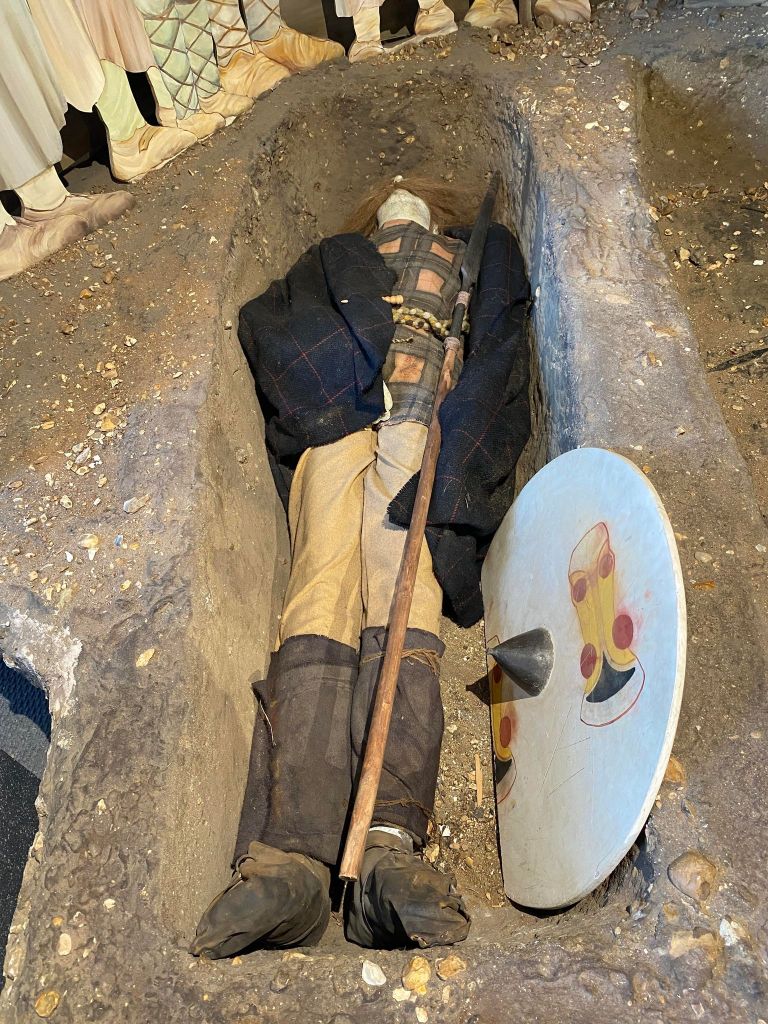
In terms of human history I’m quite new myself. My first life came to an abrupt end fighting for Henry V. But I haven’t always been English, turned up in all parts of the world. Pity I never remembered all the languages I have spoken.

 It was all coming back to me now, no wonder it was so busy here…

That’s me, they always use your most recent name.

No I couldn’t really, but I hadn’t been that bad had I?

Silly Saturday – Roaming and Romans

https://en.wikipedia.org/wiki/Roman_dodecahedron

Happy Birthday William Shakespeare – 1564

It is also Saint George’s Day, but a saint that doesn’t mean much to us. Whereas William, even with his imagination, could not have predicted how many millions of people would be seeing his plays, saying his sayings and coming to visit his home town. He would probably not have liked what we did to his wonderful language, but living languages change all the time. He was also not responsible for the ways in which English has been spread around the world, but with the negatives come the positives. Around the world bilingual and multilingual folk can communicate with a common language and if we only speak English we must applaud them for learning and talking to us. No doubt Shakespeare would have his own blog and smart phone if they had been around then.

Tuesday Tiny Tale – Drums

‘…and the drums did not stop. I can still hear them in my head when I try to sleep. That was how the hunters passed messages safely across the dangerous wild lands; a complex drum language they had created with what means they had. Drums are easy to make with an endless supply of animal skins and pliable green wood from the vast new forests.’

Ah, that is interesting, drums have been an important part of many cultures, probably from the very beginnings of social awareness. Actually I play drums, love drumming, I’m in a bhangra band and play the dohl.’

My interviewer certainly seemed to be taking seriously my recounting of my visit to 2099 and he was far from the aloof official I had imagined. Even as he spoke, his fingers were drumming a rhythm on the desk between us.

‘The hunters certainly used them for entertainment as well, but drums also had another important use. A whole group of drummers gathered to escort me back to the bunker. I was put on a horse, clinging on for dear life, but feeling safe surrounded by guards, hunters and drummers. Off we marched, like being in an epic film, the drummers beating to ward off the dangerous animals, the hunters carrying flaming torches, even though it was broad daylight. The drums did not stop and no beast came near us.’

‘It sounds as if you were well cared for by the hunters, even if it was hardly the life style you were used to, so why did they return you to the bunker people?’

The leaders were in some sort of negotiation, there is interaction between the two societies. The hunters supply them with fresh meat and what passed as vegetables and fruit. In return I think they got medicines and medical advice … and mushrooms, that was all the bunker people could grow underground. Anyway, Doctor Chowdry needed me for his plan to travel back to 2023 and I agreed, it seemed like my only chance to get back.’

‘Yes I am so excited to be meeting Doctor Chowdry soon and so is my boss.’

‘Can’t you tell me who your boss is?’

‘No, no, protocol and all that. All you need to know is that we both believe your story, or at least we are taking the position that every word is true unless we can prove otherwise. But to be frank, it is going to be nearly impossible to get world leaders and experts to listen to what the doctor has to say, let alone act on it.’

My positive mood evaporated. I liked this chap, even though I had no idea who he was, but it didn’t sound as if he or his boss had much influence in the real world.

Stuck in this beautiful rural hideaway, that apparently belonged to The Boss, we were not prisoners, but nor did we have any means of getting away or accessing the media. We had been here nearly two months with only phone calls with my family. In that time I had learnt a lot about the second half of the 21st century from my time travel companions, Doctor Chowdry and Belinda Billings, but I feared they were not learning much about 2023. They were mesmerised by television and radio; I tried to shield them from programmes that I had previously sneakily enjoyed, but now saw as utter rubbish compared with more important issues.

The doctor had early on realised that time travel was simple compared to the task he had set himself, to persuade people to care for Gaia and live in peace. He could at least understand, from television news and serious documentaries, how countries and their leaders could get so wrapped up in the disasters of the moment and never see the bigger picture. Empty talk he called it, so many summits and meetings, everyone talking and nobody doing anything.

As for me, I had to face the fact that I was as guilty as anyone else of letting humanity sleepwalk to disaster. I had been wrapped in a cosy world of husband, children, work, friends and fun and even when I was able to return to my family it could never be cosy again.

Ten Pound Poms

Many of us have been watching a new BBC Sunday evening drama, Ten Pound Poms, prompting friends to ask how it compared with my family’s experience. The brief answer is completely different and I have found myself being irritated by some aspects of the series, not enough to stop me watching it though! In the drama it is the 1950s and the characters sail out to arrive in Sydney six weeks later, six seconds later for viewers. They are taken on a bus to a migrant camp, winding through bushland till some Nissan huts hove into view. My first annoyance was we had no idea how far away from Sydney they were, all it takes is for a character to say ‘blimey, a hundred miles from the city…’

Anyway, there they were with Nissan huts, dreadful looking outside ‘dunnies’ ( toilets ) and shower blocks. My running irritation is that one of the main characters, Kate the nurse, has make up more suited to modern reality shows or a girls night out. Her eyebrows are ridiculous and in the Australian heat her makeup would be running down her face, not that matron at the hospital would have allowed her to wear such makeup!

The Australians they meet are mostly awful, but so are some of the migrant characters; there are a lot of running stories packed in to this series. They seem to be in the middle of nowhere, but also near a country town, a hospital, the sea and some very swanky houses. What themes do ring true in this drama are the treatment of the Aborigines, who were not counted as humans in the census till the 1960’s and the fact that English children were sent out to Australia as orphans, but many had parents who didn’t know where they had gone.

Perth, Western Australia in the 1960’s

My family’s story is not as dramatic, for any of you who are watching the television series. It took Mum and Dad only six months from the time of applying to us all getting on a chartered migrant flight at Heathrow in October 1964. They chose Perth, Western Australia and we had a ‘sponsor’ who was a chap Dad knew ‘from the office’, the two families had never met. He met us at Perth airport at 1am and took us to the caravan he had booked for us. A week later my parents had found a house to rent. If we had needed to go to a migrant camp I’m sure my mother would not have stepped on the plane! By Christmas they had bought a house on a quarter acre block in a new suburb. Migrants were told that all houses were built on a quarter acre block, that idea didn’t last, but our house had natural bushland.

My novel Quarter Acre Block is inspired and informed by our family’s experience, but not autobiographical. It is told from the point of view of the daughter, who may have some similarities to me… and of the mother. Mum helped me with the adult experience point of view. In the rented house in an older suburb Mum said the only neighbour who talked to her was Dutch, but at our new house we quickly became friends with our new neighbours, who were dinky di Aussies from the goldfields of Kalgoorlie.

The lifestyle migrants looked forward to..

We knew little about Aborigines, I guess we assumed they were enjoying their lifestyle out in ‘the bush.’ We knew nothing about migrant children and stolen Aboriginal children being abused in orphanages.

In the nineteen sixties many ‘ten pound pommies’ had never left England before and most expected never to return or see loved ones again. George Palmer saw Australia as a land of opportunities for his four children, his wife longed for warmth and space and their daughter’s ambition was to swim in the sea and own a dog. For migrant children it was a big adventure, for fathers the daunting challenge of finding work and providing for their family, but for the wives the loneliness of settling in a strange place.’

Only 99 pence to download to Kindle or buy the paperback for ten pounds.

Have you been watching Ten Pound Poms, or have you or your family had experience of migrating to another country?