Happy Birthday Shakespeare

DSCN5865

Stratford-upon-Avon was a busy town long before William Shakespeare was born. In 1196 King Richard I granted Stratford the right to hold weekly markets. A lively town in the heart of the country, trading wool, with many craftsmen such as blacksmiths, carpenters, shoemakers, brewers and bakers. By the 13th century Stratford also had a small grammar school.
DSCN5866

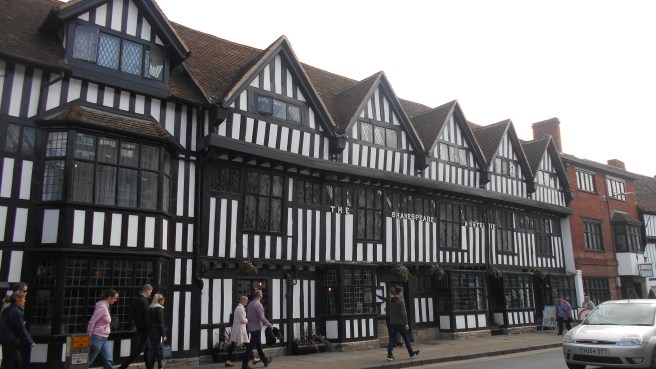
The town is full of interesting old buildings which must have seen many transformations over the centuries, ending up as hotels or designer shops.

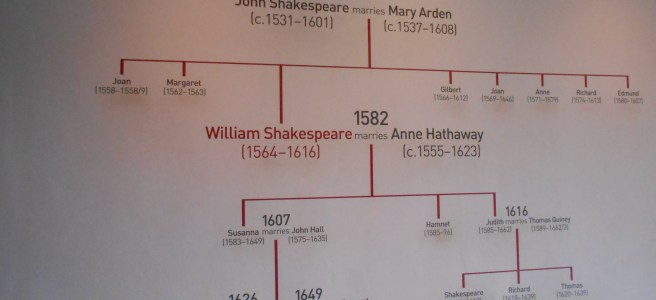
In 1557 a glover from Stratford Upon Avon named John Shakespeare married Mary Arden, the daughter of a well-to-do farmer. Their son William was born on or about 23 April 1564 in a house in Henley Street. And it is this house I had the chance to visit recently. After a varied history the house was purchased by a charitable trust in 1847, sponsored by well known names such as Charles Dickens.

30698416_2052037664826013_8232524434582274048_o

DSCN5840

DSCN5861

Luckily it was a fine day when I was there; the gardens are very pretty and you can sit and listen to costumed actors who will take your requests for speeches.


DSCN5846

DSCN5843

dscn5851.jpg

DSCN5844

DSCN5854

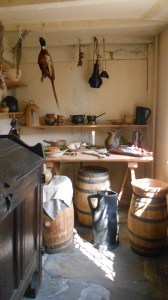
Inside the house costumed guides are there with plenty of snippets of information or domestic details. Dinner was eaten at 11am; as the son of a middle-class citizen William would have attended the grammar school. He went to school at 6am then came home for his dinner. Sumptuary laws in Tudor times aimed to keep class distinctions and prescribed what people could eat. The Shakespeare family were allowed two courses, but each course included plenty of dishes.
DSCN5860

30709555_2052910448072068_6578983328660062208_n

Upstairs you can see the marital bedroom where William was born, even the likely spot near the fire, with his mother probably using a birthing stool. Younger children shared with their parents, a truckle bed being wheeled out from under the parents’ double bed and did not sleep in a separate room until they could be trusted with a candle. Wooden houses with rush floors were a great fire hazard. For the same reason all domestic fires had to be put out at sunset; the risk of a spark while everyone was asleep was too great. Doorways were small, not because people were much shorter, they weren’t, but to keep the heat in. The long nights of winter must have been uncomfortable, especially as people slept sitting up with a bolster and pillows. They believed if the Devil saw them lying down he might think they were dead and take their souls.

DSCN5859

Read more about my trip here.

https://www.ccsidewriter.co.uk/chapter-four-travel-diary


Visiting Jane

DSCN5962

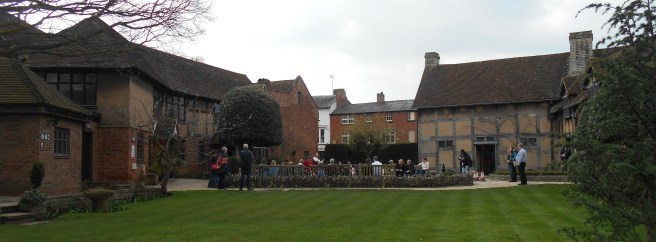
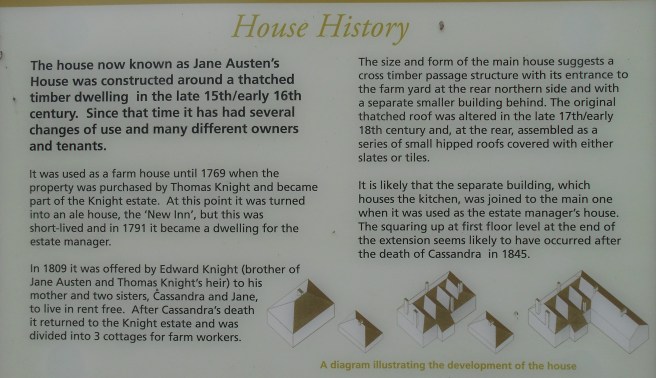
On Monday we paid a long overdue visit to Jane’s house; Jane Austen’s House in Chawton, Hampshire. I had always imagined the little cottage under siege by coach loads of tourists, timed tickets and queues. Perhaps a Monday school day, arriving soon after opening time, made it a simple and civilised visit that Jane would appreciate.

dscn5963.jpg

We parked in the free car park as instructed on the website; all was quiet, rain threatened, but never happened. The wet winter has left the gentle Hampshire countryside lush and green.

dscn5968.jpg

Jane’s friends were cheerful and welcoming, the tulips and primroses in the pretty gardens were at their best. It was a bit early to call on the Misses Austen so we roamed the gardens, looked around the bakehouse, enjoyed a moving picture of family life and admired the beautiful quilt given to Jane for her anniversary last year. Everything was seemly, nothing tawdry presented to visitors.

DSCN5970

We felt immediately at home when we stepped inside the red brick cottage. The Austen ladies do not own this house, but I would never let on that I knew this. What does that matter when Jane feels so at home here, at peace to write while Cassandra and their aptly named friend Martha take care of the housekeeping. Left an orphan, with just a little money I gather Martha Lloyd became part of the family long ago, not in a position to be independent or find a husband.

30716485_2055172457845867_551388799108644864_o

dscn5974.jpg

The Drawing Room is newly papered in a pretty yellow pattern, Chawton Vine. It was here we met a relative of Jane’s brother Edward, Jeremy Knight, who invited us up to the Great House, as Jane calls it, for lunch later. Who could have foreseen when the Austens sent their son to be adopted by the Knight family that he would be instrumental in making sure his sister’s novels were published.

DSCN5989

Upstairs the floorboards creaked and Jane will not have the creaky door fixed as it is a warning of someone coming so she may hide her writing. Mrs. Austen’s room is the largest and is newly decorated with a pretty ribbon trellis pattern wallpaper. The ladies have stitched a beautiful patchwork coverlet. Every window sill had a pretty cup with a posy of spring flowers, testament to how beautifully the ladies keep the cottage.

DSCN5987

DSCN5985

We didn’t stay too long, Jane’s health has not been good and like all authors she probably can’t wait for visitors to leave so she can return to her writing.

DSCN6000

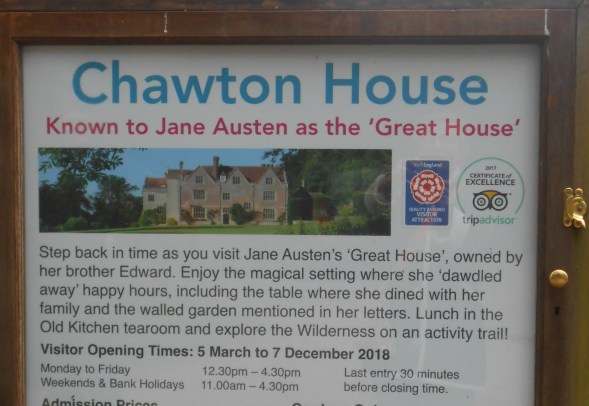
Back outside the rain still held off and we walked up the road in Jane’s footsteps to Chawton House, the merry sound of the local children at playtime ringing in our ears as we passed their school. With fields all around one can see why Jane and Cassandra enjoy two hour walks every afternoon. Up the long driveway to the house it was very quiet, we rang the doorbell and it was quickly answered; we were welcomed inside and shown into the cosy kitchen. We only had time for a scone and tea, as we had another appointment, but promised to come again when we return to see Jane.

dscn6001.jpg

DSCN6004

DSCN6005

Every Picture Tells a Story

We have shelves full of them, boxes in the loft; barring a house fire or aircraft crashing onto our roof, a large collection of photograph albums, some inherited, could be passed on into history. Black and white pictures on black pages, sticky pages unpeeling, flip up albums of 6×4 prints. But the days of calling at the chemist to collect a packet of prints, the hoped for best shot out of focus, are a mere memory.

dscn97931

When we joined a camera club over a decade ago, only half the members had converted to digital, now the colour slide show has been replaced by digital images projected from a computer onto a screen. Charity shops are full of old cameras. The real enthusiast used to be someone who had his own dark room, now he has a computer, sophisticated software packages and a good quality printer. Digital photos can be printed out by anyone, a trip to the supermarket machine, put in your memory device and collect.

DSCN2389

Unlike a roll of film, digital never runs out. Many computers are full of thousands of unseen images, lost to history as technology changes. From pictures taken on mobile phones of news as it happens, to bumble bees captured with the most expensive macro lens; everyone is a photographer now. I prefer compact cameras that point and shoot. But for the ‘technowhiz’ with the right software and a lot of patience, there is nothing that can’t be done to a digital image; cut down to size, lamp posts erased, colours altered, several snaps melded together or the photograph turned into a painting. My book covers are all created with digital designs using original photographs.

Authors are advised to have a website; you can build your own or find a website provider. I found myself with a template; a digital scrapbook waiting to be filled, not just with words, but with pictures. The means to an end became an end in itself.

P1050019

Visit my website for seasonal pictures, travel views and a picture quiz.

https://www.ccsidewriter.co.uk/

P1040418

Facebook; social interface, time waster, or something more sinister? It does not need to be filled with family photos and intimate details of your life. Artists and photographers just enjoy sharing pictures and many of us relish seeing places we are never likely to visit ourselves.

P1050387

I have my camera or my smart phone with me all the time, still recording holidays and family events, but looking out for the unusual and interesting, snapping anything that might be suitable for future blogs or Instagram.

DSCN2296

P1040880

P1050043


Ironically, despite this revolution and the explosion of digital colour everywhere we look, people love old black and white photographs; most of us are intrigued if we visit an exhibition. We enjoy the iconic images and the best photographers of that era took beautiful pictures. There is a clarity and sharpness in black and white photographs that has never been present in colour images. The other attraction is that past lives are captured, whether it is a crowded city street or an individual’s gaze, every picture tells a story.


dscn0620.jpg

It might seem that in modern life onlookers are all too ready to snap or even film disasters with their smart phones, but keen photographers are often reluctant to take photographs of people going about their normal day, fearful they will be seen as terror suspects or unsavoury characters. It would be a shame if the early Twenty First Century was represented by rural scenes and cityscapes devoid of human beings, I enjoy taking natural shots of people.

DSCN0029DSCN0026P1050116


Visit my Beachwriter’s Blog to see my latest pictures of people and places.

https://www.ccsidewriter.co.uk/chapter-five-beach-writer-s-blog/

P1050630

DSCN1421

P1050626


P1050898

P1060944

P1100380

Silly Saturday – Strange Species

27835424_1971591706203943_476442722_o

Is your computer safe?


DSCN1365Are you safe?

DSCN0953

Or are you having flights of fancy?


DSCN4584Who’s at your window?

P1100878… at your door?

P1070881

…or in your garden?

P1070260

p1110728.jpg

Trotting by your house?

DSCN2237

In your neighbour’s garden or…

DSCN2230

…dropping by for dinner.

…and if you get the chance, don’t forget to check who has access to your computer.

p1110625.jpg


Caught on Camera

One holiday not long ago we were on Bodmin Moor, Cornwall; a dog walker, a few sheep and a man tending a crackling bonfire in the garden of the solitary house. A strange noise made us look up into the evening sky. We zoomed in with our cameras, not a UFO, but the first drone we had ever seen. Not the sort that drops bombs luckily, but what was it doing? Watching us? Is there anywhere you can go without being seen?

DSCN2829

The next day we returned and drove up a road to investigate the tall mast on Caradon Hill we had seen from afar. Warning signs said Private road, access only. We walked the rest of the way up the grassy hill, veering away from the unmade road, past the gigantic guy ropes, steel cables holding up the metal tower. There was a complex of buildings, entry by security pass only, CCTV in operation. Obviously a secret facility, we were being filmed and I expected armed troops to emerge at any moment to take us in for interrogation. The signs were headed by the word Arqiva – a sinister secret organisation for sure.

DSCN2847

The truth was more prosaic when I looked the place up on Wickepedia.

The Caradon Hill transmitting station is a broadcasting and telecommunications facility. Built in 1961, the station includes a 237.7 metres (780 ft) guyed steel lattice mast. The mean height for the television antennas is 603 metres (1,978 ft) above sea level. It is owned and operated by Arqiva, a British telecommunications company which provides infrastructure and broadcast transmission facilities in the United Kingdom and Ireland.

But perhaps that information was a cover up; we only escaped arrest because they had identified us as civilian ramblers.

DSCN2842

We are all being watched, all the time. CCTV cameras we know about, on buses, station platforms, in shops. We don’t know if we are being filmed or watched live. Above us are police, military and coastguard helicopters.

It is not only people who are being watched, so is your vehicle. Drive down many main roads and your journey has been recorded by ANPR – Automatic Number Plate Recognition; if the car is stolen or of interest for any reason it will be spotted. Police cars can now carry similar equipment. Writers of thrillers or crime novels have a harder time than ever helping their characters hide or escape, though in fiction and real life criminals are often one step ahead of new technology.

But writers can find new inspiration for plot ideas.

Pity the chap whose neighbour offers to give him a lift to Heathrow Airport in his mate’s car. By the time they are driving through the tunnel they have already been spotted on the spur road. Unbeknown to the occupants of the car, the neighbour’s friend is a criminal or terrorist. When the car is stopped they will have a hard time explaining who they are, by which time the flight will have been missed.

We have all seen pleas on television for missing persons or witnesses to the movements of a murder suspect. There on the screen is a CCTV picture taken inside a bus with the exact time and date. A wife spots her husband, who never uses buses and should have been at work on the other side of the city. A good starting point for a mystery.

In Brief Encounters of the Third Kind the main characters fear they are not only being observed, but controlled. There is no rational explanation for inexplicable events and when they finally reach a glimpse of the truth it is not what they expected.