Friday Flash Fiction – Jack’s on a Mission.

Heartbeat


‘Don’t let the cold air in Jack.’

‘Sorry, did I wake you?’

‘No, the three alarms woke me.’

‘I didn’t want to be late picking up the other three. I’ll creep out now and let you get back to sleep.’

‘Fat chance of that with you clumping around, anyway you know I’ll be worried till I hear you’ve arrived safely.’

‘No need to worry if you don’t hear, not likely to get reception up there.’

Jo yawned. ‘Is it foggy out there like the weatherman said?’

‘Yup can’t see a thing.’

‘Do be careful out on those winding lanes, thank goodness Phil’s not driving… have you got everything, flask, long johns on, all your gear?’

‘Yes… yes, look I’ve got to go, I want to be right clear of the city before the rush hour.’


Phil was waiting by his garden gate for Jack.

‘Hope this fog lifts or we’ll never see it. Did you remember to fill up the petrol this time?’

‘Yeah, ready to go, hope the other two set their alarms.’


‘You are now entering the Red Rose County…  at last’ said Phil.

‘Still a way to go yet, keep an eye out for the road signs, I don’t want to miss that turning this time.’

‘Sun’s up and I think that mist is clearing.’


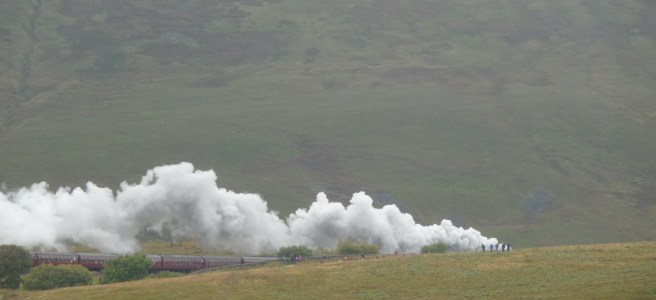
Jack felt a thrill as the road climbed and the number of sheep multiplied. Once they were in the car park he jumped out and took in the cold damp air of the moors. After a quick sup from their flasks they started getting the camera gear out; it was time to split up. The four men had planned their positions several days ago, every vantage point had to be covered. Later there would be time to warm up at the inn, get a hot lunch, a few beers and most importantly have a debriefing. Jack strode away from the gritted car park and on to the spongy moor. The sheep took no notice of him, they were used to walkers and sightseers. After ten minutes he was happy with his spot and checked his watch, half an hour to go. He took out a sandwich and the flask and sat on a hillock taking in the silence; nothing but the occasional bleating of a sheep. He had a good team, but he needed to be alone for this part. It was quite a miracle when the sun came out, it didn’t happen often up here. Though the warmth and light was welcome, low in the sky, the sun could cause problems for his shots.


It was the same as before, he merely sensed it at first. Still out of sight when he heard it, like a heartbeat, like the blood pulsing in your ears at night. When he was a child he thought it was a train in his head.

Then he saw the white plumes of smoke, switched on the video camera and started clicking away with the camera, following the graceful curve of the rail. The sky was clear as the train crossed the viaduct, he was going to get his best shots ever.

All too soon it was out of sight, Phil would be getting a perfect view from Ribblehead Station platform. The sheep carried on grazing, oblivious to the marvels of Victorian engineering.

ooo000oooP1090050P1090039


https://www.settle-carlisle.co.uk/heritage/history

Read more flash fiction and longer stories in Someone Somewhere.

Women Can Do Science

It’s International Women’s Day – have you heard of Millie Dresselhuase?

Deborah Drucker's avatarNotes Tied On The Sagebrush

You may think I went a tad overboard this month, and I probably did, but I wanted to shine a big light on the issue of gender equity in STEM careers. I am sharing stories about women in science who have had to overcome stereotypes about their gender to pursue careers in science. I am in awe of these women who continued studying and working in spite of all the barriers in their path. Part of the problem besides outright prejudice and discrimination may be that we do not read about these women in the media as often as we read about male scientists. So I mentioned two journalists who decided to analyze and remedy the lack of gender equity in their reporting. And I included what some organizations and companies are doing to bring more women into careers in the sciences. The stories about women in science definitely demonstrate…

View original post 839 more words

Virgin Snow and Virgin Boxes

There was more disruption in our house this past week due to upgrading of the Virgin Box than there was due to the Beast from the East. The new box had been safely delivered before snow. Cyberspouse was waiting for an open ended day to unplug the life support system and replace the old box; Virgin claimed two hours should be allowed, he wanted five hours to be on the safe side, but there is never a good time to detach the umbilical cord to the outside world and the ether we writers need to breathe.

Thursday night brought freezing rain on top of the day’s continuous snow. Friday morning was a white delight, but the beautiful virgin snow was now frozen hard. We were not going to starve if we stayed home, would probably not get scurvy if we relied on baked beans and frozen peas. But with local shops so handy we’re used to daily shopping, more importantly I did not want to miss out on Day 2 Snow Experience and more pictures for Instagram, Facebook and my website. We planned a circular walk to the cliff top and down Grand Avenue to the Grove for coffee and shopping.

It was a foolish mission that could have ended in disaster; impossible to walk on the icy crust of snow, hanging on to garden walls was not an option as they were covered in ice. We weren’t the only ones who made it to the cliff top, just the only ones without dogs or children. It wasn’t as cold as Thursday, the sky was heavy laden, insulating us and I could just about take my gloves off without getting frostbite and operate my smart phone.

Our favourite Ludo Lounge was open and it was packed. With schools closed and parents unable or unwilling to go to work it was like summer holidays, but with ice and slush. A waitress said they had received twenty eight phone calls before 9.30 am checking if they were open; people had their priorities right.

The greengrocers’ was closed, however Sainsburys’ was open with enough veggies for a good stir fry. But something was wrong, there was no milk on the shelves. It hadn’t occurred to us that out in the real world milk tankers would be unable to get to farms or back to dairies, nor would delivery lorries be able to get to supermarkets or corner shops. With only enough milk left for me to have two cups of tea this was a First World Problem of mega proportions, but Cyberspouse takes everything black and we have a Tassimo coffee machine. Worse was yet to come.

Saturday the snow melted, I bookmarked everything appearing on line and the WiFi was switched off; as predicted by me, the new box did not work. The help line was rung, the engineer would come out on Tuesday. No Saturday night Swedish Noir on television, no Facetiming Australia early on Sunday morning and no blogging.

This big First World problem had a First World solution, our smart phones would keep us in touch with the outside world and I could still put pictures on Instagram and Facebook, but phone screens are small. If I was a Borrower it would be fine… The Borrowers, by the English author Mary Norton, published in 1952, features a family of tiny people who live secretly in the walls and floors of an English house and “borrow” from the big people in order to survive. How they would have loved to borrow my Samsung phone to use as an interactive big screen TV.     https://en.wikipedia.org/wiki/The_Borrowers

Smart phones are great when you are out or on holiday, people can’t resist checking them at five minute intervals. But with minute writing and the perils of predictive texting it is not the way I like to read, enjoy and comment on blogs and photographs. If anyone has received any strange comments from me I apologise.

I did at least get more of my novel written with no distractions. By the time I got home on Tuesday evening all was restored. I’m blogging again, but my Bookmarked list is longer than ever. Visit my website to see snowy pictures.

https://www.ccsidewriter.co.uk/chapter-two-coastal-views


Friday Flash Fiction Fantasy

                                      Andromeda Advertiser                           

       The Hotel Inspector

 How long would you spend in suspended animation to reach a one planet solar system? How many holidaymakers would be prepared to trek across the universe to visit the only habitable planet in a third rate solar system? Planet Gaia has only one moon and an outdated space station; what it does have is water and this is the main selling point in their first venture into intergalactic tourism.

The second unusual feature is its tilted axis, which gives it a great variety of climates to choose from. The downside? The brochures omit to mention the unpredictable nature of the locals, or even to explain which is the prime species.

Our tour started when we woke up on the moon, quaintly called Lunar Base. From here we enjoyed wonderful views of the shining blue planet; this alone made the trip worthwhile. We had yet to meet our hosts.

Next stop was the antiquated space station which must be pre booked due to lack of space, but essential if you wish to orbit Gaia.

By the time we landed on the planet we were ready for a meal. We had chosen a tiny island with a mild climate which boasted large colonies of homosapiens. The hotel itself was on the edge and not for the faint hearted unused to water.

This was when the tour began to lose some of its starlight. How do the locals expect to attract tourists without making any effort to learn their language? Even the sign language was limited by their possession of only two arms. It can only be presumed that the more intelligent species live in the oceans, but we did not have time for the underwater trips, nor was our travel agent accredited for this risky expedition.

Our meal was surprisingly tasty and we were soon ready for our guided tour. Having come this far I was determined to put my foot in the water which is called by many names; here it was flat, thin, perfectly safe and called sea. The sensation was not unpleasant and we also enjoyed watching the homosapiens splashing around making their mating calls.

Our party of three and a half was booked in for five days, but the brochure skimmed over the fact that the days are very short, making the stay poor value for money. The ablution facilities consisted of more water, with no sign of any hot dust. Our first night was cramped and uncomfortable; we should have been advised to book more than one room.

The most fascinating aspect was the rapid change of atmospheric conditions. We had not been guaranteed rain, so we were delighted on the second day when the hotel was pounded by strong air currents full of water. From our viewing platform we could see the water had now turned to waves and we were glad to be in the shelter of the hotel.

How did I rate the experience? Mixed; frankly we were glad that the days were so short. I gave our accommodation five suns.


Wagner, Elgar and All Star Superslam Wrestling

The Pavilion is one of my favourite buildings in Bournemouth, an Art Deco theatre and ballroom built nearly a hundred years ago, a Grade Two listed building  that has outlasted two Winter Gardens. The ballroom has wonderful views of Poole Bay and The Purbecks.  If you go to the theatre, don’t be late getting to your seat if you are in the middle of the row; they are narrow with very little leg room, a timely reminder of how slim our recent forebears were. But outside the auditorium there is plenty of space. If you are going to the theatre, explore the rest of the building, saunter down (literally ) the sloping corridors on either side and look out on the Lower Gardens. Then if you need to go before the show, don’t want to queue to use the loo, descend the stairs to the ballroom toilets, more spacious than those at the front of house, with the original ashtrays still in the cubicles.

https://www.list.co.uk/place/50527-pavilion-theatre-bournemouth

On Sunday there was a matinee concert with the Bournemouth Symphony Orchestra. The whole Pavilion was abuzz so there was obviously another event going on in the ballroom, which could have been anything from a wedding fair to an antiques show. But what no one, sauntering down the corridor in the depths of the building to the ballroom toilets, expected to see were large bare chested men wandering around, wearing what appeared to be ladies see through panties. A shock for elderly ladies on a respectable Sunday afternoon outing and for mothers who had brought their young daughters for some culture. All through Wagner’s serene Siegfried Idyll I was wondering if the chaps had come from some Netflix fantasy drama. I was relieved the young man playing Elgar’s Cello Concerto had his normal concert gear on, as my seat was only a few feet away.

In the interval we discovered from the ushers guarding the ballroom doors that it was All Star Superslam Wrestling. Unfortunately the wrestlers were not seen again so I didn’t get a chance to have another look. But I’m sure Dvorak’s New World Symphony was more exciting.

Alas, Bournemouth Symphony Orchestra, one of the country’s leading orchestras              a Cultural Beacon for the South and South West of England, only play seven or eight concerts a year in Bournemouth. They do not live here, but down the road in Poole at The Lighthouse Centre for the Arts. A bit annoying, as when we moved here I thought I had steered us to heaven, a seaside town with its own orchestra. The orchestra is older than either building, founded in 1893. They are also Classic FM’s Orchestra in the South of England. At The Pavilion Saturday evening and Sunday afternoon concerts we get a jolly Classic FM presenter, who has stories to tell, just like the radio only thankfully without the advertisements.

https://www.bsolive.com/

At The Lighthouse things are more serious, except at Christmas. Here the audience have been praised by conductor Kirill Karabits for trying lesser know pieces every season. BBC Radio Three broadcasts live concerts regularly; occasions when you certainly don’t want to be late getting to your seat or forget to turn your mobile off.

Music is one of the themes of my Brief Encounters trilogy; download the first book for only 99 pence.


Friday Flash Fiction – The Writer’s Tale


‘How hard can it be to write a novel?’ thought Joe as he walked through the town towards the Job Centre. Redundancy could be the best thing that ever happened to him; a golden opportunity for a new career as a writer. Passing the library he stopped to look at a notice in the window WRITING CLASS. He went in to enquire for details, couldn’t remember the last time he had been in the library; the sight of all those books intensified his desire to write one himself. He gave his details to the librarian.

‘It’s your lucky day,’ she said ‘the class meets in ten minutes, you could attend to see if it’s what you are looking for.’

The morning flew by, Joe listened to the other people in the group and thought If you can write, so can I. When they did an exercise the words flew out of him. He signed on.

At lunchtime he sat down in the coffee shop to make a shopping list, then strode down the road to WH Smith. Much later he emerged laden with purchases; writing books and magazines, note pads, pens, pencils, Microsoft Word, six Three for the Price of Two modern paperback novels, a large piece of board and a packet of felt pens.


Arriving home he staggered through the front door.

‘How did you get on at the Job Centre dear?’ called his wife.

He faltered and nearly dropped his shopping. ‘Fine dear, I’m just going on the internet to look up some job websites.’

He closed the door of the spare room.

An hour later his wife called out ‘Dinner’s ready.’

With no response she stumped upstairs and pushed the door open. On the wall was a large board with strange plans in bright colours. Joe sat at the desk in front of the computer, open notepad by his side. On the screen were written two words Chapter One; absorbed he hadn’t noticed her come in. She looked more closely at the board; at the top was written Dove Street, below were drawn two rows of squares filled with names, she peered at them puzzled. ‘Mary and John White, Mr and Mrs Khan and their three children, young Polish workers, old Mrs Green…’

‘Joe, what are you doing?’ she exclaimed, startling him.

‘I’m going to write a novel,’ he exclaimed proudly ‘in fact I may well do a series, there are so many interesting people who live in Dove Street, the possibilities are endless.’


No Time Like The Present

There’s no time like the present, especially for authors. How long does the present last; a year, a week, a day, a second?

My first novel Brief Encounters of the Third Kind’ was set in the present, that was where I intended it to remain. I did not want to name a year; the characters lived in London and the 2005 bombings were still quite recent when I started writing, I did not want their story overshadowed by such a major event.

But first novels, especially long ones, take a while to write, to be read by others and edited. The present was fast becoming the past. World events were turning out differently to what most of us could ever have imagined and technology was racing ahead. My characters had mobile phones that took photos, they Skyped and went on Facebook, a few of them had SatNav. But they did not have smart phones, tablets, ipads, Kindles etc. and the last thing I wanted them to be able to do was Google their location or look up information on the internet with their smart phone; that would have wrecked the plot. More of the Twenty First Century passed by while I went down the traditional route of looking for agents. In the meantime I had written my second novel, Quarter Acre Block, a shorter straight forward family drama set firmly in 1964 and 1965. It became the first novel I published on Amazon Kindle.

I decided to stick to self publishing, Brief Encounters became a trilogy and I describe all three novels as being set in the early years of the Twenty First Century. As far as my characters are aware, they are living in the present and in a new century.

My work in progress was initially inspired by a local event during the Valentine night storm of 2014 and the novel should come to an end within 2014. All the places the wandering hero finds himself are real. But real places can present problems if your story takes place in the present; pity the author whose character goes shopping or works in BHS, no sooner is it published than the shops close down.

If you avoid ‘the present’ and set a year you still have to be on the alert. London and other cities have many familiar and iconic landmarks, but well known scenes can change dramatically. If you set your novel in a particular year, don’t have your hero enjoying the view from the top of The Shard before it has even been built, or the heroine after years away abroad, tearfully spotting the iconic cooling towers on the horizon that mean she is near home – the cooling towers that were demolished two years previously.

But there is no need to rely on your memory; what did authors do before the internet? Rush down to the library to search through old newspapers. Whether you are writing an historical novel or a millennial saga you can look up when Queen Victoria visited your local town, or what the weather was like in Portsmouth when your hero set sail for his solo trip round the world.

As for getting the future right, you will just have to wait and see; not many writers from the past got it completely right or completely wrong.