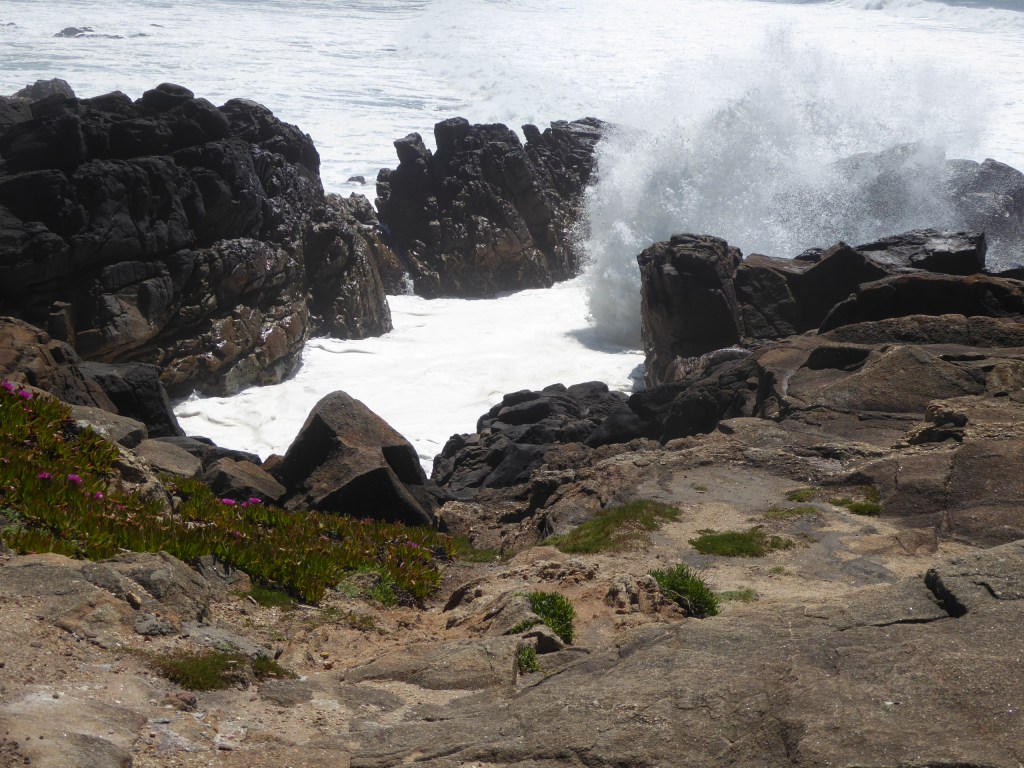
An island community is calling for their independence to be recognised. The ᛏᛁᛈ ᛏᛟᛖ ᛈᛖᛟᛈᛚᛖ or Tip Toe People appear to have gone unnoticed on their little isle in the Irish Sea. Even ornithologists had no knowledge of a bird unique to ᛏᛁᛈ ᛏᛟᛖ ᛁᛋᛚᚨᚾᛞ, Tip Toe Island. Sea bird experts are refusing to disclose the location of this island surrounded by rugged seas.
The Tip Toe people are so called because they tip toe barefoot carefully around the ground nests of the Rainbow Gaeulls. Unlike most sea birds with their blacks, greys and whites the Rainbow Gaeull has bright red, yellow and blue plumage, fluorescent orange webbed feet and a magenta beak.
Their stunning appearance makes them vulnerable to attack by predators and humans and this is the likely reason they are only found on this island, protected by their unique ancient association with the Tip Toe people. The gaeulls take off each morning in their strange formation and spot shoals of fish, the Tip Toe fishermen then follow in their small boats. As they haul their nets in the birds are rewarded with a share of the bountiful catch.
But this idyllic lifestyle is threatened by the discovery of precious Iridium deep in a cave, at the base of the cliff on the rocky side of the island avoided by the Tip Toes.
The foolhardy adventurer who made the discovery remains anonymous and the Tip Toes claim to know nothing about his revelations. But he must have told someone because now Eire, Northern Island, Scotland, The Isle of Mann and England are all claiming ownership of the isle.
Now our intrepid reporter from BBC Radio Nan Gaidheal, Rhuari MacGael, has landed on the island and brings us this report.
‘Is iad na Toes Tip tíre garbh, wiry le gruaig rua fiáin, ach síochánta agus milis. The Tip Toes are a rugged, wiry folk with wild red hair, but peaceful and gentle, or so I have bin tellt. They claim their language is a unique mix of Gaelic, Cymraeg and ᚾᛟᚱᛋᛖ , a heritage from the lands that surround them and the seafaring Norsemen. So I am finding it a wee bit difficult to understand them and only a few islanders have a smattering of English. I tried to explain that David Attenborough is on their side. To which I think they replied
Pwy yw’r uffern yw David Attenborough?
Achub ein gaeulls enfys sanctaidd
They were pleading with me to leave their sacred birds alone, then they addressed me in i toin beagán níos láidre
Nid oes unrhyw un o’r tu allan erioed wedi gadael yr ynys hon yn fyw.
Concern is growing for a reporter from BBC Radio Nan Gaidheal who was last heard reporting from the newly discovered island of Tip Toe in the Irish Sea.
David Attenborough had earlier pleaded for this precious island and its unique birds to be left alone.
Language experts have been attempting to translate the last words Rhuari MacGael transmitted.
Happy Birthday Doctor Who. Many of us, including the media are indulging in nostalgia as it is sixty years since BBC children’s drama series Doctor Who appeared on our screens. I was always rather resentful that I missed the first episode as we got stuck in traffic on the way home. In those days if you missed a programme that was IT, no recording on your video player, or catching up on iPlayer. It was not until 1990 when we bought a boxed set of videos of the first four episodes for a relative, that I discovered why the Time Lord travelled in a police phone box. The Tardis was meant to change its appearance to fit the surroundings wherever and whenever it landed. It landed in 1960’s London, but due to a technical fault ( or perhaps the BBC budget ) the Tardis remained a police box forever.
It was the second series that introduced the iconic Daleks. With sink plungers their only weapons and unable to climb up stairs, they still struck terror in our hearts. I only have to hear the word EXTERMINATE and a chill goes down my spine. I only have to hear the words Radiophonic Workshop and the electronic theme music fills my head.
Urban myth has it that children used to hide behind the sofa when the Daleks were on and I know this to be true. My aunt and uncle for many years recalled my friend hiding behind the sofa at my 11th birthday party and this same friend today recalled that she did indeed hide behind the sofa.
Doctor Who is wandering round my local area at this very moment, his police box is parked in the middle of Boscombe.
Back to adult television in 2023 and at last there is a drama with Janet as the lead character. Unfortunately she has her fingers chopped off in the first few minutes… well only one hand. Boat Story is a black comedy drama and there were more scenes I couldn’t watch!Not sure if I can face the second episode…
For proper adult drama I am really enjoying the second series from Australia of The Newsreader, set in the 1980s.
Were you a Doctor Who fan?
I know not all bloggers watch television, no doubt having better things to do like reading our blogs and writing their blogs. If you are a viewer have you found a favourite programme lately?
You need to be a deep sea diver or have a very large tank to meet an alien for a meaningful exchange. For most humans, watching Planet Earth 111 or listening to The Infinite Monkey Cage on BBC Radio Four, will give you an insight. I have knitted an octopus and been in an Octopus’s Garden, though that was a children’s soft play area, so doesn’t really count. But we don’t need to be underwater life experts to ponder what it might be like to be an octopus. Experts tell us they are far more intelligent than we previously thought when we were eating them. They certainly have more brains than us, nine altogether and three hearts, so who can guess their thoughts and emotions.
We understand vertebrates, however strange some might be they have the same basic four limbs and backbones and of course one heart and brain. The octopus developed along completely different evolutionary lines, as might an alien on another planet. We have a very vertebratist view of how intelligence can be measured, assuming the longer an animal spends raising its young, the more intelligent it must be. We can coo over monkeys cuddling their babies and young whales keeping close to their mothers, but have had to come to terms with turtles burying their eggs then heading out to sea, never to see their young. Baby turtles emerge from the sand and head towards the sea, usually getting eaten along the way, without any idea what they are or who their parents are.
Obviously we can’t judge other species by our limited ideas. If your only experience of solitary life was the Covid lockdown and you love meeting friends for coffee, you will find it hard to feel a connection with the octopus.
May not be accurate representation of an octopus.
There are many varieties of octopus, but in human terms it seems their lives are short and lonely, though they could well be very happy exploring their deep sea paradise. Somehow they manage to meet up and mate, with the male having one of his eight arms conveniently adapted for… well we should not intrude into their private lives.
This picture is not from Planet Earth 111
In the Planet Earth 111 film the females gathered at hydrothermal springs two miles below the surface to lay their eggs, the warm water reducing the brood period to ‘only’ two years. During this time mothers don’t eat or move from their spot, gently wafting water over the eggs to keep them clean. By the time the eggs at last hatch the mother is dying. Looking like me when I fall asleep at meetings or watching television, we saw the Octopus eyelid droop further and further. With her last strength she urges the last few babies out, all the tiny ethereal creatures drift up and up never to see their mother again. Soon all the mothers are dead.
I wonder if the octopi communicate with each other during their long nesting. Are the last existential thoughts of an octopus ‘What are we all here for anyway and what’s the point of being an octopus?’
Why do we in the Northern Hemisphere who have daylight saving, always say with surprise, soon into November ‘Doesn’t it get dark early?’ Luckily we have squirrels to light our way home.
We learnt a new word today at our ‘Wellness Pilates’ class. A new class is starting at the sports centre – Equilates. Browsing the internet I see it is not new. What is it? Clue below and answer at the end of this post.
Too many books? You can never have too many books or can you? A decorating project Chez Tidalscribe led to moving a lot of books and wondering why so many are unread. Some are inherited from my book loving aunt and uncle, others date back to our Book Club days when we would leave a book club, then re-join it later to get yet another introductory offer of six books for a pound each, then there are the treasured Christmas presents. Many are beautiful illustrated hardback non fiction, excellent reference books in pre internet days. Alas, when we are writing a blog or checking facts for our novels, we don’t say to ourselves ‘I’ll just pop downstairs and look that up in the very heavy giant Encyclopaedia of British History or the equally heavy Family Medical Encyclopaedia ( probably out of date )’; we just Google it. As I dust each book to decide where to put it on the new shelves I am overwhelmed with guilt at my neglect and promise to read it on the afore mentioned long winter evenings.
Answer to equilates.. apparently around for a while, it is Pilates for horse riders, not the horse, though that may well come. We didn’t know horse massage and saddle fitting was ‘a thing’ till a family member trained for them and soon acquired plenty of clients.




 Times and Tides of a Beachwriter