
Today Sally at Smorgasbord posts her review of my first novel Quarter Acre Block. Thanks Sally.


Today Sally at Smorgasbord posts her review of my first novel Quarter Acre Block. Thanks Sally.
Many of us have been watching a new BBC Sunday evening drama, Ten Pound Poms, prompting friends to ask how it compared with my family’s experience. The brief answer is completely different and I have found myself being irritated by some aspects of the series, not enough to stop me watching it though! In the drama it is the 1950s and the characters sail out to arrive in Sydney six weeks later, six seconds later for viewers. They are taken on a bus to a migrant camp, winding through bushland till some Nissan huts hove into view. My first annoyance was we had no idea how far away from Sydney they were, all it takes is for a character to say ‘blimey, a hundred miles from the city…’
Anyway, there they were with Nissan huts, dreadful looking outside ‘dunnies’ ( toilets ) and shower blocks. My running irritation is that one of the main characters, Kate the nurse, has make up more suited to modern reality shows or a girls night out. Her eyebrows are ridiculous and in the Australian heat her makeup would be running down her face, not that matron at the hospital would have allowed her to wear such makeup!
The Australians they meet are mostly awful, but so are some of the migrant characters; there are a lot of running stories packed in to this series. They seem to be in the middle of nowhere, but also near a country town, a hospital, the sea and some very swanky houses. What themes do ring true in this drama are the treatment of the Aborigines, who were not counted as humans in the census till the 1960’s and the fact that English children were sent out to Australia as orphans, but many had parents who didn’t know where they had gone.

Perth, Western Australia in the 1960’s
My family’s story is not as dramatic, for any of you who are watching the television series. It took Mum and Dad only six months from the time of applying to us all getting on a chartered migrant flight at Heathrow in October 1964. They chose Perth, Western Australia and we had a ‘sponsor’ who was a chap Dad knew ‘from the office’, the two families had never met. He met us at Perth airport at 1am and took us to the caravan he had booked for us. A week later my parents had found a house to rent. If we had needed to go to a migrant camp I’m sure my mother would not have stepped on the plane! By Christmas they had bought a house on a quarter acre block in a new suburb. Migrants were told that all houses were built on a quarter acre block, that idea didn’t last, but our house had natural bushland.

My novel Quarter Acre Block is inspired and informed by our family’s experience, but not autobiographical. It is told from the point of view of the daughter, who may have some similarities to me… and of the mother. Mum helped me with the adult experience point of view. In the rented house in an older suburb Mum said the only neighbour who talked to her was Dutch, but at our new house we quickly became friends with our new neighbours, who were dinky di Aussies from the goldfields of Kalgoorlie.

The lifestyle migrants looked forward to..
We knew little about Aborigines, I guess we assumed they were enjoying their lifestyle out in ‘the bush.’ We knew nothing about migrant children and stolen Aboriginal children being abused in orphanages.

‘In the nineteen sixties many ‘ten pound pommies’ had never left England before and most expected never to return or see loved ones again. George Palmer saw Australia as a land of opportunities for his four children, his wife longed for warmth and space and their daughter’s ambition was to swim in the sea and own a dog. For migrant children it was a big adventure, for fathers the daunting challenge of finding work and providing for their family, but for the wives the loneliness of settling in a strange place.’
Only 99 pence to download to Kindle or buy the paperback for ten pounds.
Have you been watching Ten Pound Poms, or have you or your family had experience of migrating to another country?
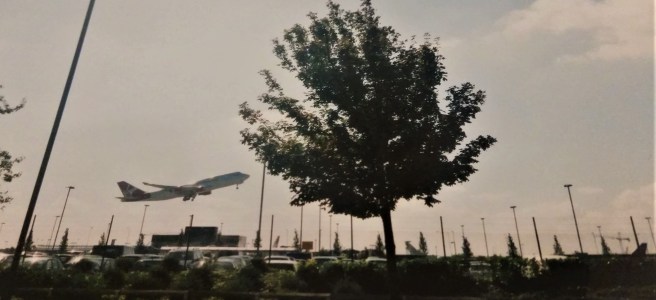
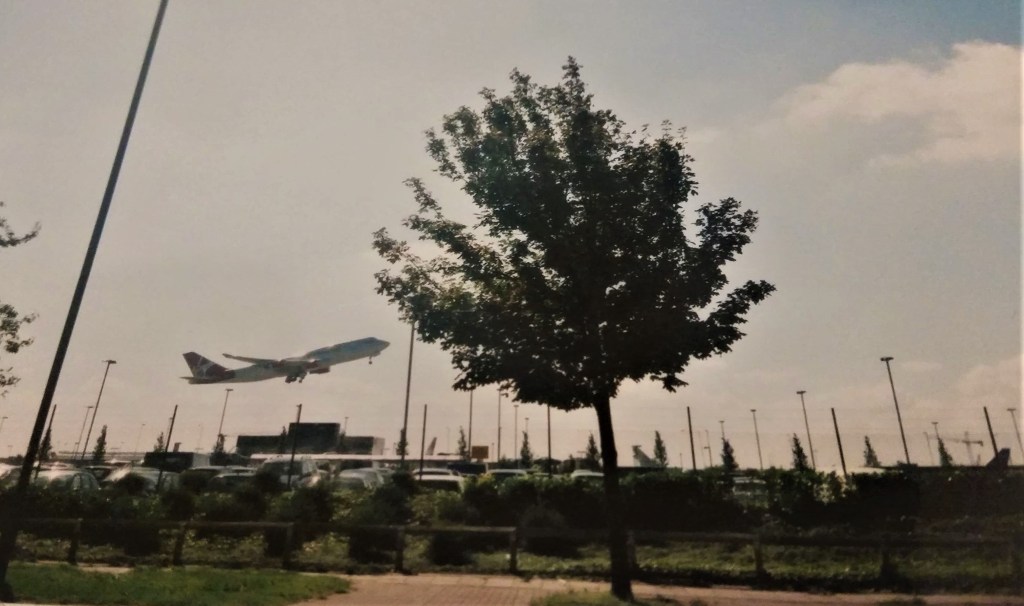
In 1955 Queen Elizabeth officially opened new buildings in the centre of what was then London Airport; the Europa Terminal ( which later became Terminal 2 ) and The Queen’s Building with its offices and roof gardens. In 2009 they were demolished to make way for a new Terminal 2. The Queen has outlived her own historic buildings. In the meantime, in the nearby historic Harmondsworth Village mentioned in the Doomsday Book, The Great Barn built in 1426 still stands.

‘Built by Winchester College as part of its manor farm at Harmondsworth, the oak-framed barn is an outstanding example of medieval carpentry and contains one of the most intact interiors of its era. At nearly 60 metres long, 12 metres wide and 11 metres tall, with 13 massive oak trusses holding up the roof, both its size and aisles evoke the space and shape of a cathedral.‘ It is now under the care of English Heritage; when we lived nearby it was on private land and only open to the public occasionally, but one visit was enough to stand inside and be awestruck. It was heart breaking to hear that Harmondsworth Village could be demolished to make way for a third runway. There was ridiculous talk of moving the barn and in 2015 our future Prime Minister famously said, as MP for the Uxbridge constituency near the airport, that he would “lie down with you in front of those bulldozers and stop the building, stop the construction of that third runway”.
The barn is still there and there is no third runway yet, but Heathrow Village must be the most changed and continually changing patch of grade A agricultural land in Britain; perhaps not in the whole world, Dubai and China might compete for that honour. There will still be people who remember a few tents being put up by the Bath Road in the 1940s; many years ago an old lady told me they looked across the road from their house and thought those few tents would not make much difference to them…
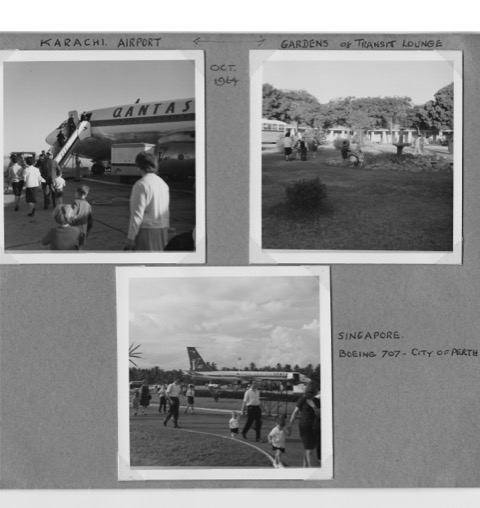
When our family emigrated to Australia in 1964 we left on a chartered migrant flight from London Airport on a Saturday afternoon. We walked across the tarmac to the steps of the plane and waved to our relatives standing on a balcony; just as well we could wave as we had arrived late at the airport ( that’s another story ) and had no time to chat to them. So there was no time for pictures, or perhaps Dad had no camera till he bought one in duty free during the trip.
In the late 70s, early 80s you could still go up on the Queen’s Building roof gardens; there was a playground for the children and it was a playground for plane enthusiasts who sat with their sandwiches and radios listening in to the control tower and incoming aircraft. But Heathrow has always been a continual building site, constantly adding bits on or demolishing. I occasionally worked in the old Terminal 2 and as you went through and down into the staff airside area, the ceilings seemed to get lower and lower, a security chap told me they felt like pit ponies… so perhaps this building was ready for demolition.
While I was working at Terminal Three it was being modernised, yet again. In Singapore business lounge our passengers went out on the last flight of the night and when we locked up and walked through the main departure lounge it was totally deserted, very different from what the passengers experienced. As we went out through the staff exit the builders would be coming in, nearly decapitating us as they wielded planks and all sorts of equipment.
One day going into work I got off the bus as usual, down to the subway and moving walkways, up into Terminal 3 Arrivals, turned left to step on to the up escalator that was there the day before and nearly fell over, it had disappeared. Another night our late flight was delayed and I was the only one heading for a particular staff exit… but when I got there it wasn’t there, it wasn’t just closed, there was no sign that it had ever been there in the first place. A story idea for sure, I was suddenly trapped in the no man’s land of Airside, would I ever see my home again? Luckily I saw a security bloke and said ‘I know you won’t believe this, but I can’t seem to find the staff exit.’ Luckily I wasn’t going mad, he directed me to the new exit.
One of my colleagues told me that he had a job in the ‘Irish Pub’ in the departures lounge. He went on holiday back to the Philippines for three months, returned, put on his uniform for work, went in and couldn’t find ‘the pub’ – restaurants and bars had five year leases and were always disappearing to be replaced by something completely different.
We moved away in 2004 and only a few years later we went to meet someone at Heathrow and parked in the Terminal 3 multi-storey car park. I had this feeling I could not get my bearings. Absolutely nothing looked how I remembered. It turned out the original car park had been demolished and a new one built further back, creating a pleasant plaza effect. If you ever want to know how to find your way round Heathrow, don’t ask me!
Have you had a Heathrow experience, good or bad?
My short story ‘Fog’ in my Dark and Milk collection was inspired by the third runway controversy and a few thoughts on what might have been…
My novel Quarter Acre Block is inspired by our family’s experience of being Ten Pound Pommies.

I am enjoying several books on my Kindle, one novel, two short story collections, poetry and a cutting humorous slice of real life, but no new reviews since the January’s Sunday Salon… in the meantime we have been to the theatre and seen some excellent programmes on television. Here are two stories that have stood the test of time…
Agatha Christie’s murder mystery play The Mousetrap opened in London’s West End in 1952 and has been running continuously ever since then. It is the longest-running West End show, the longest initial run of any play in history; there is a twist ending, which the audience are traditionally asked not to reveal after leaving the theatre.
The play began life as a short radio play called Three Blind Mice, written as a birthday present for Queen Mary, The Queen’s grandmother and broadcast on 30 May 1947. The theatre play is based on a short story based on the radio play, but Christie asked that the story not be published as long as the play ran in the West End of London. The short story has still not been published within the United Kingdom, but it has appeared in the United States in the 1950 collection Three Blind Mice and Other Stories.
When she wrote the play, Christie gave the rights to her grandson Mathew Prichard as a birthday present. In the United Kingdom only one production of the play in addition to the West End production can be performed annually. Under the contract terms of the play no film adaptation can be produced until the West End production has been closed for at least six months. So don’t expect to see any time soon a block buster movie brought into the 21st century and set in Bollywood or Hollywood, or perhaps on a space station. The play was set in ‘the present’ but has been left safely in the 1950’s.

I first saw The Mousetrap in London in the seventies while over from Australia on the ‘working holiday’ that never ended. As for many visitors to London it was a must see and my mother had always talked about the audiences being sworn to secrecy; how amazing that no one has ever given the game away! I enjoyed it and was proud to have guessed who dunnit.

This time we were at The Lighthouse in Poole, an early stop on the play’s 2020 UK Tour. I remembered who dunnit from last time, but recalled nothing of the plot so it was a fun evening. There is one set, the interior of Monkswell Manor, recently converted to a guest house run by a young couple. On the radio we hear of a murder and the police looking for a suspect in a dark overcoat; as each character appears on stage they are all wearing dark overcoats. Heavy snow leaves Monkswell cut off from the rest of the world, so of course when a murder occurs we know the murderer is in the house… A plot happily repeated on islands and trains etc. by Christie. There are plenty of twists and turns to keep us guessing and the second half especially moves along at a good pace. I’m not going to tell you what happens and if you know, don’t mention it in the comments.
https://www.mousetrapontour.com/uk-tour/
We move along a few years into in the early 1960s for an excellent six part BBC Sunday evening drama ‘The Trial of Christine Keeler’. This is a story that never seems to lose its fascination, there have been documentaries, books and a film; the scandal has been examined with 21st century eyes. When I was a child it seemed to be on the news all the time, though I had no idea what The Profumo Affair might be. John Profumo was the Minister for War in the turbulent times of the Cuban Missile Crisis; not only did he have an affair with the naïve ( perhaps not sexually naïve, but in every other way ) Christine Keeler, who also slept with a Russian spy; to make matters worse, he lied to The House of Commons, his chums and presumably to his wife, who happened to be famous actress Valery Hobson. Stephen Ward the society osteopath was another leading character, a ‘libertine’ who mixed with the aristocracy and politicians, groomed Mandy Rice-Davies and Christine Keeler and was responsible for Keeler meeting these men in the first place. The press had a field day.
It is a tribute to the actors that our sympathies were with the two girls and Stephen Ward. They enjoyed living at his flat, looked after them is hardly the right term, Keeler was only seventeen when Ward met her, but to them he was a friend and they were having fun. When Profumo suggested he put Keeler in her own flat she replied ‘But what about Mand?’ She didn’t want to live by herself, she wanted to stay with her friend at Ward’s.
The six part drama was able to explore a lot more about Christine’s early life and the ex boyfriend dramas also going on at the time. Most viewers probably knew Ward ended up committing suicide, perhaps making all the more poignant the lead up to the sham trial of Ward. He was expecting his many important friends and clients to step forward as witnesses for his defence, but in the end they all deserted him. James Norton was brilliant as Stephen Ward. So too were Sophie Cookson and Ellie Bamber as Christine and Mandy, two girls who were real people, not just two dumb models to be exploited by everyone. From Stephen Ward’s elegant mews flat to the sixties clothes, makeup and hair do’s this was a polished production.
https://www.radiotimes.com/news/tv/2020-01-26/trial-of-christine-keeler-cast/
Have you seen the Mousetrap?
Do you prefer fiction or real life drama?
What if I had been blogging when I was eleven…
My novel Quarter Acre Block is based on our family’s experiences as Ten Pound Pommies migrating to Perth, Western Australia, but is not autobiographical. Readers ask which parts are real? Some people say ‘weren’t your parents brave.’
Brave is going to a country with a different language or as an asylum seeker, being invited by the Australian government and given free passage with only £10 per adult to pay for administration costs, is not in the same league. Of course leaving your relatives behind and burning your boats with no job to go to and little capital is braver than staying put…

I needed my mother’s help to get the adult point of view, but the Palmer family are not my family. I wanted the story to be realistic, so the Palmers follow the same journey as we did. The ‘six week holiday of a lifetime’ sounded fun and I was envious of those who had come by ship, crossed the equator and met King Neptune, but the Palmer family had to fly.
I knew no one who had been in the migrant camps: I don’t think my father would have persuaded Mum to go at all if she had to face the prospect of a camp! She hadn’t been in the services during the war and had gone from home straight to marriage, so barracks and camps did not fall within her experience. Dad knew ‘someone from the office’ who had migrated and they sponsored us. The chap met us at the airport well gone midnight and as we drove across to the other side of the little city Mum was already looking out of the ‘station wagon’ in dismay. Once on our own, inside the caravan booked for us, she was soon saying ‘Rob, what have you brought us to’. We hadn’t seen much in the dark, but Mum had apparently focused on endless rows of electricity poles. Full of the whole big adventure I was exasperated that she was complaining when we had only been in Australia two hours.
The friend returned at nine am to take us down to Scarborough Beach. His family had taken to beach life and were living ‘the dream’. My younger brother and sister were terrified of the waves and I clung to a plastic surfboard, too embarrassed to tell their children I couldn’t swim. After that experience the only beach my parents wanted to sit on was Crawley Beach by the Swan River. It was very pleasant and Mum and Dad treated this first week as a holiday, we even had an ice cream every day, unprecedented, though it was not like Mr. Whippy and tended to have lumps of ice. Perth City was small then and you couldn’t get lost. Supreme Court Gardens were very pleasant and down by the Swan River was the wide open esplanade, so far we were living the dream.

After one night in the cramped caravan I had been despatched, or invited, I’m not sure which, to stay with the family of our sponsor. I was to be in the boy’s class at school and his younger sister did ballet, so I had nothing in common with her! I cringe now to think of my prepubescent self wandering around a house of strangers in my flimsy baby doll pyjamas, but all was above board.
After a week Mum and Dad had found a house to rent; as the venetian blinds were closed they didn’t see properly what it was like until Mum pulled the blinds up when we moved in. The only neighbour to speak to Mum was a Dutch lady. It was also time for me and my younger brother to start school, where their summer term was in full swing. This was nothing compared to the reality that Dad had to find a job and a house to buy and our packing cases were not going to arrive… more next week.

Read about the strange year leading up to our departure from England in last year’s blog.
https://tidalscribe.wordpress.com/2018/03/19/quarter-acre-blog/
Read more about my novel at my website.
https://www.ccsidewriter.co.uk/chapter-six-fiction-focus/
The first time Australia was mentioned was at breakfast on a school day. I was astonished when Mum said
‘How would you like to go to another country?’
Where had this idea come from? The furthest we had ever been was a hundred miles to visit my aunt in Cheltenham.
I replied instantly ‘If I can have a horse.’
I had always wanted a horse and what other reason could there be for going to another country? I would need no help caring for it due to my extensive reading of the Kit Hunter Show Jumper series and all the other pony books I could lay my hands on.

‘Australia?’
I returned from my reverie to hear what Mum was saying. A new picture presented itself; warm weather, living by the seaside and swimming every day. I couldn’t actually swim, but had been up to my chest at Frensham Ponds and in the sea, while Mum and Dad sat in deck chairs huddled in coats and rugs.
But my most vivid image of what our Australian life would be like came from my favourite television programme, The Adventures of the Terrible Ten. Ten children living in rural Victoria, who all had ponies, discovered some old packing cases and built Ten Town. They never went to school or saw their parents.
Mum said I might get a horse, would probably get a dog and would definitely go swimming. But for now the whole adventure must be kept deathly secret; until we knew for sure we had been accepted for migration. This meant absolutely no one, not even my best friend or my younger brother and sister. I kept the secret.
It was spring now and by autumn we would be ready to go, not on the dangerous voyage of the early settlers, but Mum and Dad would be burning their boats. Cheap flights at ten pounds each for Mum and Dad and free for children; but it was a one way ticket. My parents expected never to see England or their relatives again.
In the meantime a momentous year lay ahead. It was our last year at junior school; the first year Top Of The Pops was broadcast and in the garden shed our pet white mice were multiplying rapidly. As top years we went on school holiday for the first time to the Isle of Wight. It was a very pleasant holiday, but two strange things happened. As a Church of England school we knew several of our classmates were Roman Catholics, it made no difference to them or us. But on the Sunday of the holiday, one poor catholic boy was to be marked out as different. All of us were to attend morning service at the local church, but Eric’s mother had decreed that Eric must go to the catholic church. As a relatively new boy he was already slightly different; now as his lone figure trudged off in the opposite direction, to the mysteries of candles and incense, he had become an outcast. Later that day, as we ran around in the grounds of the hotel, some primeval, sectarian instinct took over and we all chased Eric; convinced in that moment that we were going to lynch him. Luckily the teacher came out blowing her whistle and normality was restored.
Peter was another unfortunate boy. For some reason he was the only child of our class of forty who didn’t come on the holiday. As we ate dinner one evening, the headmaster came into the dining room looking very distraught. Peter had run away from home and managed to reach the island before being caught by the police. We all thought him very clever to have got that far and very sad that he still wasn’t allowed to join us.
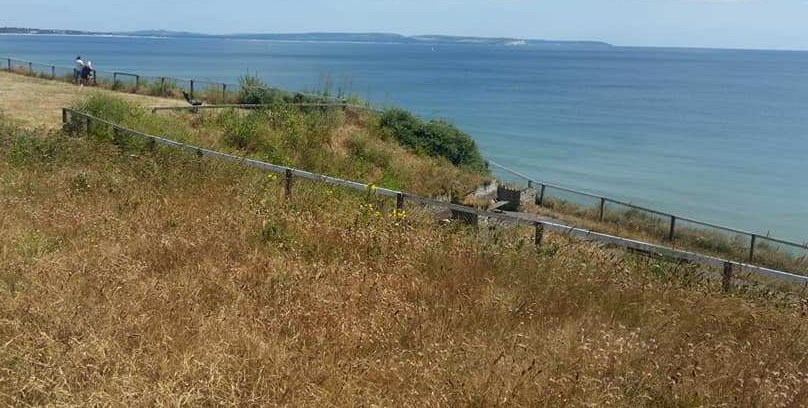
Back at school our summer term was nearing its end; we practised maypole dancing ready for our centenary celebrations and Mum and Dad visited the headmaster. Later that day he entered the classroom to chat to us; a common occurrence, but this time I realised with horror he was talking about me. I had kept my promise and not told a soul and now was mortified the headmaster was telling everyone I was going to Australia! Having spent four years mostly unnoticed, I was now the centre of attention as everyone turned to look at me.

As autumn arrived life became surreal. The date was set for our departure. I had passed my eleven plus, but it would make little difference to my future, the Australian schools were comprehensive. Our little school gang had been split in half, four of us were going to grammar school; one mother didn’t come out of the house for a week with shame that her daughter had failed. For a few weeks I experienced a glimpse of what my life might have been at a girls’ grammar school, dressed in bottle green uniform with the excitement of Bunsen burners.
Soon our house was sold and we had reached the point of no return. As the taxi collected us for the airport my grandparents stood stoically waving and my school friend Wendy skipped up the road after us; she would be the only person from those days to stay a lifelong friend.
The taxi had been late, very stressful for my parents. As we arrived at London Airport (now Heathrow) our friends and relatives were waiting, wondering if we had changed our minds. We rushed through with hardly time to say goodbye. The airport was much smaller then; as we climbed the steps to the plane we could see our loved ones gathered on the balcony waving. Except for Dad, it was the first time we had been on an aeroplane. I was really excited until I noticed the big card in the seat pocket. How to put on your lifejacket! Until that moment I had not considered the possibility that planes could crash. I wondered if we would reach Australia.

My novel Quarter Acre Block was inspired by our family’s experience. It is not autobiographical, but people who have read it ask which things were ‘true’. Find out more at my website. https://www.ccsidewriter.co.uk/chapter-six-fiction-focus
After nearly five years floating in the ether, the first novel I published on Amazon Kindle is now available as a paperback. Quarter Acre Block was inspired by my family’s experiences emigrating to Australia as Ten Pound Pommies; ironically the paperback costs £10.00 (£9.99 ). I have not yet written a novel inspired by my return to the United Kingdom, as a twenty year old on a six month working holiday which has stretched till now; suffice to say I have family on both sides of the world and there have been many journeys back and forth over the years, few of them mine.
Project Paperback QAB took on some urgency as Australian visitors were coming to stay; Kindle Direct Publishing paperbacks are not yet available in Canada or Australia.
Technology at our In House Publishers is rarely new; second hand computers, smart phones and other devices pass through the house, passed down from family who are upgrading or bought from ‘Pete at work’. Quarter Acre Block documents were in my new computer, in the external hard drive and on various memory sticks, but we couldn’t find the HTML document that had formed the original Kindle book. I wanted to add pages at the beginning and end that could not have existed in the first version, ‘By the same author’ ‘About The Author’, so with my Kindle at my side as reference I treated the Microsoft word document as a final edit. It was good to read the novel again and the Palmer family were pleased I had not forgotten them, but I was mortified to find more than one mistake in spelling and grammar. Had gremlins crept in? There was no escaping the fact that the same errors occurred in the Kindle version. I am not alone in this, I have enjoyed plenty of e-books where letters have swapped places and full stops have fallen off; perfection is hard to achieve, but it was galling to read that George had six ‘moths’ to feed.
At last the book was ready to download, with a new cover and perfect pages. Before you press Publish, Amazon comes up with a helpful spell check, a feature not available when we first published. Six errors… four were colloquial, wheatbelt should have been The Wheatbelt, but the glaring mistake was Goerge. One of my main characters, George, had endured the indignity of having his name spelt incorrectly in the first chapter; I can only hope that like the jumbled letter quizzes on Facebook – only people who are highly intelligent can read this – readers did not notice.
We ordered one copy to check it was fine. The visitors arrived on Thursday, the book on Friday. I ordered ten more; they were due on Sunday, an e-mail from Amazon on Sunday afternoon stated they had been delivered and left in the porch. The porch was empty, the visitors were going on Tuesday morning. On Sunday evening the neighbours came round with a parcel that had been left in their porch. On Monday evening we gave our visitors their gift and luckily they had enough room in their suitcases to take copies for my mother and niece; at 95,000 words the book is quite heavy, I had saved a lot on postage and packing.
In all the excitement we had not noticed one glaring omission. There was no title on the spine… on Amazon Kindle nothing is set in stone, you can go back in at any time and change the book, future copies will not be spineless. Perhaps those first eleven copies will be famous rarities in a hundred years time…
Read my previous blog on how KDP print on demand first came into my life. https://wordpress.com/post/tidalscribe.wordpress.com/383
 Times and Tides of a Beachwriter