Jurassic Holiday

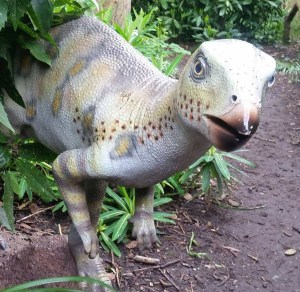
How to take your family to Jurassic Park without the children being eaten by dinosaurs? Enjoy a holiday on the Jurassic Coast.

‘The Jurassic Coast is a World Heritage Site on the English Channel coast of southern England. It stretches from Exmouth in East Devon to Studland Bay in Dorset, a distance of about 96 miles, and was inscribed on the World Heritage List in mid-December 2001.’

Obviously you won’t see it all on a week’s holiday or a day out, but whether you enjoy beautiful scenery, geology, fossil hunting or relaxing at the seaside, any part of this coast is worth visiting.

https://jurassiccoast.org/

Adults don’t like talking to young children about death if they can avoid it, or scaring them with tales of monsters, but most young children love dinosaurs; they know they are long dead and yet they are full of life to the child. They love their plastic dinosaurs as much as their cuddly teddy and adore the fact that they were huge and scary.

DSCN1822

For our half term holiday with Team H we stayed in two cottages in a village where the borders of Dorset, Devon and Somerset meet. On any English holiday it will rain, but it will also stop raining at some point so it is always worth setting out. Fossil hunting was the main aim and the beach to head for was Charmouth.

1

Charmouth, Dorset is one place where everyone is looking down, but not at their phones, they are all looking for fossils. There is a pleasant village with the river Char running gently out to sea; you can step over it at low tide or walk across the little bridge. The row of beach huts is deceptive, walk a little further and this is not a normal seaside beach. Gaze up at black layered cliffs. Don’t go too close, there are regular mud slides and crumbling of the cliff edge. This is why fossil hunting is so popular, new fossils end up on the beach and people are welcome to collect them as they would otherwise be washed out to sea. You can also book a guided walk. At the free Charmouth Heritage Centre you can learn about prehistoric times and volunteers will identify your fossils. The grassy hill is in contrast to the beach and a pleasant walk, but don’t go near the edge. The beach has a lovely heritage centre and a cafe, but the rest is unspoilt coast. When we set off to walk along the beach the first thing we saw was a father and son climbing up the cliff chipping away with their hammers; there is always someone who has not read the boards about dangerous cliff falls!

DSCN1828

https://charmouth.org/

The second full day of our holiday brought the torrential rain the weatherman had forecast. We went into Seaton, a seaside town with an electric tramway that runs along the estuary of the River Axe to Colyford and the village of Colyton. Fortunately lots had changed since the last time we were there and next to the tram station was the new Seaton Jurassic, an excellent centre to escape the rain. Visitors are escorted in and the children given passports for the time machine. It’s all very interactive and older children can stamp their passports and answer clues. It is also quite dark and mysterious with lots of turns and tunnels, so make sure you don’t lose little ones. The final part takes you outside to gardens. Most importantly there is a good restaurant. We had lunch and by that time it had stopped raining and we went on the tramway. The little ones loved being on the open topped tram, the day remained grey, but it was still a pleasant gentle ride with a lovely little station and playground in Colyton.

DSCN1926

https://www.visitsouthdevon.co.uk/things-to-do/seaton-tramway-p141323

The next day was fine and Team H decided to get up very early and catch low tide at Charmouth for more fossil hunting, followed by cooked breakfast at the cafe. We followed them, but not quite so early.

Yes you can find fossils, not necessarily big ones, but if you are sharp eyed you should find some ammonites and children can take anything they find into the heritage centre to show the volunteers, who will tell them how old it is and you can also put your fossils under a microscope.

DSCN1847


Albertopolis

Everyone remembers the first time they see a dinosaur. For many of us it will have been on our first visit to the Natural History Museum in London. As you walked in the Great Hall there he was staring at you, the huge skeleton of Diplodocus. We were on a junior school outing, squashed cheese and tomato sandwiches in Kensington Gardens, then round the museum with our activity sheets. It wasn’t until I visited as an adult that I was disappointed to discover he was only a plaster cast of the original, uncovered in the plains of fossil-rich Wyoming.

One memorable visit was when two friends and I took our seven children, including three toddlers in buggies, on the tube train. On the way home in rush hour the poor passengers had to contend with four large plastic diplodocuses, their dangerously long tails waving in their faces. Diplodocus is now touring round the country and you can see a real Blue Whale skeleton instead.

https://www.theguardian.com/science/2017/jan/01/dippy-diplodocus-london-tour-replica-dinosaur-whale-natural-history-museum

7

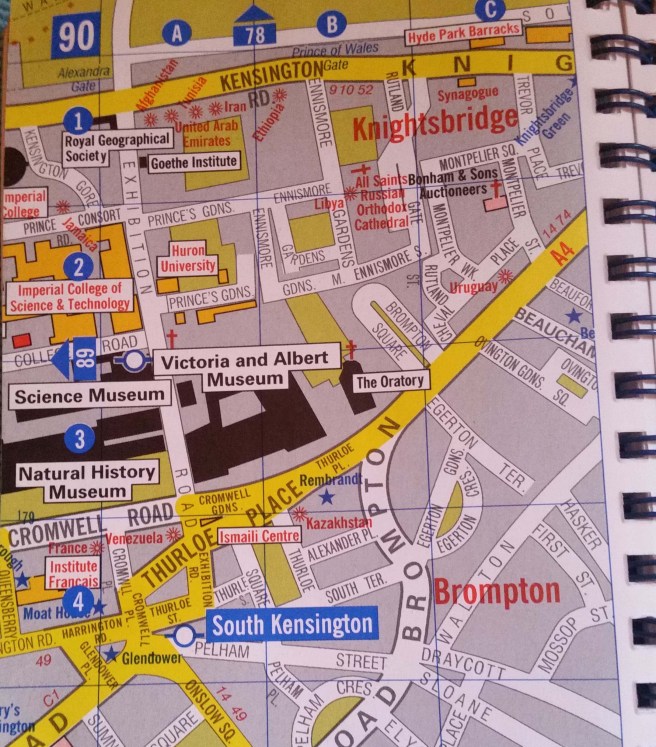
But Prince Albert would have been pleased how many school children and families visit Albertopolis.  Over 150 years ago open fields and market gardens changed when two men had a vision to develop a part of London dedicated to the arts and sciences, using the profits of the Great Exhibition of 1851 held in nearby Hyde Park. Nicknamed ‘Albertopolis’, the area was designed to celebrate the achievements and grandeur of Victorian Britain, it is still thriving today with three museums, colleges and the Royal Albert Hall.

https://www.discoveringbritain.org/activities/greater-london/walks/albertopolis.html

39613703_397479757449518_5582809189551439872_n-e1534894085854.jpg

Prince Albert’s vision for the hall was to promote understanding and appreciation of the Arts and Sciences. When he died of typhoid fever in 1861, plans were put on hold until they were rekindled by Albert’s collaborator Henry Cole. The Royal Albert Hall of Arts and Sciences was opened on 29 March 1871 by Queen Victoria. Albert’s very ornate statue sits across the road in Kensington Gardens. The design of the Hall was inspired by Cole’s visits to ruined Roman amphitheatres and it was originally intended to accommodate 30,000 people, reduced to 7,000 for financial and practical reasons, and today to around 5,500. Every summer it is the main venue for the BBC Proms, the world’s greatest music festival, which surely would have pleased the prince.

39799723_488185681646015_9009656414120968192_n.jpg

Even if you have never been to London, the building will be familiar if you watch The Proms on television; a good way to enjoy the concerts as you get to meet musicians and find out about the music. There is something for everyone from ‘Cuba meets Jamaica’ to the first appearance of the Estonian Festival Orchestra founded in 2011. Premiers of new music are bundled in with old favourites so no one will be scared off. You will learn to interpret the words of the commentators; ‘what an amazing sound picture’ – no tune – ‘especially commissioned work’ – it’s only five minutes long…

But you can’t beat a live performance. I must confess I have never queued for cheap tickets on the day to stand in the arena with the Promenaders. I have not lived near enough and don’t like queuing or standing, is my excuse, but enthusiasts will tell you it is a wonderful experience and some go to every concert. If you are booking seats, all you need to know is don’t book the cheap seats near the top if you want to hear your favourite pianist or violinist  – the soloists look like tiny puppets going on stage. But if you are going to hear a big symphony or the Planet Suite, sit wherever you like, it will be fun. If you want to go on the famous Last Night plan well ahead and check how the ballot system works.

What are your museum memories? Have you been to The Proms?

Silly Saturday – Strange Species

27835424_1971591706203943_476442722_o

Is your computer safe?


DSCN1365Are you safe?

DSCN0953

Or are you having flights of fancy?


DSCN4584Who’s at your window?

P1100878… at your door?

P1070881

…or in your garden?

P1070260

p1110728.jpg

Trotting by your house?

DSCN2237

In your neighbour’s garden or…

DSCN2230

…dropping by for dinner.

…and if you get the chance, don’t forget to check who has access to your computer.

p1110625.jpg