Why stay in airbnb when you can pay more for the same chance of not knowing what to expect at traditional bed and breakfast establishments? We have stayed in strange hotels and at the ubiquitous Premiere Inns, where you know exactly what to expect and we have stayed in a variety of B&Bs all over the British Isles. They are all different, that’s the fun. Some are wonderful, better than your own home. There are strange hosts and strange guests. We arrived at one place in a seaside terrace to find no one at home, the landlady was out walking her dogs.
But my most embarrassing near disaster was the second night of a holiday to Scotland with my daughter, sister and sister’s friend. This part was my responsibility as I had booked us to stay at a B&B in Blackpool, owned by relatives of an in-law, we had even met them once at a family wedding. When the door opened we were met with blank expressions, they didn’t seem to recognise us, let alone be expecting us. They weren’t, the booking had been forgotten, but that wasn’t the worst, the ceiling in one of the guest rooms had just collapsed.
All was not lost ‘I’ll pop across the road and ask the boys’ said the lady of the house. And so we found ourselves at the superior Hotel Babylon with delightful landlords Craig and David who kindly charged us only what we would have paid. The bedrooms were very swanky with red nets draped from the ceiling in one room and similar pink decor in the other. I’ve just looked them up and they are still in business, so if you are going to Blackpool I can recommend Hotel Babylon.
Our stay at the weekend was in a guest house in Hythe, Kent, a lovely old house with beautiful gardens. Satnav got us there, but the usually available private parking, a small triangle of gravel at the back of the house, was blocked with a huge horse box and a couple of cars. Further up the steep hill we found a side road. We then slid back down the hill, with our luggage, on a pavement carpeted in wet autumn leaves. A car was backing out of the guest house; it drove back in and a woman half climbed out, we assumed she was our hostess but she said ‘Mother will look after you’ and drove off.
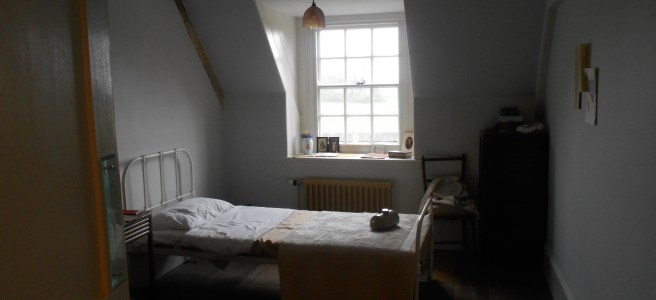
At the back door we were greeted by an elderly lady who showed us into the hall and up to the landing; all the walls were covered in shiny silver flowery wallpaper. Upstairs everything was a pink time warp and the three rooms and guest lounge were named after Winnie the Pooh characters. In our room there was a 14inch television perched on the dressing table with lots of interference, but there was WiFi. The For Sale signs we had seen outside did make us wonder if the place was being gently run down.
We left from the front door to find somewhere for dinner, but as it was dark by then the descent of the uneven, steep front path was an adventure.
At breakfast four guests were seated at the other table, we were all sitting in the hall and the daughter and granddaughter wandered back and forth in their dressing gowns with mugs of tea. The other guests asked the elderly lady if she ran the place by herself.
‘Oh yes, I’ve been doing it for forty years’ she answered cheerfully as she brought us tea and coffee; no pots, the cups rattled in their saucers as they shakily descended to the table.
As we left on the second morning we asked if the place was for sale because she was retiring.
‘I am 82, so I suppose I’ll have to retire sometime, but I don’t want to.’
Visit my website ‘Travel Notes From a Small Island’ if you enjoy looking at other people’s holiday snaps and want to read about some very different places.
As I sat reading a book I felt and heard the reassuring rumble of the underground. But I was not on a London tube train, Mum and Dad were in the kitchen next door washing the dishes. We were in our little suburban house in Perth, Western Australia.
It was 10.59am, a bank holiday on the 14th October 1968, we had just experienced the Meckering Earthquake, my mother said she had to cling to the kitchen sink. The small town of Meckering was 130 km away in the wheat belt, the 45 second earthquake was magnitude 6.9 on the Richter Scale making it one of the largest recorded in the seismic history of Australia. A few buildings in Perth were damaged. A baby had a miraculous escape in Meckering, their town fell down, but no one was killed. Had the epicentre been in a big city it could have been a major disaster. For us it was exciting, proof that Man cannot control nature.
At school the next day the earthquake was the only topic of conversation. In the classroom we were all startled to feel an aftershock, this time we knew what it was and we were scared. The teacher told us to calm down. There was no evacuation or talk of emergency procedures. It was unlikely the one storey asbestos building would collapse dramatically.
Fast forward to December 1974, Knightsbridge, London; I had a Christmas job as a floorwalker in Harrods toy department. It was the Saturday before Christmas and that afternoon I had the last tea break. The staff restaurant was on the top floor. As I stood in the Ladies combing my hair I heard a muffled thud and assumed it was an IRA bomb going off somewhere else. Of importance later was the fact that I had my handbag with me.
I walked out to see the busy shop deserted, the escalators switched off and a couple of security guards annoyed to see me still in the building, everyone else had been evacuated. Somehow I caught up with colleagues as we poured out of the building; it was only as we looked up and saw thick black smoke pouring from the corner of the iconic department store that the shock hit us. No one was hurt that day, the heroes were the staff who had noticed something suspicious in their department and evacuated customers safely. Heavy fire doors had contained the explosion. Once again I had had a wide escape. We sat in a nearby pub waiting to go back in and fetch our coats, but nobody would return to work that evening. Lucky for me I had my handbag with my season ticket for the train, even if the journey home was a bit chilly without my coat.
News is with us in all the media twenty four hours a day and this year fire, flood, hurricanes and earthquakes have been regular events and of a magnitude hard to comprehend. We wonder what it is like to be at the heart of a major disaster. Reporters find their way to the most unreachable scenes of devastation only to ask victims how they feel.
Back to Perth, Western Australia, when my fourteen year old self was riding her bike. The suburbs were laid out in a grid design with long straight roads, there was a ‘Give Way To The Right’ rule, logical as long as everybody obeyed; there were always accidents at intersections. I was pedalling towards a corner when suddenly two cars collided in front of me, one of them rolled over. The two young drivers clambered out with some difficulty, but both were laughing, unhurt. When I tried to get back on my bike my legs were shaking so much I couldn’t lift my foot onto the pedal. I have always wondered if everyone benefits from adrenalin when faced with real peril, or if some people turn to jelly. How many writers secretly long to be in the midst of a disaster and emerge unscathed, or just a bit hurt so they can tell their dramatic story from a comfortable hospital bed?
Our family’s migration to Western Australia inspired my novel Quarter Acre Block – only 99 pence on Amazon Kindle, also available as a paperback.
I hadn’t read the previous novel about Kate, so knew nothing about her, but Kate knows nothing about herself either when she wakes up. This is a thriller with no heroes, the Snowman is desperate to help her and it seems at last he can, but it is not to be. If this was a television thriller the Snowman would save the day, but the story becomes more complex. We follow the killer’s thoughts as well as the other main characters, an advantage of books over screens. The reader will never sympathise, but we might comprehend what’s going on in Jack’s mind. Michael is another character who we think might save the day, but he is a mix of flaws and must face up to the grief he has caused the woman he loved and the other woman who loves him. This is not a novel for the faint hearted; what starts as a mystery of unconnected murders is also the story of those unfortunate enough to be in the path of a killer or know his intended victim. We know from the news that bizarre killings can occur when a murderer becomes obsessed and this murderer is obsessed with Kate.
I downloaded this novel onto my Kindle as it sounded fun and we have relatives who have become DFLs* on the Isle of Thanet. But this is a story that would make an enjoyable read for anyone with family or lively family as neighbours. Whether you are married, divorced or thankful to be single, the lives of Tess and her family and friends will probably sound familiar. The story bowls along, with prospects of romance dashed at every twist and turn and plenty of modern life problems.
*‘Down From London’ – a good train service from St. Pancras, lower property prices and the seaside have made the Isle of Thanet, Kent a popular choice for workers needing to commute and also artists and entrepreneurs.
How do you watch television these days, perhaps not even on a television set? But drama serials are still ever popular, whether we sit down each week, catch up digitally or binge watch. I like the idea of the TV schedule, but inevitably if we’re out or have visitors I am thankful we can record or catch up. PAUSING programmes is also a brilliant asset as my good intentions to leave the computer or the kitchen by 9pm always fail.
There have been so many good dramas lately we have some still to watch. My two recent favourites were very different.
Vanity Fair by William Makepeace Thackeray is a long novel that many people on social media have confessed to not having read. But with a film and at least four television adaptations we can be forgiven for not being sure if we have actually read the book. BBC 1967, 1987 and the one I remember really enjoying was a few years ago – no it was 1998! So how would ITV’s new production compare?
Thackeray, played by national treasure Michael Palin, took his rightful place as the narrator at the beginning and end of each part; he watched his characters go round and round on a carousel.
The story starts in 1813 England, a turbulent society embroiled in war for twenty years. Thackeray introduces a world where everyone is striving for what is not worth having. The impossibly smart red and white soldiers, beautiful women, lovely horses and clean streets were not out of place because he wanted us to watch his characters in a performance. The battle field sequences contrast with this.
Becky Sharpe has nothing, but is determined to have everything, whoever she hurts on the way. We are whirled through years of love, heartbreak, family troubles, business disasters and tragedy with one love story ending happily.
BBC4 on Saturday nights is a must if you love Scandi Noir or anything with sub titles. We have followed Danish politics, Swedish thrillers, Sicilian detectives, Paris police, Belgian undercover in French and Flemish, but most recently it has been Outback Noir.
Mystery Road in six episodes, was filmed in the Kimberly region of north Western Australia. Having lived in Perth, Western Australia and with family there, I try and watch any Australian series that come our way. I have never been to that part of the state, another country to suburbanites in the city. The series was worth watching for the scenery alone, wide landscapes of dusty red soil and long roads, a fascinating country town and a cattle station homestead that makes you yearn to live somewhere with endless space. A great cast did justice to a complex story linking past and present with layers of secrets. The old landowning family, the indigenous people and European backpackers all find their lives bound together in small town life.
So Lar looked over the plains; how many had passed this way over the years? Weary bodies, bent limbs and always murmurings of revolt, lives lost as well and for what? Tomorrow would demonstrate what this had all been for and So Lar would be proved right. A new age of enlightenment would begin on the longest day as the Sun bestowed His blessing. Of course it was hard for the workers to see what they and their fathers and forebears had been labouring towards, what So Lar’s father and grandfather had dreamed of, knowing they would never see the day when it was complete.
The old pagan beliefs would be buried for good and they would look towards the one true God, the Sun God. But as the long warm evening began to fade into twilight So Lar had the first misgivings, dark clouds rolled over the indigo sky. When night had fully set over the plains the moon could not be seen, not one single star could be seen. Without clouds there would be no rain, man and beast needed rain, but not tomorrow…
There was no sleep for him that short night; most souls in the camp were sound asleep, trusting the night watch to wake them in good time for the revelation So Lar had promised at dawn. If the blanket of cloud was not drawn back then they would not see the first rays shine through the entrance of the temple of knowledge.
Blackness turned to grey, dawn had arrived, but not a glimmer of gold could penetrate the dark clouds. They surrounded So Lar now, angry and afraid. Rab the trouble maker spoke.
‘So much for your Sun God, we have angered our gods, desecrated their sacred plains, your stone temple is a terrible scar on the landscape that should be torn down. The gods will not let your weak sun god shine until they are appeased.’
So Lar lay bound inside his precious circle. These people would never be enlightened, would never understand how the heavens and earth worked without the need for human intervention. They still thought blood needed to be spilled, that he must be sacrificed if the sun was to shine again.
When you are on Staycation you will visit places after breakfast that others have crossed the world to see. We had not been to Stonehenge since the new visitors’ centre was built, out of sight of the World Heritage Site. The A344 which previously enabled motorists to ‘come across’ Stonehenge, but also intruded on the peace of the past, is now used solely by the fleet of buses with destination The Stones on the front.
If you belong to English Heritage or the National Trust entry is free. You can hop on the bus or walk; divert off the road through chalky fields to enjoy the peaceful scenery of Salisbury Plain. There is nothing at the stones now so make sure you avail yourself of the visitor centre toilets and take a bottle of water.
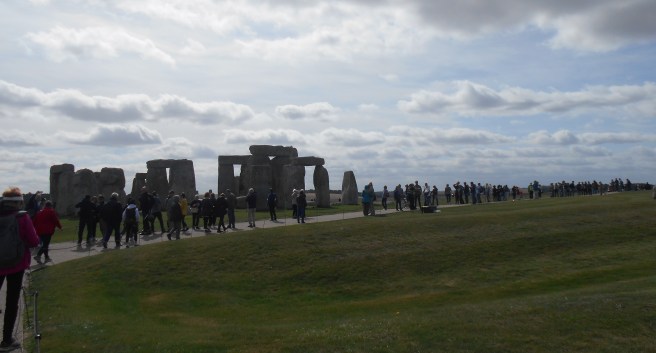
On a Monday morning, with school holidays over and the website stating timed tickets were not needed, we thought it would be quiet. The lady at the booth issuing our free tickets said it was very busy as several cruise ships had come in; this presented a strange vision.
It was almost a pilgrimage, Pilgrimage Lite perhaps. We set off at a brisk pace, overtaking lots of people and hearing various languages, we’re British, we can walk fast…
We started to anticipate the moment when Stonehenge would be revealed; round the next copse or over the next brow? Alas, the first view was partially blocked by the ubiquitous buses and queues of people. Queues waiting to have their tickets checked and file between the ropes to the stones, even longer queues waiting to get back on the shuttle bus.
Only a low rope separated us from the stones, creating enough space inside the circle to imagine how they were when they stood alone. A young Canadian tourist asks to have his photo taken, with the toy penguin that is to accompany him on his trip round Britain.
We ask a tour guide where she’s from.
Portland
USA?
No, Dorset…
She had come to meet passengers who had left their ship at Dover and been coached to Wiltshire.
But the tourists that morning were not rushing and ticking off another place visited, they were in genuine awe that they were really there looking at an ancient construction no one can explain for sure.
This year marks one hundred years since Stonehenge was given to the nation.
On 26 October 1918, Stonehenge was offered by Cecil and Mary Chubb as a gift for the nation. Cecil Chubb had bought Stonehenge for £6600 at a local auction three years previously. Prior to 1918, the monument was propped up with wooden poles and some of the stones were in danger of collapse. Increasing numbers of visitors through the late 19th century had led to damage, with people regularly chipping the stones for souvenirs and scratching their names on the monument.
The first guidebook in 1823 claimed Stonehenge survived Noah’s flood. We do know the stones came from South Wales, that is part of the mystery, how they got there. Stonehenge was built between about 3,000 BC and 1,600 BC and its purpose remains under study. What is certain, if you stand in just the right place inside the monument at the summer solstice, facing northeast through the entrance towards a rough-hewn stone outside the circle, known as the Heel Stone, you will see the sun rise above the Heel Stone.
The ground floors of department stores are bright, white and overpower you with a nauseous mix of perfumes. On board the yacht I have a stomach of iron, but I was not looking forward to hunting for my sister’s favourite perfume.
A young man, with more make up than the girl assistants, came skillying up.
‘Good afternoon Madam, may I help?’
For a moment I was so fascinated I could not answer. He looked like a beautiful slender doll, high cheek bones, rosebud lips, hair spiked immaculately and dressed totally in black. His charm was enough to make me, in my jeans and anorak, feel I was as entitled as any other woman to grace these hallowed halls of beauty. He laughed when I confessed my predicament. I had forgotten the name of the perfume.
‘Can’t you phone or text her?’
‘She’s just started a three hour exam and I’ve got to get back to the harbour while the tide’s high.’ I looked at the shelves full of elegant boxes, none of the names jogged my memory.
‘Treat yourself instead; what do you miss most out at sea?’
‘Flowers?’
I was talked into buying an expensive tiny bottle.
In my cabin I cautiously removed the delicate stopper, sniffed and was transported to a walled garden I had visited as a child. A summer scent never recaptured until now. How was such a scent created? How did the young man choose so perfectly?
We visit Winchester Cathedral quite often; this time we had been told about the flower festival. After a late breakfast at Wetherspoons we sauntered down the road to the cathedral. It was a week day so we weren’t expecting to see a queue to get into the cathedral, but a flower festival by definition can only last a short time.
It was worth the wait; it was a flower festival like no other I have ever seen and the rich colours cannot be conveyed in the pictures. What can be shown is the crowds. There were a lot of very English,’ excuse mes’ and ‘sorrys’ as we all tried to take photos or stay out of the way of other people taking them. Winchester is very light inside and gazing up you could forget you were not alone.
The rich reds, blues and purples reflected this year’s theme which was inspired by the Winchester Bible.
The Winchester Bible is the largest and finest of all surviving 12th-century English bibles. A single scribe wrote out its text in Latin, while artists worked its exquisitely illuminated capital letters. Their glowing colours, including gold and lapis lazuli, are as intense today as 800 years ago.
We have never seen the Bible. On a previous visit, hoping to see it, we were informed with great satisfaction by an officious lady that the room where it was kept was closed that day! This time we could have queued to see one volume in a temporary exhibition, but made the decision to queue for the crypt.
Down here, often standing in water, is Antony Gormley’s statue. Cyberspouse got a picture years ago when he pushed open a door that was ajar to see where it went; that time the statue was a complete surprise. This time the surprise was to see a candlelit path to the man with cupped hands.
On staycation you visit places for the day that others may have travelled across the world to see. We chatted to a couple who had come down from the North, but had the convenience of a son-in-law who worked at the cathedral and lived in the cathedral close, so they had free delightful accomodation and the opportunity to look round when everyone else had gone home.
In my novel Three Ages of Man the stranger has never seen anything as old and solid as a cathedral and marvels as he lays his hands on the stone walls of Winchester Cathedral.
Salisbury is a small city where we used to think not much happened. It lies in the county of Wiltshire, where you might think not much has happened since Stonehenge was built. Salisbury is a city because it has a cathedral. It is not large, but it is busy with a hospital, university and many places of interest to historians and tourists.
Since March this year it has been in the international news with the poisoning by novichok nerve agent of two Russians and a local policeman. Just when Salisbury was getting back to some normality there was the bizarre tragedy when two locals were taken ill and one became the first fatality. Two Russian suspects have been named and even appeared on Russian television to explain they visited Salisbury merely as tourists to see the cathedral with its famous spire and the oldest clock in the world.
You couldn’t make this story up; if these two men were ‘secret agents’ they certainly bungled the whole mission, their target was not killed, though he and his daughter only survived thanks to the National Health Service and skilled care. Before leaving Salisbury they dumped the novichok in a rubbish skip. Through all these months, parts of Salisbury have been closed off and scoured for any trace of the nerve agent, a nightmare for businesses expecting a busy tourist summer.
We quite often go to Salisbury and went there last week after our morning at Stonehenge. Everywhere seemed busy, but perhaps they were locals.
I can believe the two suspects didn’t find the cathedral; though the famous spire can be seen for miles around, the first time we visited we stood in the main square and could not see it, we had no idea which way to go.
Through an arch you will find yourself looking at the cathedral green; fine weather shows the scene at its best. This area is full of interesting houses and museums and the expanse of grass is ideal for children to run and play and school parties to let off steam. There is too much for one visit, but whatever your plans just stand by yourself and look up at the spire.
The refectory, cloisters and smart toilets are free to wander in. Do you pay to go in the cathedral? There is a suggested donation. On our visit, late in the afternoon, I was just trying to read what we might ‘kindly be asked’ to pay when I realised Cyberspouse was already inside. We may have accidentally followed a coach party in. The house of God should be free to enter, but cathedrals need constant loving and expensive care. We always buy our refreshments at the refectory and there is a nice shop for tourists.
Cathedrals can be overwhelming, I guarantee most of us do not remember all the saintly and royal details in the leaflets. Take in the ambience and spend time with what takes your eye. Highlights include the clock, perhaps the Russians wanted to steal our cutting edge technology! Look carefully down the nave and see if you can spot the columns bowed at the centre of the cathedral under the weight of the spire. A model of the spire shows the original wooden scaffold still there. Another model shows the cathedral being built; I had a nice chat with an American lady as we admired the model and the original builders. The biggest miracle of ancient buildings is the fact they are still standing and I love to wonder if those who built it could have imagined how far into the future their creation would be admired.
Cathedrals are living places and new art is added. I love the font, sculptor William Pye, consecrated in 2008.
On our brief stroll around the cathedral Cyberspouse met a woman from Iceland, tourists are still coming to Salisbury.






 Times and Tides of a Beachwriter