We are celebrating the return of the Bayeux Tapestry with Norman Day. If you recall from a previous blog a French guardian of the tapestry was taken completely by surprise and horrified when he heard President Macron casually come out with the news that the tapestry was going to be sent to England – back to England as it was made here. A grand gesture of friendship.
A recent visit to France by the King and Queen.
There were great fears the whole thing would fall to pieces, hence the monumental planning that went into the mission. A new home was created for it at the British Museum. The French requested it be displayed flat lest the characters we have come to know so well succumb to gravity and fall off the pictures. Apparently it had been hanging up and went round a corner, not ideal.
It arrived safely and now is finally ready to be displayed to the public. King Charles, President Macron and our latest Prime Minister had a private viewing last night. It tells not just the story of the Battle of Hastings, but the stories leading up to the invasion.
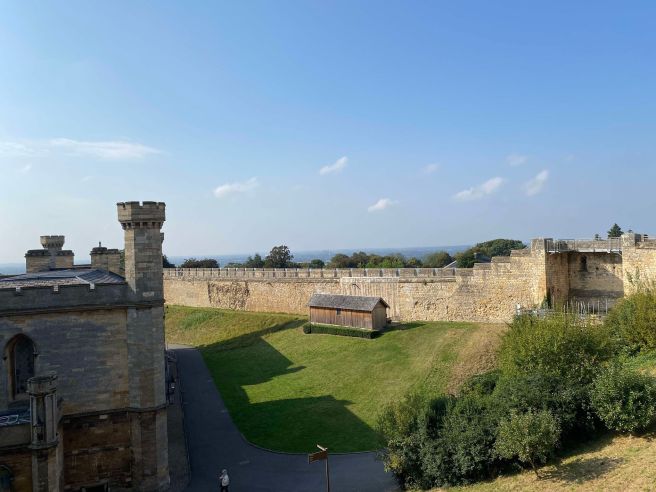
Lincoln Castle, hundreds of local homes flattened to create wonderful views and a great castle and a display of Norman power.
Norman Day on BBC Radio is featuring lots of programmes perhaps with the theme ‘What Did The Normans Ever Do For Us?’ A lot, but that’s for another blog. Salient points, they were not French, they were Vikings. They inherited plenty of culture from the Anglo Saxon including… here we come to the exciting bit, this great work was created by Women! What can be more civilised and peaceful than a sewing circle and this must have been a Sewing Circle writ large. As men continued fighting over the past millennium this remarkable piece of history survived.
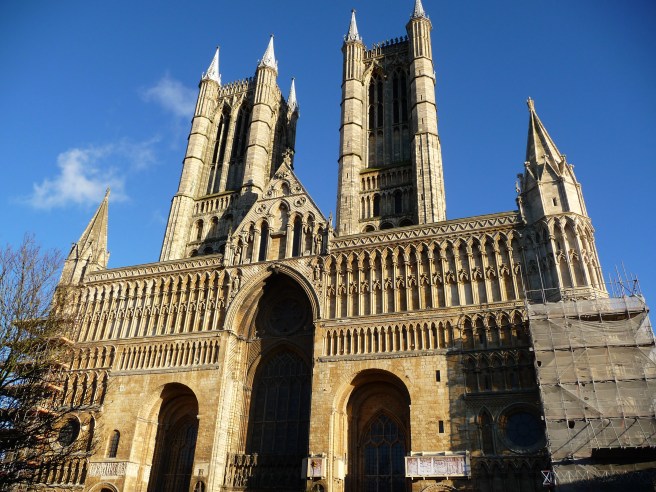
Lincoln Cathedral shares the historic quarter of Lincoln with the nearby castle. Castles and Cathedrals are a vivid reminder of the Normans changing our landscape.
And what has been going on in the rest of the world? A lot, but let us zoom out and leave our troubled planet for a moment. I like to liven up housework and cooking listening to radio programmes with intelligent presenters talking to very intelligent guests about their lives and important things other than politics. I always forget names, probably just as well in case I misquote, but the gist of one conversation was this… The guest had been a cosmologist, but one day she realised that the universe was actually very boring, just piles of rocks floating around, so she decided to study our planet instead, which is far more interesting. This led me to wonder if the creation of the whole multiverse had gone drastically wrong, with Earth accidentally evolving against the odds?
Have you ever seen the Bayeux Tapestry or even better, been part of a sewing circle that created a wall hanging?
Would you rather study the whole universe or potter in your garden?
Tides are a fascinating phenomena. I first became aware of them when I was eight and we had a fortnight’s holiday in a converted train carriage in Wittering, West Sussex. Mum and Dad obtained a tide timetable so we could visit the beach at low tide when the sand ( sand flats perhaps a better description ) appeared and we were safe in the shallow water. My parents sat on the beach with a rug over their knees and no intention of going in the water. At high tide we abandoned the pebble beach for cultural pursuits such as visiting Chichester Cathedral. Staying for a fortnight illustrated the fact that times of the tides changed slightly every day, for reasons I still don’t understand, but the Moon is involved. So a typical holiday agenda would be beach in the morning first week and by second week, beach in the afternoon.
Tides are at their most interesting when islands are involved, islands close enough to walk to at low tide, with the additional excitement of perhaps being stranded or washed away on the incoming tide. At Saint Michael’s Mount in Cornwall you can walk across a stone causeway or have a boat ride at high tide. By the time you have finished exploring the little rocky island the tide will probably have turned and you will return by the opposite method to your arrival. The Saint Aubyn family still live here and manage it with the National Trust. On arrival you can follow a steep path winding up to the castle. The harbour village has a shop and café. This is my favourite island, what fun to enjoy living on an island, while still being able to pop over to the mainland for your shopping. I love the sub tropical terraced gardens and the castle is very homely, just the sort of little castle I would like to own.
We have also been to the mother ship, I mean monastery, Mont Saint Michel in Normandy, France. This island is on a larger scale, full of restaurants and tourists. You can walk all round the island at low tide and there are lots of photo opportunities. In more recent times no cars go over the causeway. There is a visitor centre with car park and a free shuttle bus across the causeway, or you can take a horse and carriage or walk. The tides vary greatly, at roughly 14 metres (46 ft) between highest and lowest water.
If you have ever travelled on the east coast railway line to Edinburgh you will have been treated to views of Durham Cathedral high above and the Newcastle bridges, but also you can look across shimmering seas to the Holy Island of Lindisfarne. I instantly wanted to go there and we finally made it on a Northumberland holiday which included other great sights such as… you will have to wait for another day to find out.
The island has a causeway which you can drive across, though you leave you car in the car park to enjoy the peace of the island. Saint Aiden came from the holy Island of Iona on the west coast of Scotland to found an abbey.
When we visited, a bride was being driven across in a carriage pulled by black horses, she was being married at the castle. We wondered if the wedding guests would all get off the island again before high tide.
‘Warning signs urge visitors walking to the island to keep to the marked path, to check tide times and weather carefully. For drivers, tide tables are prominently displayed at both ends of the causeway The causeway is generally open from about three hours after high tide until two hours before the next high tide. Despite these warnings, about one vehicle each month is stranded on the causeway, requiring rescue by HM Coastguard and / or the SeahousesRNLI lifeboat.’
Tidal fun doesn’t have to involve an island. We once had a holiday on Grange-over-Sands railway station, Cumbria. The working station also had part of the building converted to a cottage, it was surreal hearing trains go through in the middle of the night. Grange-over-Grass might be a more appropriate name as at low tide sheep were put out to graze, then sheepdogs rounded them up before the incoming tide. The station looked out over the vast stretch of Morecambe Bay. I have looked this up and can’t find holiday accommodation listed for the station or any mention of sheep. Did I imagine the whole thing?
You can walk across the bay at low tide, it’s a long way and the Morecambe Bay sands are renowned for their quick sands and fast flowing tides. Crossing the sands has always been dangerous. The King’s Guide to the Sands is the royally appointed guide to crossing the sands.
We did not try that.
What is your favourite island and more interestingly, have you ever been stranded on one?
My guest today is one of our local authors, Greg Duncan.
J: Greg, you have recently published a historical novel with the intriguing title Champagne in a Broken Teacup. What’s the book about?
G: Without giving too much away, here’s a short summary I wrote for Amazon.
In the spring of 1940 recently married Marie-Claire is blissfully pursuing her career as a freelance artist in Paris. She has no idea that in early May Hitler’s armies will invade France and rip her life apart. In the book we follow her life as tragedies strike and she is forced to flee Paris to escape from the Gestapo. Using a false name and identity she begins a new life in the small provincial French town of Nevers. She finds unexpected inner strength as a resistance worker but her previous life in Paris catches up with her.
J: What inspired you to write it?
G: As a young boy growing up in Canada I was fascinated by the stories I was told about my French aunt. During WW2 she was an art teacher living in the small French town of Nevers where she became a document forger and fighter in the French resistance. As if that wasn’t fascinating enough for a young boy, even more exciting were some of the stories of her escape from the Germans.
Fast forward several decades to the time I retired and started to focus on my interest in writing and inevitably the stories of my aunt’s adventures came to mind. However, I realized I didn’t know enough detail about her life to turn it into a stand alone story and unfortunately she had passed away many years earlier. I decided I needed to find out more about the world she would have lived in and what life would have been like for her in occupied France.
Mare-Therese Pellissier 1949
Thanks to the internet and the digitization of many documents I was able to find out far more than I expected. I found it quite moving to be able to read the very newspapers my aunt would have been reading nearly a century ago. I was even able to look at copies of leaflets that the RAF dropped over France during the war – leaflets that my aunt would have picked up in the streets of Nevers and read. I was amazed to find out that the RAF dropped over 640 million such leaflets over France.
Like most of us I had been taught about the big battles and political aspects of the war but virtually nothing about the lives of the ordinary citizens. As my research progressed I became more and more fascinated reading about the things which affected people’s daily lives and the things they did to fight back against the German occupation. I decided that what I wanted to do was write a fictional novel that incorporated the stories I’d been told about my aunt interwoven with historical reality.
J: How much of the novel is true and how much is fiction?
G: That’s a good question. In one sense, being a fictional novel my characters are fictional. On the other hand some of the events included in the story are portrayals of events which involved my aunt – but obviously I can’t tell you what they are right now as that would give away too much of the plot. What I can say is that the picture on the back cover of the book, of German soldiers in the rain, was actually drawn by my aunt in Nevers in 1941 when she was a resistance forger. It is one of the few things I have of hers. It hangs on the wall beside my desk and helped inspire me to write the book.
The historical events mentioned in the book are real as I wanted my characters to react to the actual events of the time. Although a lot of what my characters experience and do may not have happened to my aunt they are based on my research and on true stories of what people actually did in the resistance at that time.
J: Did you spend a long time doing the research?
G: Yes, and I enjoyed the research almost as much as writing the book. I became engrossed in reading about such things as forging techniques, rat bombs and pencil detonators as well as more dramatic activities such as derailing trains and blowing up fuel dumps.
I was also fascinated by the small details I discovered during my research which I’ve never seen in a history book. For example, the fact that within six weeks of the fall of France the newspapers reported that it was now illegal for bakers to make croissant or brioche.
J: Illegal for the French to make croissant?
G: Yes, at first I thought the report might be some sort of joke by the newspaper, but thanks to the internet I was able to access and read the actual regulations issued by the Vichy government..
Also thanks to the internet I was able to research locations in Nevers. I even found a 1940’s picture of the steps of the Rue de Calvaire – a place which plays an important part in the story.
Nevers 1940 Rue de Calvaire
J: Tell me about the title. It’s so unusual.
G: The title is critical to the story so I can’t tell you too much about it. All I can say is I needed a title which would be unique and yet fit in the plot as plausible.
J: I enjoyed reading your novel and gave it a five star review on Amazon as a ‘cracking good read’. What have other people said?
G: I’ve had a lot of positive feedback. In fact several people have said the whole story would make a great film.
J: I agree. And before you go, that important question. Where can people get a copy of Champagne in a Broken Teacup?
G: The book is available via Amazon as a paperback, a hardback, a Kindle eBook or via Kindle Unlimited. Our website https://www.kenebec.com?d has a direct link to Amazon for this book and our other books.
I’d like to thank you for asking me to talk about Champagne in a Broken Teacup. I’m not sure how many of your readers are local but if they’re interested I’d just like to add that I’ll be giving a talk about the research behind the book in June at the Sturminster Newton Literary Festival.
Thanks for coming along Greg and good luck with your book sales and festival talk.
This is a cracking good story and a very well written novel. Paris under German occupation in World War Two is the setting. This is history, but the novel goes far deeper than the classic black and white photographs of German soldiers marching past the Arc de Triomphe. The author takes us into the lives of happy young newly-weds and their friends. This novel is inspired by the author’s aunt who worked for the resistance and is backed up by careful research. Far from being a dry recounting of the times, we are soon wrapped up in the lives of young and older Parisiens determined to fight for their country as violence and the death of friends and family becomes a reality. The Germans are not the only enemy as informers and traitors make it impossible to know who to trust, keeping us in suspense in every chapter.
It’s never a good idea to wander through a writer’s mind, especially on a Monday.
Do you rush round cleaning and tidying when the in laws are coming, are you nervous when important visitors are expected? Spare a thought for President Macron who had to cancel the visit of King Charles III as the place was in too much of a mess…
Most of us worry about the cost of running our homes. This is nothing new. We are reading Jude the Obscure for our book club. Jude and Sue are going for a very long walk on the wild heathlands of Wessex and with no coffee shops in sight and poor Sue getting weary, they call at the only cottage for miles around. They end up sharing the mother and son’s dinner and staying the night. In conversation the cottager complained she will never get her roof fixed because the price of thatch has gone up so much.
Yes, I’ve been to the Giant gallery again.
I’ll leave readers to comment… while I take a wander down to the beach.
We have been to Saint Michael’s Mount in Cornwall, how different could Mont-Saint-Michel in Normandy, France be? Just a bit bigger? In Cornwall you know you walk across the causeway at low tide and go by boat at high tide. The bay of Mont-Saint-Michel experiences some of the largest tides in Europe, but the island is not surrounded by the sea every day; it’s far more complicated than that, depending on the movement of heavenly bodies and other factors. All the tourist needs to know is that you can go on guided walks across the vast low tide bay, but you certainly should not go alone. For the photographer the scene is ever changing according to the weather and the tide; the island itself is fascinating with so many buildings, narrow alleys and winding flights of steps clustered below the abbey.
Mont-Saint-Michel is a World Heritage Site and experiences huge tides of tourists. Recently, changes have been completed to preserve the ecology of the area and cater for tourists. Le Barage across the river controls the flow of water into the bay while a big car park and tourist centre, a safe two and a half kilometres from the island, controls the flow of people. Free shuttle buses go endlessly back and forth till midnight or you can take Les Maginotes, carriages pulled by pairs of draught horses. It is also easy to walk along the causeway and the boardwalk bridge, a pleasant stroll past grazing sheep, salt marsh lamb acclaimed for their meat.
Back at tourist base the roads all have barriers, ‘rue impasse’. The effect is to feel you are on a campus; hotels, restaurants and campsite all quiet and traffic free except for coaches bringing tourists. In contrast to the melee of mixed visitors were the neatly controlled groups of Japanese tourists and lively groups of school children. The few days we were there we saw an endless procession of school children being marshalled for the walk across the bay, followed by picnic lunches on the island; evenings in restaurants we sat with Americans, Canadians and Australians while the Japanese were still in their regimented groups. Perhaps none of this was ‘real life’, but the whole tourist experience was well organised, pleasant and stress free.
Even in October the island was packed, people walking, eating, drinking and filing into the abbey. We gathered on a wall with many others to watch the tide creeping in and laugh at teenage boys vying to be the last standing on a rocky outcrop. The top terrace of the abbey had the best view out over the bay and back across the way we had come. Those who work on the island in catering must be constantly busy; for those who live here their homes are unique, but they must be constantly stared at by tourists such as myself, trying to peep in their front doors as they unlock them or peering down into their tiny gardens.
Writers can take inspiration; what a perfect place to be anonymous in the crowds, or elude capture if their character needs to escape. The abbey itself is a maze of stone arches and flights of stone steps, if you did not adhere to the signs and follow the correct route it’s unlikely you would get out of the building; even following the route I thought we would never get out… But we did emerge into the sunshine to enjoy coffee with a view at one of the many cafes.
For holiday pictures visit my Beachwriter’s Blog, this month ‘Ecrivaine de La Plage’.



 Times and Tides of a Beachwriter