Friday Flash Faction – Moving On

Someone’s on the move, who is it this time?

Tom again, another investigation. If they had just listened to him this could all be avoided.

Yup, he has been trying for years to tell them what really happened.

When Mary sees all this activity we’ll have to hear for the umpteenth time how she was moved from Saint Pancras.

Do you remember last year, the whole evening spoilt when Judith’s family decided it was time she moved closer to them? Wonder how she’s getting on. The last thing she wanted was to be reunited with her husband. She was so glad to come here and have some peace.

So what are we going to do this year then? We never plan early enough then it creeps up on us.

We must do something to cheer Tom up. All this investigating is going to bring back the bad memories.

Hmmm just when he was coming to terms with his situation.

Let’s all go into town, Tom won’t have to leave till the morning hopefully.

Yes a change of scenery is what we all need. Wonder if there will be much going on in town this year?

There will be by the time we’ve stirred things up, giving that Danny Robins more than enough material for his next series.

But we’ll have to start off in Mary Junior’s pub…

…and have to listen to her going on about the year with no summer and how she got the inspiration for her novel?

Yes and then she’ll get all sentimental and beg Percy to recite one of his poems.

… and one will lead to a dozen.

…and he will drift into melancholy and declare his heart always belonged to Mary and England.

At which point we will move on and see what’s happening elsewhere in town.

‘I don’t think October 31st is a very good night for doing this Boss.’

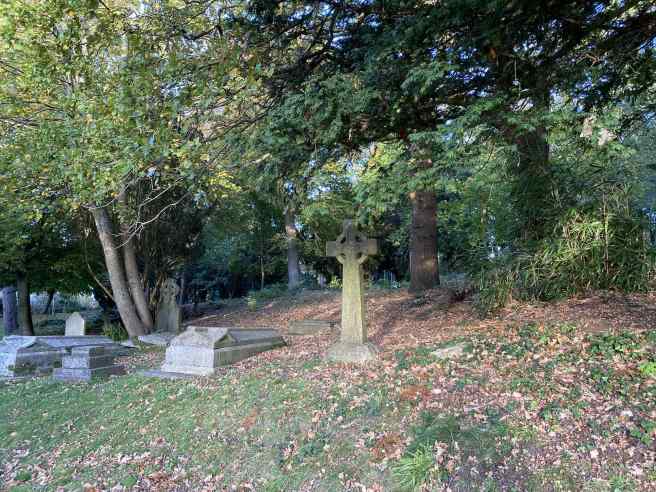
‘It’s a perfect night for exhuming a body, the locals will be keeping away from the graveyard, even if they claim not to believe in all that stuff.’

‘Why are we digging him up?’

‘His family still want answers so he can rest in peace, though he’s not getting much peace if we keep digging him up. Poor chap, last time there was no DNA, not sure what they hope to find in his bones, but that’s not our job. Ah here comes the vicar, no cracking jokes, this is hallowed ground.

 ‘I’m not laughing I’m feeling sick.’

‘You will have to toughen up if you want to be a grave digger.’

‘I did not want to be a gravedigger, couldn’t find another job. And I thought I would be burying people, not unburying them.’

‘Half the people in this churchyard have been moved from elsewhere, someone has to do it. Evening Vicar.’

‘Boss, did you hear voices?’

‘Nah just get on with digging.’

‘Vicar, did you hear that voice?’

‘Well um, that’s why I am here, to pray for any unquiet spirits.’

‘Such as poor Tom who was viciously murdered?’

‘But at peace now…’

‘Mary Wollstonecraft was buried at St Pancras old churchyard with an epitaph reading ‘Mary Wollstonecraft Godwin, Author of A Vindication of the Rights of Woman: Born 27 April 1759: Died 10 September 1797.’

‘Famously, Mary Shelley spent many hours in the graveyard that held her mother’s remains and was said to have professed her love for Percy Shelley, her future husband, there.’

 ‘Wollstonecraft and her husband William Godwin’s remains were moved in 1851 upon the request of their grandson Percy Florence Shelley, thanks to the imminent railway works across St Pancras.’

‘Today, their remains can be visited at St Peter’s churchyard in Bournemouth, where the family tomb holds the remains of William Godwin, Mary Wollstonecraft Godwin, Mary Wollstonecraft Shelley, grandson Percy Florence Shelley and his wife Jane Shelley (1820 -1899).’

 ‘Percy drowned while sailing his boat, the Don Juan, through a summer storm across the Gulf of Spezia in Italy. When his remains were found a few days later by friend and novelist Edward John Trelawny, a fire was built on the beach and he was cremated. To Trelawney’s surprise, however, Percy’s heart would not succumb to the flames. The hardened remains of Percy’s heart were plucked from the ashes and, after an argument over who would keep the remains, were eventually given over to Percy’s wife, Mary Shelley.’

Back to the 21st century  Danny Robbins presents ‘Uncanny’  BBC radio series, TV series and podcasts investigating many strange occurrences…

Sunday Salon – Nights in and a Night Out

Reviews of two very different novels and a murder mystery play by Francis Durbridge

I posted both book reviews on Amazon and Goodreads

Our Spoons Came From Woolworths

by Barbara Comyns

5 Stars

I read this as a paperback passed on to me and recommended. I had not heard of the author before.

Many of us love anything to do with the twenties and thirties; architecture, art, music and elegant young men and women capture wistfully the two decades between world wars. But we also know it wasn’t glamorous for most and for the British it was a time our parents and grandparents remember before the Welfare State and the birth of the National Health Service.

Sophia is young and naive and the novel is probably very close to the author’s own life. I love the way she tells us her story as if she was looking back and telling a friend, which indeed she does at the end. The book was published in 1950.

We have a vivid picture of life with very little money, renting rooms and sharing bathrooms. From details of what they eat to the realities of pregnancy and childbirth which will appall most women. Ironically it was also a time when new mothers who were able to afford a nice nursing home would have enjoyed two weeks of bed rest – unheard of these days! Love and poverty never go well together and being married to an artist who is never going to earn proper money is a recipe for disaster. Follow Sophia in a poignant story that has humour, very dark times and then hope.


Secrets    by Anita Dawes

4.0 out of 5 stars A deep dark look into childhood.

20 August 2018

Format: Kindle EditionVerified Purchase

I finished reading this in the middle of last night; though it is not unusual for me to turn my Kindle on in the early hours, this is not the sort of novel you should be reading in the dark watches of the night! It is a good paranormal thriller, but more than that it will make you reconsider all our childhoods. How responsible are children for what they do and what is really going on in their minds? In some ways I felt most sorry for Jack’s parents, a poignant back story gradually revealed, an event that ruined any chance of his father continuing the life he loved or his mother coming to accept their rural life. There is a lot going on in everyone’s lives, but Jackie is a reminder that those of us who have led ordinary lives cannot know what others have had to overcome. There were only a few things that jarred – I thought it was likely the social services would have got involved, Maggie did not guess an obvious pointer as Jack’s story was revealed and some dialogue and characters’ thoughts could be confusing in the pace of the story. But overall I really enjoyed this unusual novel.


SHELLEY THEATRE, BOSCOMBE.

Francis Durbridge’s  play Suddenly At Home

Thursday-Tuesday August 16-21

Durbridge won international acclaim as the creator of Paul Temple, one of the most famous of all BBC radio detectives. He also wrote nine stage plays, Suddenly At Home was first performed in 1971.

Shelley Manor

Percy Florence Shelley was the son of the poet Percy Bysshe Shelley  (1792 -1822) and Mary Shelley, author of Frankenstein.

He bought Boscombe Cottage, near Bournemouth, Dorset for his mother to live in and had it rebuilt based on the Casa Magni in Lerici, northern Italy, the last home of Percy Bysshe and Mary. He renamed it Boscombe Manor. Mary died before it was completed and Percy and his wife Jane took residence.

Sir Percy had a timber theatre built in the grounds but replaced it with the current grander theatre which opened in 1870 with a public performance. Many of their friends acted and came to see shows including Sir Henry Irving and Robert Louis Stevenson (who wrote Jekyll and Hyde in Bournemouth).

Now this lovely pocket sized theatre has been restored and is a treat to visit. The volunteers give you a friendly greeting, there is a pleasant bar and the seats are very comfortable – they came from the much hated Bournemouth Imax cinema building when it was demolished, but that story is for another blog!

Small theatres are always fun, the audience are there to enjoy themselves for a play such as this which follows in the  long British tradition of  darkly comic murder mysteries.

The London Repertory Players were at the Shelley Theatre for a four play summer season. The action was set in one room; all that was needed were a few items of furniture and several doors. Door bells and ringing phones, always at the wrong moment, kept the cast and audience on their toes and guessing till the final curtain.

http://shelleytheatre.co.uk/article.php?sec=ABOUT&articleId=3224


Frankenstein and the Forgotten

For the benefit of those who have not visited one, JD Wetherspoons are a large chain of British pubs where you can eat cheaply all day, take children and have refillable mugs of coffee. Some are in beautiful buildings with amazing toilets and we have visited them from Canary Wharf up to the top of Scotland.

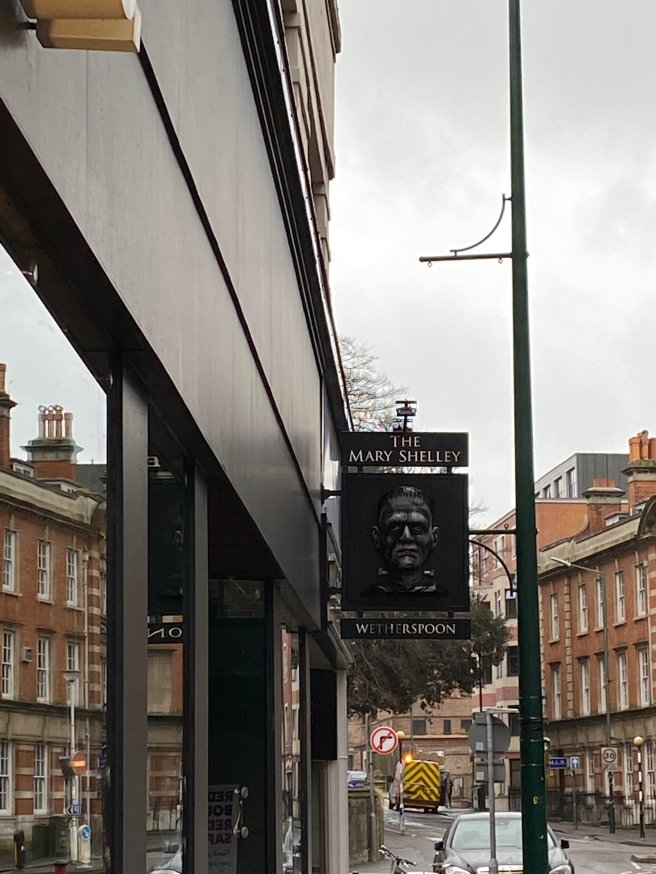
One of the two Wetherspoons in Bournemouth town centre is a former night club with nothing distinctive about its architecture. It is called ‘The Mary Shelley’ and I wonder what a famous authoress and wife of a great poet, would have thought had she known she would end up as a pub, as a result of her final burial wishes.
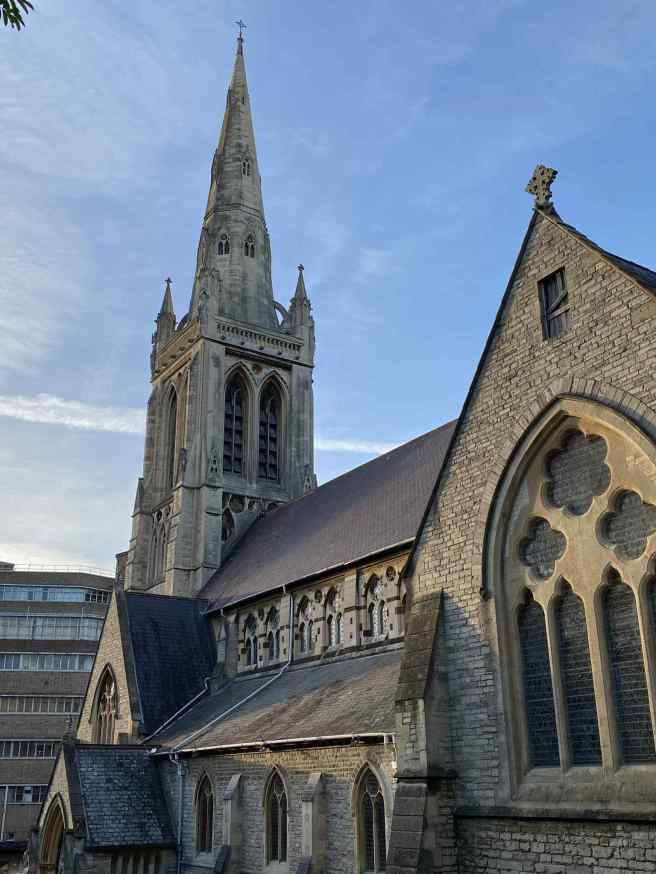
The pub faces the lovely St. Peter’s church. Bournemouth celebrated its bicentenary in 2010, the church was consecrated in 1845 and was rebuilt from a little rustic church to boast the towering spire it has today.
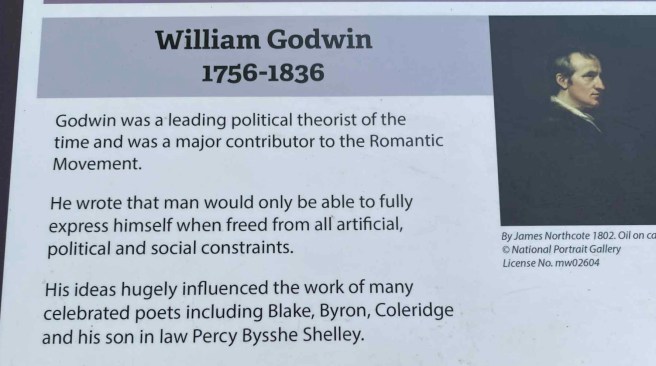
Mary was the daughter of Mary Wollstoncraft, writer on women’s rights, who died soon after her birth, she was brought up by her father William Godwin a writer and liberal thinker. Percy Bysshe Shelley was a friend of her father’s; famously at the age of 23, he ran off to France with 16 year old Mary and her step sister, leaving behind a teenage wife whose life would end in tragedy. Perhaps these days he would have been accused of ‘grooming’ and there would have been an all ports call to find a vulnerable teenager. With Lord Byron as a friend, what parent wouldn’t be worried about Percy? But he was the love of her life.

It was a night like no other that would go down in literary legend. To be precise, three days in June 1816, the Year Without a Summer. Severe climate abnormalities were caused by a combination of an historic low in solar activity and major volcanic eruptions capped by the 1815 eruption of Mount Tambora in the Dutch East Indies (Indonesia), the largest known eruption in over 1,300 years.
The five young people cooped up by the endless rain in the Villa Diodati by Lake Geneva, could not have known the causes. They passed the time telling fantastical tales and challenging each other to create their own. Lord Byron, Percy Bysshe Shelley and Mary Godwin, not yet married to Shelley, are well known, Mary’s step sister and Lord Byron’s physician, less so.
Mary is most famous for writing Frankenstein and January 2018 marks two hundred years since it was published.

I have always felt sympathy for Doctor John Polidori finding himself in such a writing group. Was he eager to emulate Lord Byron? Apparently the others were dismissive of his poetry and stories. His painting shows a dark good looking young man resplendent in the smart clothes of that era. He was clever; university at fifteen, a degree in medicine at nineteen. Twenty years old in that summer of 1816. He is credited by some as the creator of the vampire genre, his most successful work, conceived in those drug filled nights. But his story ‘The Vampyre’ was at first attributed to Byron, published without the permission of either man. The theme was adopted by others and it is Bram Stoker’s name that comes down in history. Perhaps Doctor John Polidori should become the patron saint of sidelined and unrecognised writers!
Polidori was not completely forgotten, appearing (without permission) as a character in numerous novels and films inspired by Doctor Frankenstein, vampires and the scandalous romantic writers. His diaries were ‘redacted’ by his sister, so we shall never know all his thoughts on that summer.
In the true fashion of the romantics his life was cut brutally short. He died in August 1821, aged twenty five years. The coroner gave a verdict of natural causes, despite strong evidence he took prussic acid – cyanide. Perhaps if he had followed medicine and not Lord Byron things might have turned out differently.

Mary Shelley’s life was longer, but hard, only one of her children survived and thirty year old Percy was drowned at sea, his body recovered and burnt on a funeral pyre on an Italian beach. Legend has it his friend seized his heart untouched from the flames and it is only these remains that are in the family tomb.
Mary’s son Sir Percy Florence Shelley had moved with his wife to Boscombe, near Bournemouth, during her final illness and she requested she be buried there with her parents. This involved the building of a family tomb and the disinterment of her parents’ bodies from a Paddington cemetery. Percy Florence and his wife are also buried in the tomb.
Her family are also remembered in street names, but more importantly Percy Florence built a family theatre at his home, Boscombe Manor, which has now been restored. You can read more about the family history and the theatre at their website.

http://shelleytheatre.co.uk/article.php?sec=ABOUT&articleId=3224