Return to the Pink Zone

I was back in the Pink Zone for my Radiotherapy planning. Despite the long instructions in the letter for finding radiotherapy I was flummoxed when I found myself back in the familiar Oncology Outpatients. As it is on floor minus 2 and has a low ceiling I assumed this area was a dead end; unfortunate choice of words perhaps…

Luckily a lady in grey ( one of the health care assistants who pop up helpfully everywhere ) asked if I was lost and took me through a door that hadn’t been there before. Then she asked if I wanted Chesil, Furzey or Varian. I had no idea what she was talking about so produced my appointment letter ( always take your hospital letter with you ) and she took me to reception. I was soon given a gown and taken to get changed in a cubicle with the fatal words ‘Just come back to reception when you are ready’ assuming you are going to remember the way back…

I did find my way back and was soon in a room having a CT scan and lots of measurements taken. They give you four tiny tattoos as guide lines, apologising that they will be permanent. I am hardly likely to worry about that when I have a long scar and no breast, but at least they are acknowledging you still own your body. I asked for a butterfly tattoo, but they said they don’t have the artistic skills.

When I arrived for the start of my fifteen daily treatments ( weekends not included ) a couple of weeks later, I smugly assumed I knew where I was going, but at reception she asked if I was Chesil, Furzey or Varian.  No idea, but she soon returned with the answer. I had to find Varian 2 and was directed to turn and follow and turn down several corridors. Every time you go through a double door a whole new hospital seems to unfold before your eyes…

Chesil and Furzey are local place names, but who, what or where was Varian? Lord Varian, the famous Dorset benefactor or Planet Varian from Star Trek… ‘Captain, the Varians are attacking.’

Varian is the manufacturer of the machines under which we patients lie in treatment rooms Varian 1 and 2. We arrive at the pleasant Varian waiting room from where we are called to the sub waiting room on the intercom. There we change into the gowns with three armholes which we are allowed to keep for all our sessions. From here you can see the lighted red warning signs when the radioactivity is active and staff must leave. The radiologist soon comes to fetch you and take you round the curving corridor. The actual zapping with rays is brief, most of the time is spent adjusting you to exactly the right position with the two radiologists talking numbers and degrees. They take a three year degree to learn all this. The weird grey machine makes various beeps and noises, but all we have to do is keep our arms raised holding on to the bars and stay completely still. When out of the room the staff are watching you on closed circuit TV and you can wave to them if there is a problem… All the staff are very friendly and reassuring.

 After a few sessions I thought I was getting the hang of the routine; three buzzes and staff must leave the room. I have three zaps from three different directions and in between, the Great Varian grinds and moves. A long buzzy beep is the actual dose of rays. One time it had just started when the room lights suddenly came on. Over the intercom a voice said ‘Don’t worry, we have an interlock, we just have to wait five minutes before we can restart.’

This was definitely out of Star Trek… ‘Captain we have an interlock with the Varian ship.’  I was about to go through a time shift or into another dimension. After what seemed like twenty minutes the voice said ‘Only two more minutes to go.’ The staff returned and so did normality.

All my appointments have been quite early and very specific times. 9.06am, 9.18am 9.03. I have usually been called in on time or early, but one morning I was sitting by myself, no one on the reception desk and the screen said Varian Two On Time.  Time passed, other patients came in and we compared appointment times. I was first, what was going on? After the interlock incident of the day before I wondered if the machine had broken down, but why had no one come to tell us? Had Varian Two taken all the staff through a time shift or zapped them all with a mega dose of radiation… more time passed and at last I was called. The explanation was more prosaic than my imaginings. They were busy, short staffed and had no time to update the screen in the waiting room.

Strangely, my trips down the corridors have got shorter with familiarity.  The route is lined with paintings and the area is bright and pleasant. The shiny wooden floor squeaks when anyone walks, it is not just my new shoes.  A look at the health ap on my phone shows I have walked less than a kilometre from the hospital main entrance and back again, not the miles it seemed.

Some of the questions I have been tempted to ask as a writer, but haven’t yet…

Do you get many patients who panic?’

‘Has anyone accidentally been given a mega dose or forgotten about?’

‘Have you ever had a rogue/insane radiologist who tampered with the machine?’

As a patient I don’t think I will ask as they are all very professional and sane and nice…
A Long Attachment

Read no further if you are squeamish, read on if you are going to have an operation or look after an operatee.

Torrential rain immediately after my operation meant helpers did not have to water the garden and I wasn’t missing much in the outside world. I wasn’t as incapacitated as I expected, but for nearly two weeks I was attached to a long tube which led to the wound drainage bottle – a contraption the district nurse said she hadn’t seen before, patients often have bags that are changed daily. A green concertina device showed if the vacuum was still intact, the same principle as syphoning petrol.

In the days when people spent a good few days in hospital after an operation they would be attached to all sorts of tubes putting fluids in and taking other fluids out; people who managed to avoid hospitals would know little about such mysteries. One of the the district nurse’s daily tasks was to measure output and replace a bottle if the suction went. Carrying this bottle, even with the handy bag sewn by a kind patient who had invented them, was like never being able to put your shopping bag down. I was also constantly forgetting it was attached. If I had known that the amount of tube inside me was about a foot long I would not have worried so much about pulling it out. Family and visitors wondered what was going into the bottle to make the ‘strawberry smoothie’ – some blood plus a lot of lymph fluid that wasn’t sure where to go after all the lymph nodes were removed. We all know about blood circulating and kidneys etc, but the lymphatic system is unfairly ignored by most of us!

This long attachment precluded any serious attempt to get dressed or try on the surgical bra and foam falsie, but haven’t half of us lived in our dressing gowns since Covid started? So what to do except sit and receive visitors, cards and flowers? I soon got bored with resting; thank goodness for the back garden, I could sneak out and do some dead heading when the rain stopped. I tried to avoid the kitchen; family were great with meals and coffee and tea for visitors, but there was a relaxed attitude to washing up and tidying the kitchen!  

The wound was sewn up with dissolvable stitches, sealed with ‘superglue’ and a hundred steri strips and to my relief the dressing stayed put for the required two weeks. The super glue allowed showering, though soaking in the bath was not recommended. The whole area stayed numb for ages and I felt like a first stage Cyborg, half my rib cage replaced by a steel plate. There are exercises to do from day one, then more after the drain is taken out and continued for ever… Lifting is forbidden to start with and reaching up for things catches you out.

I was glad to get out for walks once the bottle had gone, now there was another week to wait before going back to the hospital for pathology results.

The Long Corridor

If you are purposely going into hospital for an operation, perhaps purposefully, elective, not elected… you will probably be filtered through the system with all the operations for that morning, afternoon or day; so make sure you get the right operation and don’t assume the time on your letter has anything to do with the actual time you meet your doom go to the theatre.

The basic procedures are much the same for all of us and after our many lockdowns and isolations at least we get to talk to lots of people and answer lots of questions, again, from nurses, anaesthetists and surgeons. This is your opportunity to remind the surgeon which side they are doing. You can also mention to the anaesthetist that documentary you saw thirty years ago about patients who wake up during their operation, but can’t alert anyone because their eyes are taped over and they are paralysed. Point out this is in the notes on general anaesthetic under Rare Risks AWARENESS, just above Very Rare Risks DEATH. Anaesthetist reassures you that there is only a very slight possibility of waking up, just wave your arm if you do. You have more chance of being involved in a road accident on the way home… reminding you of something else to worry about. Of course, there is also a very good chance of waking up at the right time in the recovery room.

In this long corridor of waiting rooms and little consulting rooms and long waits, at some stage you will have to change into a hospital gown, tight black stockings which are hard to pull on ( ladies, you needn’t have worried about shaving your legs after all ) and your dressing gown and slippers, which hopefully you haven’t forgotten to bring. Then you realise the overnight bag you brought isn’t big enough for all your street clothes.

When I went for my interview with the breast care nurse the week before, she produced the consent form for me to sign and it said mastectomy left hand side ‘NOoo, it’s the Right side’

‘That’s funny, only the second time that’s happened to me in twenty years, I’ll do a new form.’

Because I was slotted in at an earlier date I hadn’t met the surgeon who was going to do my operation. He asked if I was happy for him to examine me or did I want a nurse present. I thought hmm, not worried about being molested at my age, but I just said ‘No, that’s fine.’ I was tempted to add ‘well you will certainly be the last chap to play with that breast… ‘ I did add ‘…as long as you know which is the right side, which is the right side…’ He did some drawing with his felt tip pen, saying don’t worry, it will come off.

The worst part was being back in the waiting room in the middle of the afternoon with no food since 7.30am and no water since 11am and more waiting; there were not many patients, but they all seemed to go before me...

Then at last yet another nurse comes to collect me, my bags are confiscated secured and tagged. Now the long walk to the theatre, the walk down long corridors, this is why you bring your slippers. It was a relief to get moving and stretch my legs and interesting seeing all the secret parts of the hospital. Everything is blue; corridors, doors, uniforms, scrubs…

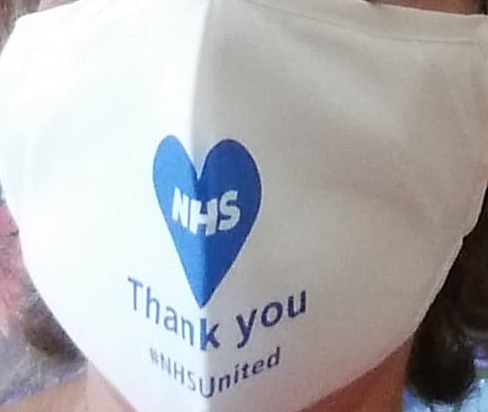
These days patients wear masks as well as the medical staff, so naturally I was wearing my favourite mask to get Brownie points. My last general anaesthetic was in 1978 and most of those involved tonsils or teeth. I had all my caesareans with epidurals and some hand surgery under local anaesthetic, so I didn’t miss out on what was going on…

Destination anaesthetic room, next door to Theatre Number One; the nurse let me peer through the porthole where people in blue scrubs were getting everything ready; all that just for me! My elderly neighbour who had the same operation a year ago had reassured me that being an anaesthetist is an actual job, an important job and my friend who watches all the hospital programmes said they look after you all the way through the operation!

Everyone who has an operation will tell you that they put the canula in, put an oxygen mask on and tell you to take some deep breaths, next thing you know you wake up in the recovery room. I kept taking the deep breaths and I was still wide awake, it wasn’t working! Then the anaesthetist said ‘Okay, I’m going to start putting the drugs in now, first the pain killer, tell me when you feel funny.’

It was a lovely warm glowing feeling and then…