Sunday Salon – Meet The Author

J: Greg, you have recently published a historical novel with the intriguing title Champagne in a Broken Teacup. What’s the book about?

G: Without giving too much away, here’s a short summary I wrote for Amazon.

In the spring of 1940 recently married Marie-Claire is blissfully pursuing her career as a freelance artist in Paris. She has no idea that in early May Hitler’s armies will invade France and rip her life apart. In the book we follow her life as tragedies strike and she is forced to flee Paris to escape from the Gestapo. Using a false name and identity she begins a new life in the small provincial French town of Nevers. She finds unexpected inner strength as a resistance worker but her previous life in Paris catches up with her.

J: What inspired you to write it?

G: As a young boy growing up in Canada I was fascinated by the stories I was told about my French aunt. During WW2 she was an art teacher living in the small French town of Nevers where she became a document forger and fighter in the French resistance. As if that wasn’t fascinating enough for a young boy, even more exciting were some of the stories of her escape from the Germans.

Fast forward several decades to the time I retired and started to focus on my interest in writing and inevitably the stories of my aunt’s adventures came to mind. However, I realized I didn’t know enough detail about her life to turn it into a stand alone story and unfortunately she had passed away many years earlier. I decided I needed to find out more about the world she would have lived in and what life would have been like for her in occupied France.

Thanks to the internet and the digitization of many documents I was able to find out far more than I expected. I found it quite moving to be able to read the very newspapers my aunt would have been reading nearly a century ago. I was even able to look at copies of leaflets that the RAF dropped over France during the war – leaflets that my aunt would have picked up in the streets of Nevers and read. I was amazed to find out that the RAF dropped over 640 million such leaflets over France.

Like most of us I had been taught about the big battles and political aspects of the war but virtually nothing about the lives of the ordinary citizens. As my research progressed I became more and more fascinated reading about the things which affected people’s daily lives and the things they did to fight back against the German occupation. I decided that what I wanted to do was write a fictional novel that incorporated the stories I’d been told about my aunt interwoven with historical reality.

G: That’s a good question. In one sense, being a fictional novel my characters are fictional. On the other hand some of the events included in the story are portrayals of events which involved my aunt – but obviously I can’t tell you what they are right now as that would give away too much of the plot. What I can say is that the picture on the back cover of the book, of German soldiers in the rain, was actually drawn by my aunt in Nevers in 1941 when she was a resistance forger. It is one of the few things I have of hers. It hangs on the wall beside my desk and helped inspire me to write the book.

The historical events mentioned in the book are real as I wanted my characters to react to the actual events of the time. Although a lot of what my characters experience and do may not have happened to my aunt they are based on my research and on true stories of what people actually did in the resistance at that time.

J: Did you spend a long time doing the research?

G: Yes, and I enjoyed the research almost as much as writing the book. I became engrossed in reading about such things as forging techniques, rat bombs and pencil detonators as well as more dramatic activities such as derailing trains and blowing up fuel dumps.

I was also fascinated by the small details I discovered during my research which I’ve never seen in a history book. For example, the fact that within six weeks of the fall of France the newspapers reported that it was now illegal for bakers to make croissant or brioche.

J: Illegal for the French to make croissant?

G: Yes, at first I thought the report might be some sort of joke by the newspaper, but thanks to the internet I was able to access and read the actual regulations issued by the Vichy government..

Also thanks to the internet I was able to research locations in Nevers. I even found a 1940’s picture of the steps of the Rue de Calvaire – a place which plays an important part in the story.

Nevers 1940 Rue de Calvaire

J: Tell me about the title. It’s so unusual.

G: The title is critical to the story so I can’t tell you too much about it. All I can say is I needed a title which would be unique and yet fit in the plot as plausible.

J: I enjoyed reading your novel and gave it a five star review on Amazon as a ‘cracking good read’. What have other people said?

G: I’ve had a lot of positive feedback. In fact several people have said the whole story would make a great film.

J: I agree. And before you go, that important question. Where can people get a copy of Champagne in a Broken Teacup?

G: The book is available via Amazon as a paperback, a hardback, a Kindle eBook or via Kindle Unlimited. Our website https://www.kenebec.com?d has a direct link to Amazon for this book and our other books.

I’d like to thank you for asking me to talk about Champagne in a Broken Teacup. I’m not sure how many of your readers are local but if they’re interested I’d just like to add that I’ll be giving a talk about the research behind the book in June at the Sturminster Newton Literary Festival.

Thanks for coming along Greg and good luck with your book sales and festival talk.

Janet Gogerty

5.0 out of 5 stars A great story that brings recent history to life.

Reviewed in the United Kingdom on 15 March 2025

This is a cracking good story and a very well written novel. Paris under German occupation in World War Two is the setting. This is history, but the novel goes far deeper than the classic black and white photographs of German soldiers marching past the Arc de Triomphe. The author takes us into the lives of happy young newly-weds and their friends. This novel is inspired by the author’s aunt who worked for the resistance and is backed up by careful research. Far from being a dry recounting of the times, we are soon wrapped up in the lives of young and older Parisiens determined to fight for their country as violence and the death of friends and family becomes a reality. The Germans are not the only enemy as informers and traitors make it impossible to know who to trust, keeping us in suspense in every chapter.

https://www.amazon.co.uk/Champagne-Broken-Teacup-Adventures-resistante-ebook/dp/B0DPVJNZRM/

Friday Flash Fiction 1000 – Per Ardua ad Astra – The Summer of 2018

Edward was not unique in his obsession with aeroplanes, but he was fortunate that his wife understood, or at least didn’t mind spending the summer touring round all the air shows in their camper van. The boys didn’t always go with them these days, but they had enjoyed a childhood of camping and exploring the British Isles.

A slight autumnal melancholy would descend on the couple as the air show season drew to a close, but the winter months were still busy for Edward, visiting air museums and doing research. Josie did not mind him spending long evenings on the computer, she was free to watch her favourite television dramas.

Winter also gave Edward time to spend in his man den at weekends; this was no ordinary garden shed, but the sanctuary where he tinkered with his inventions. If his wife and sons had paid more attention to what he was creating they would have been very excited… or very worried.

DSC_8564

Josie and the boys did not share Edward’s obsession with World War Two and the RAF. His special love, the other woman in his life, as Josie teased him, was the Spitfire, the most perfect aircraft ever built, a beautiful bird that pilots did not just fly, but became a part of. Or so Edward had read and heard from those who had flown them. His six foot four gangly frame, poor eyesight and asthma had precluded any hope of joining the RAF, let alone becoming one of the special few who flew with the Battle of Britain Memorial Flight. He was a frequent visitor to the BBMF visitor centre at RAF Coningsby and all the tour guides knew him well, too well; they didn’t always appreciate him volunteering extra information to their polished talks.

Edward had no idea where his Spitfire dreams came from, nobody else in his family had been interested in flying. Josie said he should consult a medium, perhaps he had been a pilot in a previous life, helping to win the Battle of Britain. In his dreams at night he was always soaring up into the blue sky, not diving down to a violent death.

DSC_8016

But Edward’s thoughts and day dreams went far deeper than his family could imagine, in his den were creations nobody knew about. Talk of time machines was outdated, Edward’s calculations and research pointed to folds in time and certain frequencies. His plan was to tune into the frequency of the iconic Merlin engines and his dream was to save lives; the Spitfire was built to fly not die, not kill. If he could bring the Spitfires forward to the present, before their pilots perished in the Battle of Britain, their young lives would not be wasted.

His theory became reality when he realised that even if he could not see the past he could tune his adapted radio to hear it. Edward had plotted meticulously the dates and air bases of that summer of 1940, but all the planes would converge to one date, the final day of the Sandy Cliffs Air Festival. The spitfires would fly in formation above the fields of Kent they knew so well.

There were only two drawbacks to Edward’s grand plan; the weather might be bad and he could change the course of history. If it changed so he had never existed then he would never have been around to change it… On the other hand if he was alive and well to witness the proof of time travel, he would also be able to observe if history had been changed. If the pilots were taken away the Battle of Britain would be lost, but that didn’t mean WW2 would be lost. Edward had given this great thought; historic events weren’t a matter of one way or another, there were infinite possibilities at the start of every day. Whatever happened, it should be a jolly good show for the RAF’s centenary.

DSCN0117

The weather was beautiful, Edward could hardly contain his excitement. Josie had a headache and decided to stay in the shade of the camper van, the boys had come along reluctantly and were mooching around glued to their smart phones. They should all be snapped out of their languor at three pm.
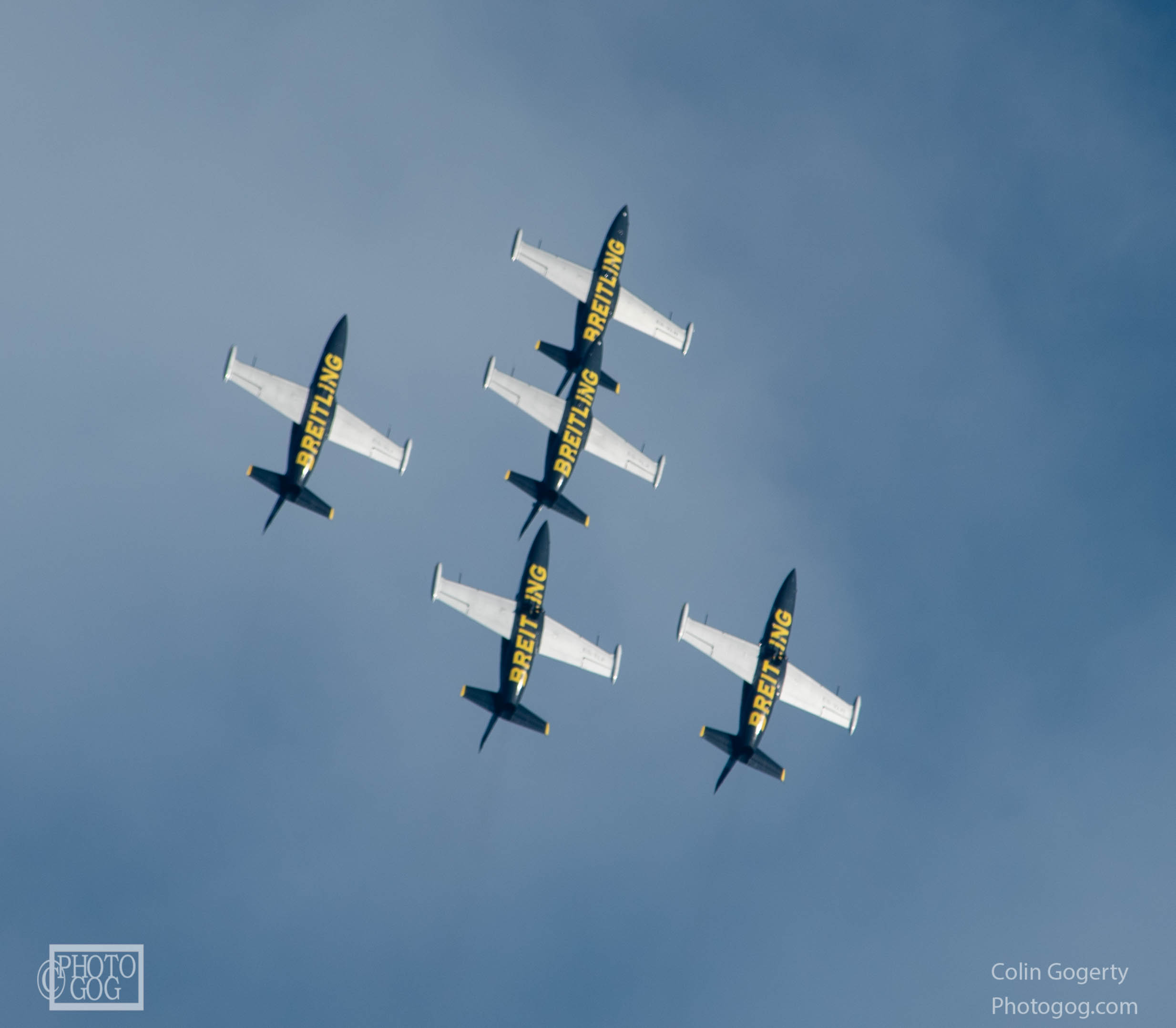
DSC_7005

The commentator also had a headache, the extra hot summer and too many air shows were taking their toll on his health. Wearily he turned on the microphone.

…and don’t forget the finale of the show with the Red Arrows and a few surprises, but now here come the Spitfire and Hurricane; on a sunny day like this in 1940 the sky would have been full of these beautiful planes… but

He took his glasses off and rubbed his eyes…

On the cliffs the crowd gasped in awe as tiny dots became little planes and more and more filled the skies above them…

Edward thought his heart would burst with pride, the formation grew in the orderly fashion he had planned. The commentator was silent, but suddenly crackled back into life.

DSCN0069

Once again we celebrate the strange events of 1940 when German pilots reported the enemy planes disappearing into thin air in front of their eyes, day after day until they all refused to fly for fear they too would evaporate. And so began the slow process of conciliation and the creation of our great empire Gaul.

Edward looked around at the crowds waving strange purple and green flags and wearing clothes that looked unfamiliar. He rushed back to the camper van to tell Josie what he had done; he needed her to confirm what he was seeing.

A strange woman flung open the door, two little girls ran up to him.

‘Daddy, Daddy did you see all the planes?’

‘They certainly put on a good show this year Ed’ said the strange woman.

Edward realised a factor he hadn’t taken into account, he still existed, but the great mixing of the gene pool that occurred after the war and brought Josie’s grandparents to Britain had not occurred, or had occurred in a different variation…

DSC_7899

What does the RAF motto “Per Ardua Ad Astra” mean?

The College of Arms has stated that “no authoritative translation is possible” but the usual translation is “Through adversity to the stars”.

40526772_2086625508055020_203980160234422272_n

I wrote this story last year, no time slips occured… but the Bournemouth Air Festival is on right now and you never know what might happen up in the sky. We won’t see The Red Arrows this year as they are touring the USA.

https://bournemouthair.co.uk/

sunshine-blogger