Tidalscribe’s Tiny Terrors

As I sat reading a book I felt and heard the reassuring rumble of the underground. But I was not on a London tube train, Mum and Dad were in the kitchen next door washing the dishes. We were in our little suburban house in Perth, Western Australia.
It was 10.59am, a bank holiday on the 14th October 1968, we had just experienced the Meckering Earthquake, my mother said she had to cling to the kitchen sink. The small town of Meckering was 130 km away in the wheat belt, the 45 second earthquake was magnitude 6.9 on the Richter Scale making it one of the largest recorded in the seismic history of Australia. A few buildings in Perth were damaged. A baby had a miraculous escape in Meckering, their town fell down, but no one was killed. Had the epicentre been in a big city it could have been a major disaster. For us it was exciting, proof that Man cannot control nature.

At school the next day the earthquake was the only topic of conversation. In the classroom we were all startled to feel an aftershock, this time we knew what it was and we were scared. The teacher told us to calm down. There was no evacuation or talk of emergency procedures. It was unlikely the one storey asbestos building would collapse dramatically.

DSCN4070

Fast forward to December 1974, Knightsbridge, London; I had a Christmas job as a floorwalker in Harrods toy department. It was the Saturday before Christmas and that afternoon I had the last tea break. The staff restaurant was on the top floor. As I stood in the Ladies combing my hair I heard a muffled thud and assumed it was an IRA bomb going off somewhere else. Of importance later was the fact that I had my handbag with me.

I walked out to see the busy shop deserted, the escalators switched off and a couple of security guards annoyed to see me still in the building, everyone else had been evacuated. Somehow I caught up with colleagues as we poured out of the building; it was only as we looked up and saw thick black smoke pouring from the corner of the iconic department store that the shock hit us. No one was hurt that day, the heroes were the staff who had noticed something suspicious in their department and evacuated customers safely. Heavy fire doors had contained the explosion. Once again I had had a wide escape. We sat in a nearby pub waiting to go back in and fetch our coats, but nobody would return to work that evening. Lucky for me I had my handbag with my season ticket for the train, even if the journey home was a bit chilly without my coat.

39799723_488185681646015_9009656414120968192_n

News is with us in all the media twenty four hours a day and this year fire, flood, hurricanes and earthquakes have been regular events and of a magnitude hard to comprehend. We wonder what it is like to be at the heart of a major disaster. Reporters find their way to the most unreachable scenes of devastation only to ask victims how they feel.

P1040747

Back to Perth, Western Australia, when my fourteen year old self was riding her bike. The suburbs were laid out in a grid design with long straight roads, there was a ‘Give Way To The Right’ rule, logical as long as everybody obeyed; there were always accidents at intersections. I was pedalling towards a corner when suddenly two cars collided in front of me, one of them rolled over. The two young drivers clambered out with some difficulty, but both were laughing, unhurt. When I tried to get back on my bike my legs were shaking so much I couldn’t lift my foot onto the pedal. I have always wondered if everyone benefits from adrenalin when faced with real peril, or if some people turn to jelly. How many writers secretly long to be in the midst of a disaster and emerge unscathed, or just a bit hurt so they can tell their dramatic story from a comfortable hospital bed?

Our family’s migration to Western Australia inspired my novel Quarter Acre Block – only 99 pence on Amazon Kindle, also available as a paperback.


October Outing – Stourhead

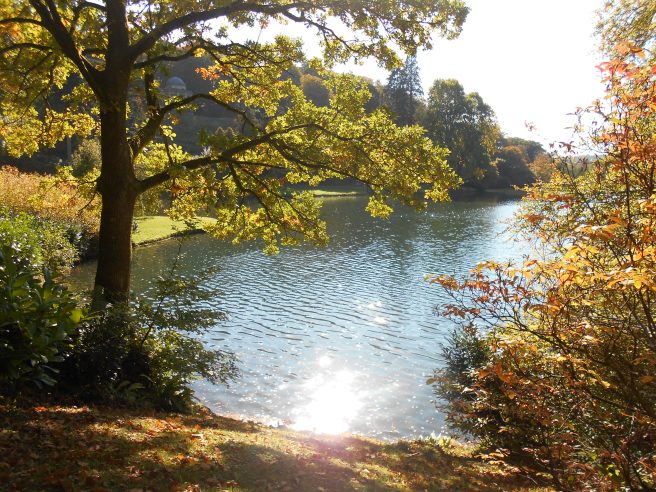
Last week we went on what could be the ultimate autumnal outing, certainly for those of us who haven’t been to New England in the fall. Thanks to modern weather forecasting the predicted blue skies and sunshine made the gardens of Stourhead picture perfect. It was a little early for nature and photography experts, the trees had not reached their full colour potential, but when a gentle breeze sends golden beech leaves floating to the ground it is like pennies from heaven and perhaps this is the closest to heaven on earth most of us will get.

DSCN0797

Like most National Trust properties and other great houses and castles that you pay to enter, you are sealed off from real life. There is no traffic except the gardeners’ tractor and trailer, no traffic noise, no building work going on, no homeless people to remind you of the darker side of life and little likelihood of being mugged or caught up in a street riot. Your children can safely run around, as long as they don’t fall into the lake…  Everybody is there to enjoy nature or a healthy walk. I guess there is always the chance a fight will erupt between photographers spoiling each other’s view, perhaps the loser rolling down the manicured lawns into the lake; that would make a good story, but it didn’t happen on our visit.

Fortunately patience prevailed at the archway to the house. Two Japanese ladies left behind by their party were admiring the masses of red leaves of the Virginia Creeper that smothered the stone arch. They kept rearranging themselves to photograph each other and also seemed to examine each leaf in detail. Meanwhile on one side was Cyberspouse with his camera and on the bank opposite a couple of photographers waiting for the ladies to move out of the way. I like taking pictures with people in, but I guess the others had to wait until next autumn.

dscn0760.jpg

Inside the house, phones were to be switched off, bags left in lockers and no flash photography. My point and shoot compact has a habit of switching its flash back on so I only managed one quick picture of the library before one of the volunteers started telling me how they cleaned the books with pony hair brushes, then suck the dust away with a mini vacuum cleaner. But I did ask the important questions readers and writers would want to know. Did the family of old read all these books? Yes, this was their learning and entertainment centre and only a few books have been found with the pages still uncut at the edges. Does anyone still read them? Yes you can apply. What is the oldest book? ‘Oh dear, I never remember’ said the lady, then called up to an elderly gentleman perched precariously on top of a ladder – one of the hazards of having book shelves that go up to the ceiling. He wobbled down to tell me the answer, a German manuscript of 1591.

dscn0781.jpg

The Hoare family who created the house and beautiful gardens were bankers. Henry ‘the good’ bought Stourton Manor and medieval buildings were replaced by a Palladian villa, but he died in 1724, a year before the house was completed. Henry the Magnificent’s nickname was earned by the landscape vision he created in his garden. With hills, water and classical architecture overlaid by a fabulous collection of trees and shrubs, Stourhead was described as ‘a living work of art’ when it first opened in the 1740s. Henry died in 1785, but like all altruistic planters of trees he could not know how his gardens would look over two centuries later.

You can walk all round the lake, created by damming the River Stour which flows sixty miles to Christchurch harbour. Stop to admire follies, temples and the grotto as well as the views, then return to the Spread Eagle Inn to enjoy refreshments.

DSCN0810


Friday Flash Fiction – The Stones

 So Lar looked over the plains; how many had passed this way over the years? Weary bodies, bent limbs and always murmurings of revolt, lives lost as well and for what? Tomorrow would demonstrate what this had all been for and So Lar would be proved right. A new age of enlightenment would begin on the longest day as the Sun bestowed His blessing. Of course it was hard for the workers to see what they and their fathers and forebears had been labouring towards, what So Lar’s father and grandfather had dreamed of, knowing they would never see the day when it was complete.

The old pagan beliefs would be buried for good and they would look towards the one true God, the Sun God. But as the long warm evening began to fade into twilight So Lar had the first misgivings, dark clouds rolled over the indigo sky. When night had fully set over the plains the moon could not be seen, not one single star could be seen. Without clouds there would be no rain, man and beast needed rain, but not tomorrow…

There was no sleep for him that short night; most souls in the camp were sound asleep, trusting the night watch to wake them in good time for the revelation So Lar had promised at dawn. If the blanket of cloud was not drawn back then they would not see the first rays shine through the entrance of the temple of knowledge.

Blackness turned to grey, dawn had arrived, but not a glimmer of gold could penetrate the dark clouds. They surrounded So Lar now, angry and afraid. Rab the trouble maker spoke.

‘So much for your Sun God, we have angered our gods, desecrated their sacred plains, your stone temple is a terrible scar on the landscape that should be torn down. The gods will not let your weak sun god shine until they are appeased.’

41489466_2277742345588876_4579338519482204160_o


So Lar lay bound inside his precious circle. These people would never be enlightened, would never understand how the heavens and earth worked without the need for human intervention. They still thought blood needed to be spilled, that he must be sacrificed if the sun was to shine again.


Stonehenge – September Staycation Part Three

41489466_2277742345588876_4579338519482204160_o

 When you are on Staycation you will visit places after breakfast that others have crossed the world to see. We had not been to Stonehenge since the new visitors’ centre was built, out of sight of the World Heritage Site. The A344 which previously enabled motorists to ‘come across’ Stonehenge, but also intruded on the peace of the past, is now used solely by the fleet of buses with destination The Stones on the front.

If you belong to English Heritage or the National Trust entry is free. You can hop on the bus or walk; divert off the road through chalky fields to enjoy the peaceful scenery of Salisbury Plain. There is nothing at the stones now so make sure you avail yourself of the visitor centre toilets and take a bottle of water.

dscn0457.jpg

On a Monday morning, with school holidays over and the website stating timed tickets were not needed, we thought it would be quiet. The lady at the booth issuing our free tickets said it was very busy as several cruise ships had come in; this presented a strange vision.

It was almost a pilgrimage, Pilgrimage Lite perhaps. We set off at a brisk pace, overtaking lots of people and hearing various languages, we’re British, we can walk fast…

DSCN0460

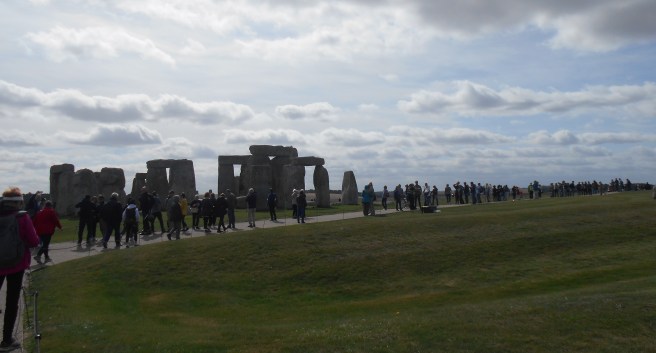
We started to anticipate the moment when Stonehenge would be revealed; round the next copse or over the next brow? Alas, the first view was partially blocked by the ubiquitous buses and queues of people. Queues waiting to have their tickets checked and file between the ropes to the stones, even longer queues waiting to get back on the shuttle bus.

dscn0473.jpg

Only a low rope separated us from the stones, creating enough space inside the circle to imagine how they were when they stood alone. A young Canadian tourist asks to have his photo taken, with the toy penguin that is to accompany him on his trip round Britain.

We ask a tour guide where she’s from.

Portland

USA?

No, Dorset…

She had come to meet passengers who had left their ship at Dover and been coached to Wiltshire.

But the tourists that morning were not rushing and ticking off another place visited, they were in genuine awe that they were really there looking at an ancient construction no one can explain for sure.

dscn0477.jpg


This year marks one hundred years since Stonehenge was given to the nation.

 On 26 October 1918, Stonehenge was offered by Cecil and Mary Chubb as a gift for the nation. Cecil Chubb had bought Stonehenge for £6600 at a local auction three years previously. Prior to 1918, the monument was propped up with wooden poles and some of the stones were in danger of collapse. Increasing numbers of visitors through the late 19th century had led to damage, with people regularly chipping the stones for souvenirs and scratching their names on the monument.

http://blog.english-heritage.org.uk/30-things-you-might-not-know-about-stonehenge

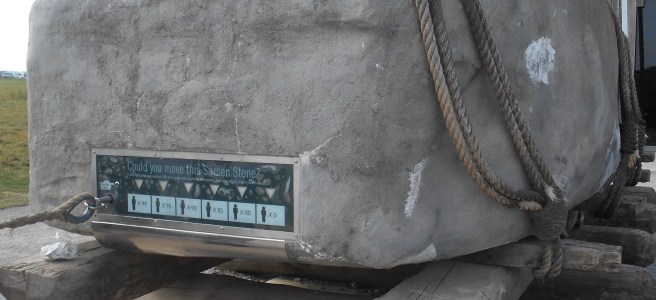
The first guidebook in 1823 claimed Stonehenge survived Noah’s flood. We do know the stones came from South Wales, that is part of the mystery, how they got there. Stonehenge was built between about 3,000 BC and 1,600 BC and its purpose remains under study. What is certain, if you stand in just the right place inside the monument at the summer solstice, facing northeast through the entrance towards a rough-hewn stone outside the circle, known as the Heel Stone, you will see the sun rise above the Heel Stone.

http://earthsky.org/earth/gallery-the-summer-solstice-as-seen-from-stonehenge

A few days later visitors came round and asked how the staycation was going and where we’d been.

‘Oh, that heap of old stones’ was their reply.


DSCN0489

See more pictures at my Beachwriter’s Blog

https://www.ccsidewriter.co.uk/chapter-five-beach-writer-s-blog

Look out for Friday Flash Fiction as the Stones theme continues…


Wonderful Winchester September Staycation – Part Two

DSCN0308

We visit Winchester Cathedral quite often; this time we had been told about the flower festival. After a late breakfast at Wetherspoons we sauntered down the road to the cathedral. It was a week day so we weren’t expecting to see a queue to get into the cathedral, but a flower festival by definition can only last a short time.

dscn0328.jpg

It was worth the wait; it was a flower festival like no other I have ever seen and the rich colours cannot be conveyed in the pictures. What can be shown is the crowds. There were a lot of very English,’ excuse mes’ and ‘sorrys’ as we all tried to take photos or stay out of the way of other people taking them. Winchester is very light inside and gazing up you could forget you were not alone.

41341811_2273310256032085_1206749487914024960_o

The rich reds, blues and purples reflected this year’s theme which was inspired by the Winchester Bible.

DSCN0382

The Winchester Bible is the largest and finest of all surviving 12th-century English bibles. A single scribe wrote out its text in Latin, while artists worked its exquisitely illuminated capital letters. Their glowing colours, including gold and lapis lazuli, are as intense today as 800 years ago.

dscn0403.jpg

http://www.winchester-cathedral.org.uk/our-heritage/cathedral-treasures/the-winchester-bible-details/


We have never seen the Bible. On a previous visit, hoping to see it, we were informed with great satisfaction by an officious lady that the room where it was kept was closed that day! This time we could have queued to see one volume in a temporary exhibition, but made the decision to queue for the crypt.

DSCN0384

Down here, often standing in water, is Antony Gormley’s statue. Cyberspouse got a picture years ago when he pushed open a door that was ajar to see where it went; that time the statue was a complete surprise. This time the surprise was to see a candlelit path to the man with cupped hands.

http://www.winchester-cathedral.org.uk/our-heritage/art-architecture/antony-gormley-sculpture/

41290243_2273528329343611_2462619236892147712_o


http://www.winchester-cathedral.org.uk/

dscn0342.jpg

DSCN0340

DSCN0409

DSCN0411


On staycation you visit places for the day that  others may have travelled across the world to see. We chatted to a  couple who had come down from the North, but had the convenience of a son-in-law who worked at the cathedral and lived in the cathedral close, so they had free delightful accomodation and the opportunity to look round when everyone else had gone home.

DSCN0379

In my novel Three Ages of Man the stranger has never seen anything as old and solid as a cathedral and marvels as he lays his hands on the stone walls of Winchester Cathedral.

Secret Salisbury – September Staycation – Part One

Salisbury is a small city where we used to think not much happened. It lies in the county of Wiltshire, where you might think not much has happened since Stonehenge was built. Salisbury is a city because it has a cathedral. It is not large, but it is busy with a hospital, university and many places of interest to historians and tourists.

Since March this year it has been in the international news with the poisoning by novichok nerve agent of two Russians and a local policeman. Just when Salisbury was getting back to some normality there was the bizarre tragedy when two locals were taken ill and one became the first fatality. Two Russian suspects have been named and even appeared on Russian television to explain they visited Salisbury merely as tourists to see the cathedral with its famous spire and the oldest clock in the world.

DSCN0516

You couldn’t make this story up; if these two men were ‘secret agents’ they certainly bungled the whole mission, their target was not killed, though he and his daughter only survived thanks to the National Health Service and skilled care. Before leaving Salisbury they dumped the novichok in a rubbish skip.  Through all these months, parts of Salisbury have been closed off and scoured for any trace of the nerve agent, a nightmare for businesses expecting a busy tourist summer.

We quite often go to Salisbury and went there last week after our morning at Stonehenge. Everywhere seemed busy, but perhaps they were locals.

DSCN0506

I can believe the two suspects didn’t find the cathedral; though the famous spire can be seen for miles around, the first time we visited we stood in the main square and could not see it, we had no idea which way to go.

Through an arch you will find yourself looking at the cathedral green; fine weather shows the scene at its best. This area is full of interesting houses and museums and the expanse of grass is ideal for children to run and play and school parties to let off steam. There is too much for one visit, but whatever your plans just stand by yourself and look up at the spire.

The refectory, cloisters and smart toilets are free to wander in. Do you pay to go in the cathedral? There is a suggested donation. On our visit, late in the afternoon, I was just trying to read what we might ‘kindly be asked’ to pay when I realised Cyberspouse was already inside. We may have accidentally followed a coach party in. The house of God should be free to enter, but cathedrals need constant loving and expensive care. We always buy our refreshments at the refectory and there is a nice shop for tourists.

DSCN0535

Cathedrals can be overwhelming, I guarantee most of us do not remember all the saintly and royal details in the leaflets. Take in the ambience and spend time with what takes your eye. Highlights include the clock, perhaps the Russians wanted to steal our cutting edge technology! Look carefully down the nave and see if you can spot the columns bowed at the centre of the cathedral under the weight of the spire. A model of the spire shows the original wooden scaffold still there. Another  model shows the cathedral being built; I had a nice chat with an American lady as we admired the model and the original builders. The biggest miracle of ancient buildings is the fact they are still standing and I love to wonder if those who built it could have imagined how far into the future their creation would be admired.

DSCN0530

Cathedrals are living places and new art is added. I love the font, sculptor William Pye, consecrated in 2008.

DSCN0537

On our brief stroll around the cathedral Cyberspouse met a woman from Iceland, tourists are still coming to Salisbury.

https://www.visitwiltshire.co.uk/salisbury/things-to-do

My Brief Encounters trilogy is partly set in rural Wiltshire and Salisbury also features, especially in Lives of Anna Alsop.


Sunday Salon – Nights in and a Night Out

Reviews of two very different novels and a murder mystery play by Francis Durbridge

I posted both book reviews on Amazon and Goodreads

Our Spoons Came From Woolworths

by Barbara Comyns

5 Stars

I read this as a paperback passed on to me and recommended. I had not heard of the author before.

Many of us love anything to do with the twenties and thirties; architecture, art, music and elegant young men and women capture wistfully the two decades between world wars. But we also know it wasn’t glamorous for most and for the British it was a time our parents and grandparents remember before the Welfare State and the birth of the National Health Service.

Sophia is young and naive and the novel is probably very close to the author’s own life. I love the way she tells us her story as if she was looking back and telling a friend, which indeed she does at the end. The book was published in 1950.

We have a vivid picture of life with very little money, renting rooms and sharing bathrooms. From details of what they eat to the realities of pregnancy and childbirth which will appall most women. Ironically it was also a time when new mothers who were able to afford a nice nursing home would have enjoyed two weeks of bed rest – unheard of these days! Love and poverty never go well together and being married to an artist who is never going to earn proper money is a recipe for disaster. Follow Sophia in a poignant story that has humour, very dark times and then hope.


Secrets    by Anita Dawes

4.0 out of 5 stars A deep dark look into childhood.

20 August 2018

Format: Kindle EditionVerified Purchase

I finished reading this in the middle of last night; though it is not unusual for me to turn my Kindle on in the early hours, this is not the sort of novel you should be reading in the dark watches of the night! It is a good paranormal thriller, but more than that it will make you reconsider all our childhoods. How responsible are children for what they do and what is really going on in their minds? In some ways I felt most sorry for Jack’s parents, a poignant back story gradually revealed, an event that ruined any chance of his father continuing the life he loved or his mother coming to accept their rural life. There is a lot going on in everyone’s lives, but Jackie is a reminder that those of us who have led ordinary lives cannot know what others have had to overcome. There were only a few things that jarred – I thought it was likely the social services would have got involved, Maggie did not guess an obvious pointer as Jack’s story was revealed and some dialogue and characters’ thoughts could be confusing in the pace of the story. But overall I really enjoyed this unusual novel.


SHELLEY THEATRE, BOSCOMBE.

Francis Durbridge’s  play Suddenly At Home

Thursday-Tuesday August 16-21

Durbridge won international acclaim as the creator of Paul Temple, one of the most famous of all BBC radio detectives. He also wrote nine stage plays, Suddenly At Home was first performed in 1971.

Shelley Manor

Percy Florence Shelley was the son of the poet Percy Bysshe Shelley  (1792 -1822) and Mary Shelley, author of Frankenstein.

He bought Boscombe Cottage, near Bournemouth, Dorset for his mother to live in and had it rebuilt based on the Casa Magni in Lerici, northern Italy, the last home of Percy Bysshe and Mary. He renamed it Boscombe Manor. Mary died before it was completed and Percy and his wife Jane took residence.

Sir Percy had a timber theatre built in the grounds but replaced it with the current grander theatre which opened in 1870 with a public performance. Many of their friends acted and came to see shows including Sir Henry Irving and Robert Louis Stevenson (who wrote Jekyll and Hyde in Bournemouth).

Now this lovely pocket sized theatre has been restored and is a treat to visit. The volunteers give you a friendly greeting, there is a pleasant bar and the seats are very comfortable – they came from the much hated Bournemouth Imax cinema building when it was demolished, but that story is for another blog!

Small theatres are always fun, the audience are there to enjoy themselves for a play such as this which follows in the  long British tradition of  darkly comic murder mysteries.

The London Repertory Players were at the Shelley Theatre for a four play summer season. The action was set in one room; all that was needed were a few items of furniture and several doors. Door bells and ringing phones, always at the wrong moment, kept the cast and audience on their toes and guessing till the final curtain.

http://shelleytheatre.co.uk/article.php?sec=ABOUT&articleId=3224


Friday Flash Fiction Flies – Per Ardua ad Astra

Edward was not unique in his obsession with aeroplanes, but he was fortunate that his wife understood, or at least didn’t mind spending the summer touring round all the air shows in their camper van. The boys didn’t always go with them these days, but they had enjoyed a childhood of camping and exploring the British Isles.

A slight autumnal melancholy would descend on the couple as the air show season drew to a close, but the winter months were still busy for Edward, visiting air museums and doing research. Josie did not mind him spending long evenings on the computer, at least he wasn’t looking at pornography and she was free to watch her favourite television dramas.

DSCN4007

Winter also gave Edward time to spend in his man den at weekends; this was no ordinary garden shed, but the sanctuary where he tinkered with his inventions. If his wife and sons had paid more attention to what he was creating they would have been very excited… or very worried.

DSC_8556

Josie and the boys did not share Edward’s obsession with World War Two and the RAF. His special love, the other woman in his life, as Josie teased him, was the Spitfire, the most perfect aircraft ever built, a beautiful bird that pilots did not just fly, but became a part of. Or so Edward had read and heard from those who had flown them. His six foot four gangly frame, poor eyesight and asthma had precluded any hope of joining the RAF, let alone becoming one of the special few who flew with the Battle of Britain Memorial Flight. He was a frequent visitor to the BBMF visitor centre at RAF Coningsby and all the tour guides knew him well, too well; they didn’t always appreciate him volunteering extra information to their polished talks.

DSC_8562

Edward had no idea where his Spitfire dreams came from, nobody else in his family had been interested in flying. Josie said he should consult a medium, perhaps he had been a pilot in a previous life, helping to win the Battle of Britain. In his dreams at night he was always soaring up into the blue sky, not diving down to a violent death. But as his wife pointed out, he could have survived the war and lived on for a good many years; Edward was born in 1970.

But Edward’s thoughts and day dreams went far deeper than his family could imagine, in his den were creations nobody knew about. Talk of time machines was outdated, Edward’s calculations and research pointed to folds in time and certain frequencies. His plan was to tune into the frequency of the iconic Merlin engines and his dream was to save lives; the Spitfire was built to fly not die, not kill. If he could bring the Spitfires forward to the present, before their pilots perished in the Battle of Britain, their young lives would not be wasted.

DSC_8559

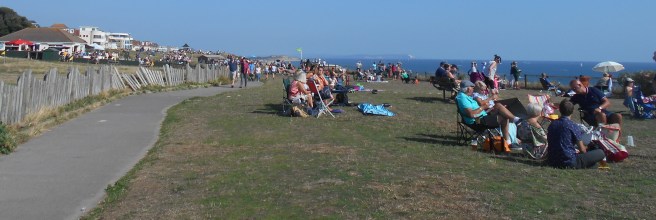
His theory became reality when he realised he could tune his adapted radio to hear the past, even if he could not see it. Edward had plotted meticulously the dates and air bases of that summer of 1940, but all the planes would converge to one date, the final day of the Sandy Cliffs Air Festival. The spitfires would fly in formation above the fields of Kent they knew so well.

There were only two drawbacks to Edward’s grand plan; the weather might be bad and he could change the course of history.

If it changed so he had never existed then he would never have been around to change it… On the other hand if he was alive and well to witness the proof of time travel, he would also be able to observe if history had been changed. If the pilots were taken away the Battle of Britain would be lost, but that didn’t mean WW2 would be lost. Edward had given this great thought; historic events weren’t a matter of one way or another, there were infinite possibilities at the start of every day. Whatever happened, it should be a jolly good show for the year of the RAF’s hundredth birthday.

DSCN0117

The weather was beautiful, Edward could hardly contain his excitement. Josie had a headache and decided to stay in the shade of the camper van, the boys had come along reluctantly and were mooching around glued to their smart phones. They should all be snapped out of their languor at three pm.

The commentator also had a headache, the extra hot summer and too many air shows were taking their toll on his health. Wearily he turned on the microphone.

…and don’t forget the finale of the show at four pm with the Red Arrows and a few surprises, but now here come the Spitfire and Hurricane; on a sunny day like this in 1940 the sky would have been full of these beautiful planes… but

He took his glasses off and rubbed his eyes…

On the cliffs the crowd gasped in awe as tiny dots became little planes and more and more filled the skies above them…

DSCN0229


Edward thought his heart would burst with pride, the formation grew in the orderly fashion he had planned. The commentator was silent, but suddenly crackled back into life.

Once again we celebrate the strange events of 1940 when German pilots reported the enemy planes disappearing into thin air in front of their eyes, day after day until they all refused to fly for fear they too would evaporate. And so began the slow process of conciliation and the creation of our great empire Gaul.

Edward looked around at the crowds waving strange purple and green flags and wearing clothes that looked unfamiliar. He rushed back to the camper van to tell Josie what he had done; he needed her to confirm what he was seeing.

A strange woman flung open the door, two little girls ran up to him.

‘Daddy, Daddy did you see all the planes?’

‘They certainly put on a good show this year Ed’ said the strange woman.

Edward realised a factor he hadn’t taken into account, he still existed, but the great mixing of the gene pool that occurred after the war and brought Josie’s grandparents to Britain had not occurred, or had occurred in a different variation…


Albertopolis

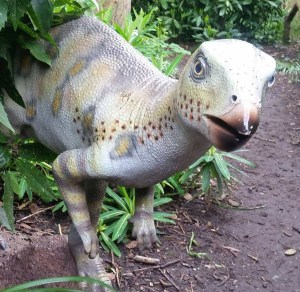
Everyone remembers the first time they see a dinosaur. For many of us it will have been on our first visit to the Natural History Museum in London. As you walked in the Great Hall there he was staring at you, the huge skeleton of Diplodocus. We were on a junior school outing, squashed cheese and tomato sandwiches in Kensington Gardens, then round the museum with our activity sheets. It wasn’t until I visited as an adult that I was disappointed to discover he was only a plaster cast of the original, uncovered in the plains of fossil-rich Wyoming.

One memorable visit was when two friends and I took our seven children, including three toddlers in buggies, on the tube train. On the way home in rush hour the poor passengers had to contend with four large plastic diplodocuses, their dangerously long tails waving in their faces. Diplodocus is now touring round the country and you can see a real Blue Whale skeleton instead.

https://www.theguardian.com/science/2017/jan/01/dippy-diplodocus-london-tour-replica-dinosaur-whale-natural-history-museum

7

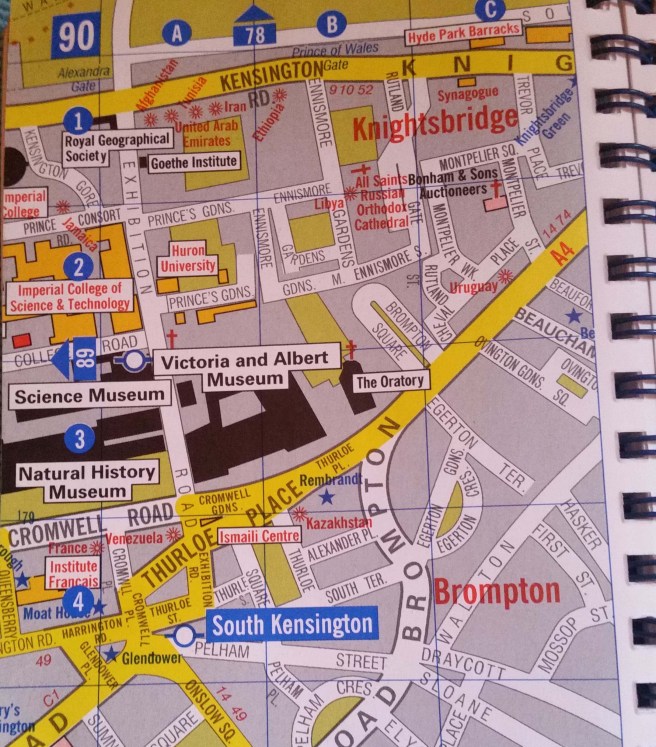
But Prince Albert would have been pleased how many school children and families visit Albertopolis.  Over 150 years ago open fields and market gardens changed when two men had a vision to develop a part of London dedicated to the arts and sciences, using the profits of the Great Exhibition of 1851 held in nearby Hyde Park. Nicknamed ‘Albertopolis’, the area was designed to celebrate the achievements and grandeur of Victorian Britain, it is still thriving today with three museums, colleges and the Royal Albert Hall.

https://www.discoveringbritain.org/activities/greater-london/walks/albertopolis.html

39613703_397479757449518_5582809189551439872_n-e1534894085854.jpg

Prince Albert’s vision for the hall was to promote understanding and appreciation of the Arts and Sciences. When he died of typhoid fever in 1861, plans were put on hold until they were rekindled by Albert’s collaborator Henry Cole. The Royal Albert Hall of Arts and Sciences was opened on 29 March 1871 by Queen Victoria. Albert’s very ornate statue sits across the road in Kensington Gardens. The design of the Hall was inspired by Cole’s visits to ruined Roman amphitheatres and it was originally intended to accommodate 30,000 people, reduced to 7,000 for financial and practical reasons, and today to around 5,500. Every summer it is the main venue for the BBC Proms, the world’s greatest music festival, which surely would have pleased the prince.

39799723_488185681646015_9009656414120968192_n.jpg

Even if you have never been to London, the building will be familiar if you watch The Proms on television; a good way to enjoy the concerts as you get to meet musicians and find out about the music. There is something for everyone from ‘Cuba meets Jamaica’ to the first appearance of the Estonian Festival Orchestra founded in 2011. Premiers of new music are bundled in with old favourites so no one will be scared off. You will learn to interpret the words of the commentators; ‘what an amazing sound picture’ – no tune – ‘especially commissioned work’ – it’s only five minutes long…

But you can’t beat a live performance. I must confess I have never queued for cheap tickets on the day to stand in the arena with the Promenaders. I have not lived near enough and don’t like queuing or standing, is my excuse, but enthusiasts will tell you it is a wonderful experience and some go to every concert. If you are booking seats, all you need to know is don’t book the cheap seats near the top if you want to hear your favourite pianist or violinist  – the soloists look like tiny puppets going on stage. But if you are going to hear a big symphony or the Planet Suite, sit wherever you like, it will be fun. If you want to go on the famous Last Night plan well ahead and check how the ballot system works.

What are your museum memories? Have you been to The Proms?