
With Halloween coming soon it’s handy to know which doors to avoid knocking on.




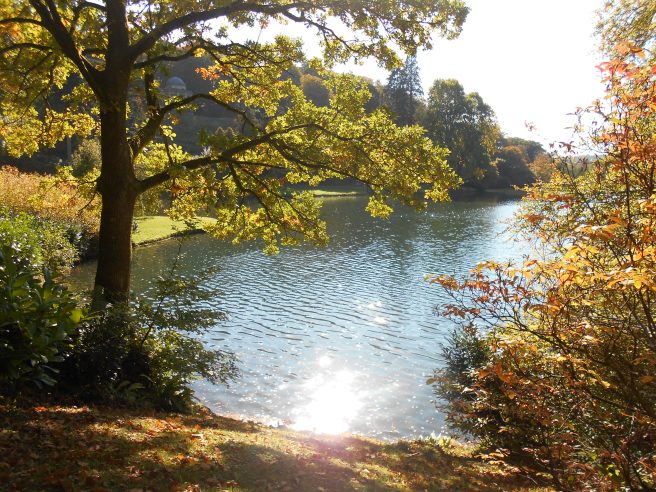
Last week we went on what could be the ultimate autumnal outing, certainly for those of us who haven’t been to New England in the fall. Thanks to modern weather forecasting the predicted blue skies and sunshine made the gardens of Stourhead picture perfect. It was a little early for nature and photography experts, the trees had not reached their full colour potential, but when a gentle breeze sends golden beech leaves floating to the ground it is like pennies from heaven and perhaps this is the closest to heaven on earth most of us will get.

Like most National Trust properties and other great houses and castles that you pay to enter, you are sealed off from real life. There is no traffic except the gardeners’ tractor and trailer, no traffic noise, no building work going on, no homeless people to remind you of the darker side of life and little likelihood of being mugged or caught up in a street riot. Your children can safely run around, as long as they don’t fall into the lake… Everybody is there to enjoy nature or a healthy walk. I guess there is always the chance a fight will erupt between photographers spoiling each other’s view, perhaps the loser rolling down the manicured lawns into the lake; that would make a good story, but it didn’t happen on our visit.
Fortunately patience prevailed at the archway to the house. Two Japanese ladies left behind by their party were admiring the masses of red leaves of the Virginia Creeper that smothered the stone arch. They kept rearranging themselves to photograph each other and also seemed to examine each leaf in detail. Meanwhile on one side was Cyberspouse with his camera and on the bank opposite a couple of photographers waiting for the ladies to move out of the way. I like taking pictures with people in, but I guess the others had to wait until next autumn.

Inside the house, phones were to be switched off, bags left in lockers and no flash photography. My point and shoot compact has a habit of switching its flash back on so I only managed one quick picture of the library before one of the volunteers started telling me how they cleaned the books with pony hair brushes, then suck the dust away with a mini vacuum cleaner. But I did ask the important questions readers and writers would want to know. Did the family of old read all these books? Yes, this was their learning and entertainment centre and only a few books have been found with the pages still uncut at the edges. Does anyone still read them? Yes you can apply. What is the oldest book? ‘Oh dear, I never remember’ said the lady, then called up to an elderly gentleman perched precariously on top of a ladder – one of the hazards of having book shelves that go up to the ceiling. He wobbled down to tell me the answer, a German manuscript of 1591.

The Hoare family who created the house and beautiful gardens were bankers. Henry ‘the good’ bought Stourton Manor and medieval buildings were replaced by a Palladian villa, but he died in 1724, a year before the house was completed. Henry the Magnificent’s nickname was earned by the landscape vision he created in his garden. With hills, water and classical architecture overlaid by a fabulous collection of trees and shrubs, Stourhead was described as ‘a living work of art’ when it first opened in the 1740s. Henry died in 1785, but like all altruistic planters of trees he could not know how his gardens would look over two centuries later.
You can walk all round the lake, created by damming the River Stour which flows sixty miles to Christchurch harbour. Stop to admire follies, temples and the grotto as well as the views, then return to the Spread Eagle Inn to enjoy refreshments.


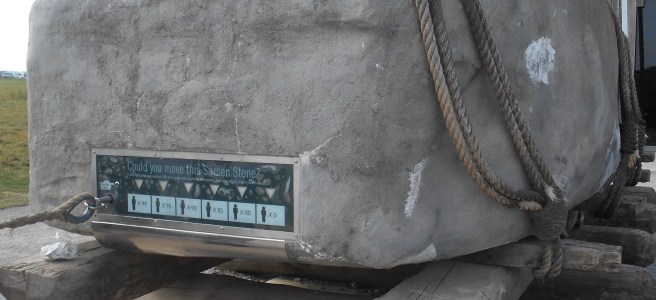


When you are on Staycation you will visit places after breakfast that others have crossed the world to see. We had not been to Stonehenge since the new visitors’ centre was built, out of sight of the World Heritage Site. The A344 which previously enabled motorists to ‘come across’ Stonehenge, but also intruded on the peace of the past, is now used solely by the fleet of buses with destination The Stones on the front.
If you belong to English Heritage or the National Trust entry is free. You can hop on the bus or walk; divert off the road through chalky fields to enjoy the peaceful scenery of Salisbury Plain. There is nothing at the stones now so make sure you avail yourself of the visitor centre toilets and take a bottle of water.

On a Monday morning, with school holidays over and the website stating timed tickets were not needed, we thought it would be quiet. The lady at the booth issuing our free tickets said it was very busy as several cruise ships had come in; this presented a strange vision.
It was almost a pilgrimage, Pilgrimage Lite perhaps. We set off at a brisk pace, overtaking lots of people and hearing various languages, we’re British, we can walk fast…

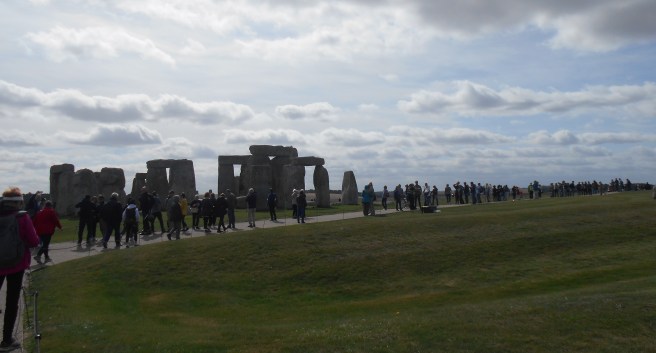
We started to anticipate the moment when Stonehenge would be revealed; round the next copse or over the next brow? Alas, the first view was partially blocked by the ubiquitous buses and queues of people. Queues waiting to have their tickets checked and file between the ropes to the stones, even longer queues waiting to get back on the shuttle bus.

Only a low rope separated us from the stones, creating enough space inside the circle to imagine how they were when they stood alone. A young Canadian tourist asks to have his photo taken, with the toy penguin that is to accompany him on his trip round Britain.
We ask a tour guide where she’s from.
Portland
USA?
No, Dorset…
She had come to meet passengers who had left their ship at Dover and been coached to Wiltshire.
But the tourists that morning were not rushing and ticking off another place visited, they were in genuine awe that they were really there looking at an ancient construction no one can explain for sure.
This year marks one hundred years since Stonehenge was given to the nation.
On 26 October 1918, Stonehenge was offered by Cecil and Mary Chubb as a gift for the nation. Cecil Chubb had bought Stonehenge for £6600 at a local auction three years previously. Prior to 1918, the monument was propped up with wooden poles and some of the stones were in danger of collapse. Increasing numbers of visitors through the late 19th century had led to damage, with people regularly chipping the stones for souvenirs and scratching their names on the monument.
http://blog.english-heritage.org.uk/30-things-you-might-not-know-about-stonehenge
The first guidebook in 1823 claimed Stonehenge survived Noah’s flood. We do know the stones came from South Wales, that is part of the mystery, how they got there. Stonehenge was built between about 3,000 BC and 1,600 BC and its purpose remains under study. What is certain, if you stand in just the right place inside the monument at the summer solstice, facing northeast through the entrance towards a rough-hewn stone outside the circle, known as the Heel Stone, you will see the sun rise above the Heel Stone.
http://earthsky.org/earth/gallery-the-summer-solstice-as-seen-from-stonehenge
A few days later visitors came round and asked how the staycation was going and where we’d been.
‘Oh, that heap of old stones’ was their reply.

https://www.ccsidewriter.co.uk/chapter-five-beach-writer-s-blog


We visit Winchester Cathedral quite often; this time we had been told about the flower festival. After a late breakfast at Wetherspoons we sauntered down the road to the cathedral. It was a week day so we weren’t expecting to see a queue to get into the cathedral, but a flower festival by definition can only last a short time.

It was worth the wait; it was a flower festival like no other I have ever seen and the rich colours cannot be conveyed in the pictures. What can be shown is the crowds. There were a lot of very English,’ excuse mes’ and ‘sorrys’ as we all tried to take photos or stay out of the way of other people taking them. Winchester is very light inside and gazing up you could forget you were not alone.

The rich reds, blues and purples reflected this year’s theme which was inspired by the Winchester Bible.

The Winchester Bible is the largest and finest of all surviving 12th-century English bibles. A single scribe wrote out its text in Latin, while artists worked its exquisitely illuminated capital letters. Their glowing colours, including gold and lapis lazuli, are as intense today as 800 years ago.

We have never seen the Bible. On a previous visit, hoping to see it, we were informed with great satisfaction by an officious lady that the room where it was kept was closed that day! This time we could have queued to see one volume in a temporary exhibition, but made the decision to queue for the crypt.

Down here, often standing in water, is Antony Gormley’s statue. Cyberspouse got a picture years ago when he pushed open a door that was ajar to see where it went; that time the statue was a complete surprise. This time the surprise was to see a candlelit path to the man with cupped hands.
http://www.winchester-cathedral.org.uk/our-heritage/art-architecture/antony-gormley-sculpture/

http://www.winchester-cathedral.org.uk/


On staycation you visit places for the day that others may have travelled across the world to see. We chatted to a couple who had come down from the North, but had the convenience of a son-in-law who worked at the cathedral and lived in the cathedral close, so they had free delightful accomodation and the opportunity to look round when everyone else had gone home.

In my novel Three Ages of Man the stranger has never seen anything as old and solid as a cathedral and marvels as he lays his hands on the stone walls of Winchester Cathedral.

Salisbury is a small city where we used to think not much happened. It lies in the county of Wiltshire, where you might think not much has happened since Stonehenge was built. Salisbury is a city because it has a cathedral. It is not large, but it is busy with a hospital, university and many places of interest to historians and tourists.
Since March this year it has been in the international news with the poisoning by novichok nerve agent of two Russians and a local policeman. Just when Salisbury was getting back to some normality there was the bizarre tragedy when two locals were taken ill and one became the first fatality. Two Russian suspects have been named and even appeared on Russian television to explain they visited Salisbury merely as tourists to see the cathedral with its famous spire and the oldest clock in the world.

You couldn’t make this story up; if these two men were ‘secret agents’ they certainly bungled the whole mission, their target was not killed, though he and his daughter only survived thanks to the National Health Service and skilled care. Before leaving Salisbury they dumped the novichok in a rubbish skip. Through all these months, parts of Salisbury have been closed off and scoured for any trace of the nerve agent, a nightmare for businesses expecting a busy tourist summer.
We quite often go to Salisbury and went there last week after our morning at Stonehenge. Everywhere seemed busy, but perhaps they were locals.

I can believe the two suspects didn’t find the cathedral; though the famous spire can be seen for miles around, the first time we visited we stood in the main square and could not see it, we had no idea which way to go.
Through an arch you will find yourself looking at the cathedral green; fine weather shows the scene at its best. This area is full of interesting houses and museums and the expanse of grass is ideal for children to run and play and school parties to let off steam. There is too much for one visit, but whatever your plans just stand by yourself and look up at the spire.
The refectory, cloisters and smart toilets are free to wander in. Do you pay to go in the cathedral? There is a suggested donation. On our visit, late in the afternoon, I was just trying to read what we might ‘kindly be asked’ to pay when I realised Cyberspouse was already inside. We may have accidentally followed a coach party in. The house of God should be free to enter, but cathedrals need constant loving and expensive care. We always buy our refreshments at the refectory and there is a nice shop for tourists.

Cathedrals can be overwhelming, I guarantee most of us do not remember all the saintly and royal details in the leaflets. Take in the ambience and spend time with what takes your eye. Highlights include the clock, perhaps the Russians wanted to steal our cutting edge technology! Look carefully down the nave and see if you can spot the columns bowed at the centre of the cathedral under the weight of the spire. A model of the spire shows the original wooden scaffold still there. Another model shows the cathedral being built; I had a nice chat with an American lady as we admired the model and the original builders. The biggest miracle of ancient buildings is the fact they are still standing and I love to wonder if those who built it could have imagined how far into the future their creation would be admired.

Cathedrals are living places and new art is added. I love the font, sculptor William Pye, consecrated in 2008.

On our brief stroll around the cathedral Cyberspouse met a woman from Iceland, tourists are still coming to Salisbury.
https://www.visitwiltshire.co.uk/salisbury/things-to-do
My Brief Encounters trilogy is partly set in rural Wiltshire and Salisbury also features, especially in Lives of Anna Alsop.



https://tidalscribe.wordpress.com/2018/09/05/to-the-pier/
https://tidalscribe.wordpress.com/2018/09/07/friday-flash-fiction-flies
 Times and Tides of a Beachwriter