September Sunday Salon

https://smorgasbordinvitation.wordpress.com/2025/09/06/smorgasbord-summer-book-fair-my-recommended-books-history-southafrica-pat-spencer-haiti-thriller-mark-bierman-australia-adventure-janet-gogerty

https://www.goodreads.com/book/show/239183916-pandemonica

Tuesday Tiny Tale – Out of the Blue

I spotted him on Facebook. He had the same surname, my maiden name, an unusual name that I never come across outside my family. Was this Brian standing on a mountain top a relative? He was gazing across a rolling green landscape. His words with the picture were Fantastic trail and so therapeutic.’

I followed the link to a national park in New Zealand, well he could still be a relative. On a whim I posted a comment.

Then I realised he was probably asleep, night time in New Zealand. I pondered which Facebook friends we could have in common, how else would I be seeing his post?

The next morning there was a brief reply to my comment.

‘Could well be, I came out here years ago.’

I was soon on the phone to Mum, she kept tabs on Dad’s relatives better than he had done.

‘Brian, Brian…hmmm your Dad’s cousin Sheila had a Brian who went out to New Zealand. I always used to send him a Christmas card, only ever got one back. Dad wondered why I bothered. I guess I did it for Sheila’s sake, her only son. He didn’t get over for her funeral; sent an ambiguous letter, not sure if it was health or money, but it is a long way. I never actually met him, not sure how old.’

I was curious. ‘Do you still have his address, I mean he probably moved around and never got your cards. But I could send him a Christmas card, from all the comments sounds like he’s been having a hard time.’

‘Bring your pill round tomorrow and show me, might not even be our Brian.’

‘You mean my tablet?’

‘Yes that screen thingy you’re always playing with.’

Mum and I checked him out, certainly seemed to be the real Brian. He had led an adventurous life, looking at some of his posts and he sounded an interesting chap.

  I sent him a card, there was still time to post airmail across the world. That seemed less intrusive than trying to contact him on Messenger. Without thinking I put one of my charity address stickers on the back of the envelope.

Yesterday I had just returned from walking the dog in the rain, wet hair plastered on my face, muddy jeans and socks left by the back door, when  I heard the doorbell. I was about to dart through the hall and dash upstairs to get showered and ready for my afternoon shift. I was not expecting anyone, perhaps John had ordered something from Amazon. I put my dressing gown on and went back downstairs to check if a parcel had been left.

I didn’t recognise him at first, drenched and with a shabby rain soaked bag at his side.

‘Surprise, surprise, thanks for your card, you don’t know how good it was to hear from someone at home.’

John wasn’t too pleased to come home late that evening and find we had a guest in the spare room, a guest wearing his dressing gown. Turns out he is not as interesting as his Facebook persona and apparently has far worse problems than his posts implied. Almost two weeks till Christmas and we don’t know what his plans are, but they include Christmas with ‘his family.’

A Christmas favourite that might cheer Brian up.

Ten Pound Poms

Many of us have been watching a new BBC Sunday evening drama, Ten Pound Poms, prompting friends to ask how it compared with my family’s experience. The brief answer is completely different and I have found myself being irritated by some aspects of the series, not enough to stop me watching it though! In the drama it is the 1950s and the characters sail out to arrive in Sydney six weeks later, six seconds later for viewers. They are taken on a bus to a migrant camp, winding through bushland till some Nissan huts hove into view. My first annoyance was we had no idea how far away from Sydney they were, all it takes is for a character to say ‘blimey, a hundred miles from the city…’

Anyway, there they were with Nissan huts, dreadful looking outside ‘dunnies’ ( toilets ) and shower blocks. My running irritation is that one of the main characters, Kate the nurse, has make up more suited to modern reality shows or a girls night out. Her eyebrows are ridiculous and in the Australian heat her makeup would be running down her face, not that matron at the hospital would have allowed her to wear such makeup!

The Australians they meet are mostly awful, but so are some of the migrant characters; there are a lot of running stories packed in to this series. They seem to be in the middle of nowhere, but also near a country town, a hospital, the sea and some very swanky houses. What themes do ring true in this drama are the treatment of the Aborigines, who were not counted as humans in the census till the 1960’s and the fact that English children were sent out to Australia as orphans, but many had parents who didn’t know where they had gone.

Perth, Western Australia in the 1960’s

My family’s story is not as dramatic, for any of you who are watching the television series. It took Mum and Dad only six months from the time of applying to us all getting on a chartered migrant flight at Heathrow in October 1964. They chose Perth, Western Australia and we had a ‘sponsor’ who was a chap Dad knew ‘from the office’, the two families had never met. He met us at Perth airport at 1am and took us to the caravan he had booked for us. A week later my parents had found a house to rent. If we had needed to go to a migrant camp I’m sure my mother would not have stepped on the plane! By Christmas they had bought a house on a quarter acre block in a new suburb. Migrants were told that all houses were built on a quarter acre block, that idea didn’t last, but our house had natural bushland.

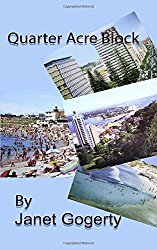
My novel Quarter Acre Block is inspired and informed by our family’s experience, but not autobiographical. It is told from the point of view of the daughter, who may have some similarities to me… and of the mother. Mum helped me with the adult experience point of view. In the rented house in an older suburb Mum said the only neighbour who talked to her was Dutch, but at our new house we quickly became friends with our new neighbours, who were dinky di Aussies from the goldfields of Kalgoorlie.

The lifestyle migrants looked forward to..

We knew little about Aborigines, I guess we assumed they were enjoying their lifestyle out in ‘the bush.’ We knew nothing about migrant children and stolen Aboriginal children being abused in orphanages.

In the nineteen sixties many ‘ten pound pommies’ had never left England before and most expected never to return or see loved ones again. George Palmer saw Australia as a land of opportunities for his four children, his wife longed for warmth and space and their daughter’s ambition was to swim in the sea and own a dog. For migrant children it was a big adventure, for fathers the daunting challenge of finding work and providing for their family, but for the wives the loneliness of settling in a strange place.’

Only 99 pence to download to Kindle or buy the paperback for ten pounds.

Have you been watching Ten Pound Poms, or have you or your family had experience of migrating to another country?

Retroblog – Australia 1965

By Christmas 1964 we were in our new house on a quarter acre block; south of the Swan River in a new suburb laid out in the popular grid pattern. Our street would soon go on for miles, but at the time there was still a sandy track between us and the few shops. The location was ideal for Dad’s new job and we could see my future high school across the paddocks opposite our house. On one side of our house was bush with beautiful ‘Christmas Trees’ covered in yellow blossom. The other side was an empty quarter acre block that mirrored ours with gum trees and black boys – now days they are called grass trees – almost prehistoric, they had black trunks with long tough grass like spikes. They were said to grow just one inch a year, which is probably why they were only waist height.

48368557_265702204123652_6619187581215047680_n

On the other side of the empty block were our only neighbours, Mable and George, dinky di Aussies who had retired from the goldfields in Kalgoorlie. George got himself a job as a dustman and after work devoted himself to the novelty of a television set. Mum and Mable became good friends, they were both strangers in Perth; to Mum it was a tiny city, but to Mable huge, she had never been on an escalator. Mable and George’s only son lived in The Eastern States, two thousand miles away; he may as well have been in another country. Even today Perth is still the most isolated modern city in the world.

DSCN4070

Around the corner were more houses; Dad soon found me some new friends when he went to buy petrol and met a Pommie who worked at the service station. The two families with two girls each were more established and had television sets. Mum and Dad had vowed never to get one now we had got used to its absence, they weren’t missing much, television was quite new in Western Australia.

Christmas was strange, no relatives to come and visit, no parcels to arrive in the post and Mum and Dad on a very tight budget.  My parents had not found a church, nor were they likely to find one to match the ancient parish church with a thriving congregation that we had left behind. Candlelit services and the dark greens and reds of winter were now in the past. But when our packing cases finally arrived it was like Christmas as we were reunited with our favourite books and toys.

Only one of my new friends was also starting high school at the beginning of February 1965. I was glad to have someone to go with, but as we walked along the sandy track on the first morning Linda told me that if you didn’t pass your junior exams you had to repeat the whole three years. I believed her.

There were fourteen hundred children in the school, it was a senior high school so that included fourth and fifth years. We all lined up on the grass in front of a long veranda. There was no assembly hall. Names were called and we were allotted to the ten classes, Linda and I were separated. Although education was comprehensive the classes were ranked. 1-9 and 1-8 the only classes to do French, then all the way down to 1.1 and if you were in 1-Special that was bad… I had made it into 1-9, another girl in my class later told me she thought 1-9 was the bottom class and went home and cried.

I was on my own, but not for long, an Australian girl said ‘Do you know anybody?’ she was new to the area and in the same boat, we became friends.

Other Families

Teenagers always think other people’s families are more interesting than their own, but Marjorie’s family really were. Marjorie was my best friend in second and third year high school in Perth, Western Australia. In first year Janice had been my best friend, mainly because neither of us knew anybody else on the first day; I was new in the country, she was new in the area. But Janice was a bit boring, confirmed by the fact that she wanted to do shorthand and typing and sidestepped to the commercial course. Our ways parted.

Marjorie was much more fun and for the next two years leading up to our Junior Exams we must have driven the teachers mad with our incessant giggling and occasional pranks. Our English teacher was driven to comment in front of the whole class

Do you two want to ruin your whole lives?

In time, it turned out that Marjorie had a photographic memory and had no need to pay any attention in class to sail through her exams.

DSCN4070

But back to the beginning and the first time I cycled round to Marjorie’s house. Her parents were Dutch and had brought her to Australia as a baby; I don’t think being Dutch had any relevance to the way their home was run, though to me it seemed more exotic than being English or Australian. I was fascinated by the way they pronounced Marjorie and to this day I think of the name with that accent and love the way the Dutch speak.

She had two Australian born brothers, Johnnie and Steve, indistinguishable with their blonde crew cuts. Their house was the only one in the street with a boat and three geese in the front garden. I don’t think the boat ever made it to the Swan River, let alone Fremantle Harbour or the Indian Ocean.

The geese made good guards; somehow I made it to the front door. Inside, the house was dark; that was not unusual, most of the Australian houses were kept in Venetian blinded gloom, shielded from the glaring sun.

Marjorie’s house was SHC, State Housing Commission. It was years before I realised some Australians were very resentful that migrants were housed ahead of them.

We headed for the bedroom to inspect her pop pin ups and she opened her wardrobe to reveal more pictures on the inside of the door. Sitting on a pile of clothes on the shelf was a packet of spaghetti; kept safe from her brothers who liked to eat it raw. When we went back to the lounge her brother was sitting on the settee eating dry cornflakes from a large green bucket. The visit was also more adventurous as her mother was out at work, a novel concept for me.

When my new friend came round to my house for the first time Mum offered her a cool drink and Marjorie said Oh, isn’t your fridge clean.

Ever after Mum wondered what their family fridge was like; empty probably. Her mother only cooked a proper meal on Sundays, when they always had steak, another reason for disapproval by my mother.

Marjorie was the first person I knew who worried about being fat and filled up with bottles of Coke to avoid hunger pangs. In our house meals were regular as clockwork and always delicious. Coca Cola never darkened our fridge, nor did I have any money to buy it from the corner shop near Marjorie’s house.

My novel Quarter Acre Block is not autobiographical, but is inspired by our family’s experience of emigrating to Australia. You can read more about that time at my website.

https://www.ccsidewriter.co.uk/chapter-six-fiction-focus/

Read about the time leading up to our family’s departure to Australia in a previous blog.

https://tidalscribe.wordpress.com/2018/03/19/quarter-acre-blog/


Quarter Acre Blog

The first time Australia was mentioned was at breakfast on a school day. I was astonished when Mum said

‘How would you like to go to another country?’

Where had this idea come from? The furthest we had ever been was a hundred miles to visit my aunt in Cheltenham.

I replied instantly ‘If I can have a horse.’

I had always wanted a horse and what other reason could there be for going to another country? I would need no help caring for it due to my extensive reading of the Kit Hunter Show Jumper series and all the other pony books I could lay my hands on.

37731933_2198003693562742_2018051222237347840_n


‘Australia?’

I returned from my reverie to hear what Mum was saying. A new picture presented itself; warm weather, living by the seaside and swimming every day. I couldn’t actually swim, but had been up to my chest at Frensham Ponds and in the sea, while Mum and Dad sat in deck chairs huddled in coats and rugs.

But my most vivid image of what our Australian life would be like came from my favourite television programme, The Adventures of the Terrible Ten. Ten children living in rural Victoria, who all had ponies, discovered some old packing cases and built Ten Town. They never went to school or saw their parents.

Mum said I might get a horse, would probably get a dog and would definitely go swimming. But for now the whole adventure must be kept deathly secret; until we knew for sure we had been accepted for migration. This meant absolutely no one, not even my best friend or my younger brother and sister. I kept the secret.


It was spring now and by autumn we would be ready to go, not on the dangerous voyage of the early settlers, but Mum and Dad would be burning their boats. Cheap flights at ten pounds each for Mum and Dad and free for children; but it was a one way ticket. My parents expected never to see England or their relatives again.

In the meantime a momentous year lay ahead. It was our last year at junior school; the first year Top Of The Pops was broadcast and in the garden shed our pet white mice were multiplying rapidly. As top years we went on school holiday for the first time to the Isle of Wight. It was a very pleasant holiday, but two strange things happened. As a Church of England school we knew several of our classmates were Roman Catholics, it made no difference to them or us. But on the Sunday of the holiday, one poor catholic boy was to be marked out as different. All of us were to attend morning service at the local church, but Eric’s mother had decreed that Eric must go to the catholic church. As a relatively new boy he was already slightly different; now as his lone figure trudged off in the opposite direction, to the mysteries of candles and incense, he had become an outcast. Later that day, as we ran around in the grounds of the hotel, some primeval, sectarian instinct took over and we all chased Eric; convinced in that moment that we were going to lynch him. Luckily the teacher came out blowing her whistle and normality was restored.

Peter was another unfortunate boy. For some reason he was the only child of our class of forty who didn’t come on the holiday. As we ate dinner one evening, the headmaster came into the dining room looking very distraught. Peter had run away from home and managed to reach the island before being caught by the police. We all thought him very clever to have got that far and very sad that he still wasn’t allowed to join us.
35886313_2139447919418320_9163025049106513920_n(1)


Back at school our summer term was nearing its end; we practised maypole dancing ready for our centenary celebrations and Mum and Dad visited the headmaster. Later that day he entered the classroom to chat to us; a common occurrence, but this time I realised with horror he was talking about me. I had kept my promise and not told a soul and now was mortified the headmaster was telling everyone I was going to Australia! Having spent four years mostly unnoticed, I was now the centre of attention as everyone turned to look at me.

DSCN4068

As autumn arrived life became surreal. The date was set for our departure. I had passed my eleven plus, but it would make little difference to my future, the Australian schools were comprehensive. Our little school gang had been split in half, four of us were going to grammar school; one mother didn’t come out of the house for a week with shame that her daughter had failed. For a few weeks I experienced a glimpse of what my life might have been at a girls’ grammar school, dressed in bottle green uniform with the excitement of Bunsen burners.

Soon our house was sold and we had reached the point of no return. As the taxi collected us for the airport my grandparents stood stoically waving and my school friend Wendy skipped up the road after us; she would be the only person from those days to stay a lifelong friend.

DSCN4070.JPG

The taxi had been late, very stressful for my parents. As we arrived at London Airport     (now Heathrow) our friends and relatives were waiting, wondering if we had changed our minds. We rushed through with hardly time to say goodbye. The airport was much smaller then; as we climbed the steps to the plane we could see our loved ones gathered on the balcony waving. Except for Dad, it was the first time we had been on an aeroplane. I was really excited until I noticed the big card in the seat pocket. How to put on your lifejacket! Until that moment I had not considered the possibility that planes could crash. I wondered if we would reach Australia.

6


My novel Quarter Acre Block was inspired by our family’s experience. It is not autobiographical, but people who have read it ask which things were ‘true’. Find out more at my website.   https://www.ccsidewriter.co.uk/chapter-six-fiction-focus