
When you are on Staycation you will visit places after breakfast that others have crossed the world to see. We had not been to Stonehenge since the new visitors’ centre was built, out of sight of the World Heritage Site. The A344 which previously enabled motorists to ‘come across’ Stonehenge, but also intruded on the peace of the past, is now used solely by the fleet of buses with destination The Stones on the front.
If you belong to English Heritage or the National Trust entry is free. You can hop on the bus or walk; divert off the road through chalky fields to enjoy the peaceful scenery of Salisbury Plain. There is nothing at the stones now so make sure you avail yourself of the visitor centre toilets and take a bottle of water.

On a Monday morning, with school holidays over and the website stating timed tickets were not needed, we thought it would be quiet. The lady at the booth issuing our free tickets said it was very busy as several cruise ships had come in; this presented a strange vision.
It was almost a pilgrimage, Pilgrimage Lite perhaps. We set off at a brisk pace, overtaking lots of people and hearing various languages, we’re British, we can walk fast…

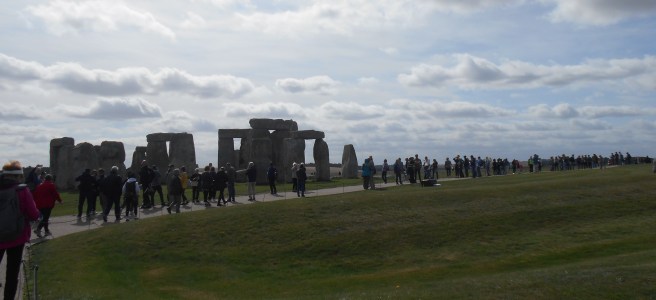
We started to anticipate the moment when Stonehenge would be revealed; round the next copse or over the next brow? Alas, the first view was partially blocked by the ubiquitous buses and queues of people. Queues waiting to have their tickets checked and file between the ropes to the stones, even longer queues waiting to get back on the shuttle bus.

Only a low rope separated us from the stones, creating enough space inside the circle to imagine how they were when they stood alone. A young Canadian tourist asks to have his photo taken, with the toy penguin that is to accompany him on his trip round Britain.
We ask a tour guide where she’s from.
Portland
USA?
No, Dorset…
She had come to meet passengers who had left their ship at Dover and been coached to Wiltshire.
But the tourists that morning were not rushing and ticking off another place visited, they were in genuine awe that they were really there looking at an ancient construction no one can explain for sure.

This year marks one hundred years since Stonehenge was given to the nation.
On 26 October 1918, Stonehenge was offered by Cecil and Mary Chubb as a gift for the nation. Cecil Chubb had bought Stonehenge for £6600 at a local auction three years previously. Prior to 1918, the monument was propped up with wooden poles and some of the stones were in danger of collapse. Increasing numbers of visitors through the late 19th century had led to damage, with people regularly chipping the stones for souvenirs and scratching their names on the monument.
http://blog.english-heritage.org.uk/30-things-you-might-not-know-about-stonehenge
The first guidebook in 1823 claimed Stonehenge survived Noah’s flood. We do know the stones came from South Wales, that is part of the mystery, how they got there. Stonehenge was built between about 3,000 BC and 1,600 BC and its purpose remains under study. What is certain, if you stand in just the right place inside the monument at the summer solstice, facing northeast through the entrance towards a rough-hewn stone outside the circle, known as the Heel Stone, you will see the sun rise above the Heel Stone.
http://earthsky.org/earth/gallery-the-summer-solstice-as-seen-from-stonehenge
A few days later visitors came round and asked how the staycation was going and where we’d been.
‘Oh, that heap of old stones’ was their reply.

See more pictures at my Beachwriter’s Blog
https://www.ccsidewriter.co.uk/chapter-five-beach-writer-s-blog
Look out for Friday Flash Fiction as the Stones theme continues…



 Times and Tides of a Beachwriter