Happy Birthday Shakespeare

DSCN5865

Stratford-upon-Avon was a busy town long before William Shakespeare was born. In 1196 King Richard I granted Stratford the right to hold weekly markets. A lively town in the heart of the country, trading wool, with many craftsmen such as blacksmiths, carpenters, shoemakers, brewers and bakers. By the 13th century Stratford also had a small grammar school.

DSCN5866

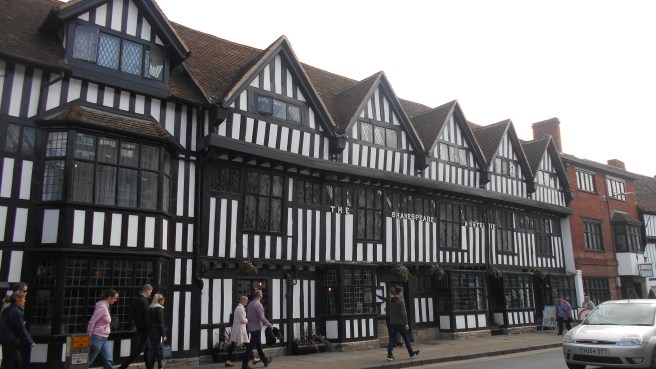
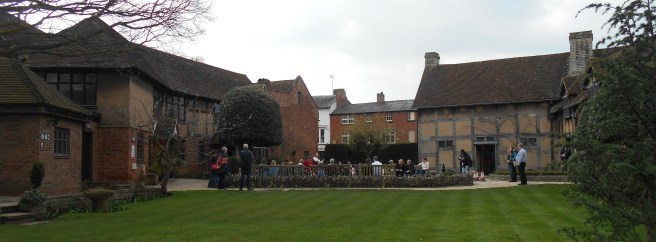
The town is full of interesting old buildings which must have seen many transformations over the centuries, ending up as hotels or designer shops.

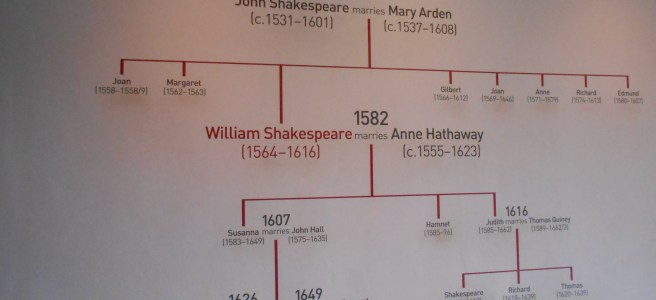
In 1557 a glover from Stratford Upon Avon named John Shakespeare married Mary Arden, the daughter of a well-to-do farmer. Their son William was born on or about 23 April 1564 in a house in Henley Street. And it is this house I had the chance to visit recently. After a varied history the house was purchased by a charitable trust in 1847, sponsored by well known names such as Charles Dickens.

30698416_2052037664826013_8232524434582274048_o

DSCN5840

DSCN5861

Luckily it was a fine day when I was there; the gardens are very pretty and you can sit and listen to costumed actors who will take your requests for speeches.


DSCN5846

DSCN5843

dscn5851.jpg

DSCN5844

DSCN5854

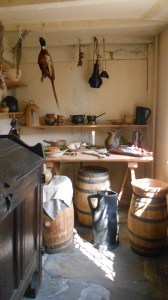
Inside the house costumed guides are there with plenty of snippets of information or domestic details. Dinner was eaten at 11am; as the son of a middle-class citizen William would have attended the grammar school. He went to school at 6am then came home for his dinner. Sumptuary laws in Tudor times aimed to keep class distinctions and prescribed what people could eat. The Shakespeare family were allowed two courses, but each course included plenty of dishes.

DSCN5860

30709555_2052910448072068_6578983328660062208_n

Upstairs you can see the marital bedroom where William was born, even the likely spot near the fire, with his mother probably using a birthing stool. Younger children shared with their parents, a truckle bed being wheeled out from under the parents’ double bed and did not sleep in a separate room until they could be trusted with a candle. Wooden houses with rush floors were a great fire hazard. For the same reason all domestic fires had to be put out at sunset; the risk of a spark while everyone was asleep was too great. Doorways were small, not because people were much shorter, they weren’t, but to keep the heat in. The long nights of winter must have been uncomfortable, especially as people slept sitting up with a bolster and pillows. They believed if the Devil saw them lying down he might think they were dead and take their souls.

DSCN5859

Read more about my trip here.

https://www.ccsidewriter.co.uk/chapter-four-travel-diary


Visiting Jane

DSCN5962

On Monday we paid a long overdue visit to Jane’s house; Jane Austen’s House in Chawton, Hampshire. I had always imagined the little cottage under siege by coach loads of tourists, timed tickets and queues. Perhaps a Monday school day, arriving soon after opening time, made it a simple and civilised visit that Jane would appreciate.

dscn5963.jpg

We parked in the free car park as instructed on the website; all was quiet, rain threatened, but never happened. The wet winter has left the gentle Hampshire countryside lush and green.

dscn5968.jpg

Jane’s friends were cheerful and welcoming, the tulips and primroses in the pretty gardens were at their best. It was a bit early to call on the Misses Austen so we roamed the gardens, looked around the bakehouse, enjoyed a moving picture of family life and admired the beautiful quilt given to Jane for her anniversary last year. Everything was seemly, nothing tawdry presented to visitors.

DSCN5970

We felt immediately at home when we stepped inside the red brick cottage. The Austen ladies do not own this house, but I would never let on that I knew this. What does that matter when Jane feels so at home here, at peace to write while Cassandra and their aptly named friend Martha take care of the housekeeping. Left an orphan, with just a little money I gather Martha Lloyd became part of the family long ago, not in a position to be independent or find a husband.

30716485_2055172457845867_551388799108644864_o

dscn5974.jpg

The Drawing Room is newly papered in a pretty yellow pattern, Chawton Vine. It was here we met a relative of Jane’s brother Edward, Jeremy Knight, who invited us up to the Great House, as Jane calls it, for lunch later. Who could have foreseen when the Austens sent their son to be adopted by the Knight family that he would be instrumental in making sure his sister’s novels were published.

DSCN5989

Upstairs the floorboards creaked and Jane will not have the creaky door fixed as it is a warning of someone coming so she may hide her writing. Mrs. Austen’s room is the largest and is newly decorated with a pretty ribbon trellis pattern wallpaper. The ladies have stitched a beautiful patchwork coverlet. Every window sill had a pretty cup with a posy of spring flowers, testament to how beautifully the ladies keep the cottage.

DSCN5987

DSCN5985

We didn’t stay too long, Jane’s health has not been good and like all authors she probably can’t wait for visitors to leave so she can return to her writing.

DSCN6000

Back outside the rain still held off and we walked up the road in Jane’s footsteps to Chawton House, the merry sound of the local children at playtime ringing in our ears as we passed their school. With fields all around one can see why Jane and Cassandra enjoy two hour walks every afternoon. Up the long driveway to the house it was very quiet, we rang the doorbell and it was quickly answered; we were welcomed inside and shown into the cosy kitchen. We only had time for a scone and tea, as we had another appointment, but promised to come again when we return to see Jane.
dscn6001.jpg

DSCN6004

DSCN6005

Every Picture Tells a Story

We have shelves full of them, boxes in the loft; barring a house fire or aircraft crashing onto our roof, a large collection of photograph albums, some inherited, could be passed on into history. Black and white pictures on black pages, sticky pages unpeeling, flip up albums of 6×4 prints. But the days of calling at the chemist to collect a packet of prints, the hoped for best shot out of focus, are a mere memory.

dscn97931

When we joined a camera club over a decade ago, only half the members had converted to digital, now the colour slide show has been replaced by digital images projected from a computer onto a screen. Charity shops are full of old cameras. The real enthusiast used to be someone who had his own dark room, now he has a computer, sophisticated software packages and a good quality printer. Digital photos can be printed out by anyone, a trip to the supermarket machine, put in your memory device and collect.

DSCN2389

Unlike a roll of film, digital never runs out. Many computers are full of thousands of unseen images, lost to history as technology changes. From pictures taken on mobile phones of news as it happens, to bumble bees captured with the most expensive macro lens; everyone is a photographer now. I prefer compact cameras that point and shoot. But for the ‘technowhiz’ with the right software and a lot of patience, there is nothing that can’t be done to a digital image; cut down to size, lamp posts erased, colours altered, several snaps melded together or the photograph turned into a painting. My book covers are all created with digital designs using original photographs.

Authors are advised to have a website; you can build your own or find a website provider. I found myself with a template; a digital scrapbook waiting to be filled, not just with words, but with pictures. The means to an end became an end in itself.

P1050019

Visit my website for seasonal pictures, travel views and a picture quiz.

https://www.ccsidewriter.co.uk/

P1040418

Facebook; social interface, time waster, or something more sinister? It does not need to be filled with family photos and intimate details of your life. Artists and photographers just enjoy sharing pictures and many of us relish seeing places we are never likely to visit ourselves.

P1050387

I have my camera or my smart phone with me all the time, still recording holidays and family events, but looking out for the unusual and interesting, snapping anything that might be suitable for future blogs or Instagram.

DSCN2296

P1040880

P1050043


Ironically, despite this revolution and the explosion of digital colour everywhere we look, people love old black and white photographs; most of us are intrigued if we visit an exhibition. We enjoy the iconic images and the best photographers of that era took beautiful pictures. There is a clarity and sharpness in black and white photographs that has never been present in colour images. The other attraction is that past lives are captured, whether it is a crowded city street or an individual’s gaze, every picture tells a story.


dscn0620.jpg

It might seem that in modern life onlookers are all too ready to snap or even film disasters with their smart phones, but keen photographers are often reluctant to take photographs of people going about their normal day, fearful they will be seen as terror suspects or unsavoury characters. It would be a shame if the early Twenty First Century was represented by rural scenes and cityscapes devoid of human beings, I enjoy taking natural shots of people.

DSCN0029DSCN0026P1050116


Visit my Beachwriter’s Blog to see my latest pictures of people and places.

https://www.ccsidewriter.co.uk/chapter-five-beach-writer-s-blog/

P1050630

DSCN1421

P1050626


P1050898

P1060944

P1100380

Friday Flash Fiction – Fortunes

On The Pier

I did the test that morning, it was positive. I should have been pleased, but all I could think about was last night’s Crimewatch. Of course I had no proof, just a gut feeling, so instead of phoning I went for a walk down to the sea front to clear my head. I wandered onto the pier and that’s when I had the idea.

dscn4541.jpg

I stood beside the gypsy caravan and read the sign.

LET ROSA TELL YOUR FORTUNE… AND GIVE ADVICE

Nervously I climbed the two wooden steps and opened the creaky door. It was pretty and cosy inside, not scary at all. A grandmotherly figure beckoned me to sit down; her cheeks were rosy and her dark eyes sympathetic. She took my hands but did not look at them.

‘Er… do I have to pay?’

‘No dear, I would never take money from one so deeply troubled.’

My mouth was dry, I didn’t speak.

‘You will have your wish, a beautiful son; but if you want to see him grow up you know what you must do today. Go now.’

‘But I don’t understand…’ I mumbled, as she motioned me out.

DSCN4533

But I did understand. I climbed down the steps, closing the door behind me and reached into my bag for my mobile. I tapped in the number that was etched on my brain, the Crimewatch number.

dscn4526.jpg

More flash fiction and longer stories in Someone Somewhere.

Take a peek.


A Novel Experience

Catching up with family and friends is always very pleasant, especially if it involves eating out. It is even more enjoyable for a writer if some of those present are reading or have finished one’s latest novel. But if someone says they have read the second in your trilogy, but could not find the third volume on Amazon, it is embarrassing to admit you haven’t finished writing it.

DSCN5154

Often the reading experience is out of our hands.  A friend has finished your novel after at last finding her Kindle charger. It was lost during the process of moving; she thought that may have been why the middle part of the book seemed to move slowly.
Whether your readers have a real paper book or are dependent upon electricity, they bring their own experience to the novel, it is out of the author’s hands. Sadly we can’t expect every reader to take a week off work and live undisturbed in isolation, so they can give our novel the attention we think it deserves. Those who devour a book in a week and get ‘lost’ in it are the writer’s dream. In reality people drop their paperbacks in the bath, can’t read their Kindle on the bus to work because it makes them feel sick, or lose their book down the back of the sofa. They read at bedtime and fall asleep after one page, or they wake up in the middle of the night with raging toothache and read their Kindle to try and take their mind off the pain, so that your novel is forever associated with misery.

DSCN3074

Outside factors may encroach; family dramas involving lots of form filling take over just as they reach chapter three of your novel.
Even if reading is proceeding well, each reader has memories and moods; they read your words through a prism of their own.
An author whose novel is turned into a film may see his book as others see it. We have all seen a film and thought it unlike the book. I saw a film after enjoying a well known novel and thought the film was rubbish, felt indignant on behalf of the author. I was later surprised to hear him talking on the radio about how pleased he was with the film adaptation.
Despite your readers’ experiences and the impossibility of seeing into their minds, if they say they loved your novel and were left stunned by the ending you know they’ve read it ‘properly’.


If you are feeling strong enough, visit my Amazon author pages for a glimpse at my novels.

https://www.amazon.com/Janet-Gogerty/e/B00A8FWDMU/

https://www.amazon.co.uk/Janet-Gogerty/e/B00A8FWDMU


Easter Eggs

                  Easter Eggs; I wonder if I would still remember how to foil wrap them? A skill I learnt one winter many years ago. I had joined a job agency in desperation; a bit of a come down after the Christmas season in Harrods toy department, but then that was the point of a working holiday, different experiences.

Croydon, South London, early on a grey winter’s morning, a disparate group of people get into the agency mini bus. We are being taken to a sweet factory to do the Easter Egg run. ‘Paynes’ it certainly isn’t, Paynes stands large, bold and gleaming white on the main road; we pass it on the way to our factory, shabby and forlorn down a side road. We are going to help produce anonymous eggs, for cheap mugs in unknown shops.

My heart sinks as we walk in, staying on at school and going to college was not meant to lead here; but everyone should experience real life, preferably straight after leaving  school. My ex schoolmates, probably all successfully teaching, nursing or doing post graduate studies, would have been astonished to see me on the factory floor, earning sixteen pounds a week.

The first and only skill we have to learn is how to wrap the egg in foil. There is a knack, you either get it or you don’t; if you think about it you don’t. We take it in turns to wrap or put them in packing boxes. If an egg breaks we are allowed to eat it, the only perk of the job. Everyone says it will put me off chocolate for life, it doesn’t.

The regulars operate the machinery, centrifugal force turning liquid chocolate into eggs. They clean the machinery with the managers torn up old vests.

29983475_2037155096314270_6191443000140942800_o

Now I cannot remember any names.

The West Indian woman is the most articulate, in contrast to the homely local woman who says all she knows is work; after a full day she goes home to cook separate meals for all her family. I vow never to do that and I don’t.

A tiny coloured woman has tears in her eyes as she tells us her brother is in prison on Robben Island, I have no idea where that is or what it is. A young woman from Ghana has immaculate, copper tinted, strangely straight hair; after several weeks I notice with surprise there is a join, a glimpse of natural Afro hair; why did she want to wear a wig? Her husband is studying in London and they have left their two young children behind in Ghana with their grandparents. I am shocked.

A young local girl wears tight trousers, only West Indian woman has cottoned on that she is four months pregnant and tries to persuade her to tell her parents and wear more comfortable clothes.

Two young French women, friends who love English pop music and giggle a lot, are probably the people I have most in common with.

Lunch is only half an hour, but we don’t want to spend any longer in the so called canteen. I take sandwiches and there is an awful drinks machine, from which unrecognisable hot and cold liquids pour into flimsy plastic cups. A world away from Harrods Staff Restaurant, but we get to meet the regular staff; one lady has spent twenty years dipping bars of nougat into coconut.

Above the basins in the dreadful toilets are notices such as ‘Don’t spit in the Basins’. Who would do that I wonder?

It took two or three buses to get to and from Croydon, most of my journeys were in winter semi darkness. Now I can’t remember where the factory was or what the area looked like. Maybe the new tramline has ploughed through the site. But every Easter I wonder what happened to those people I only knew for a few weeks.

Caught on Camera

One holiday not long ago we were on Bodmin Moor, Cornwall; a dog walker, a few sheep and a man tending a crackling bonfire in the garden of the solitary house. A strange noise made us look up into the evening sky. We zoomed in with our cameras, not a UFO, but the first drone we had ever seen. Not the sort that drops bombs luckily, but what was it doing? Watching us? Is there anywhere you can go without being seen?

DSCN2829

The next day we returned and drove up a road to investigate the tall mast on Caradon Hill we had seen from afar. Warning signs said Private road, access only. We walked the rest of the way up the grassy hill, veering away from the unmade road, past the gigantic guy ropes, steel cables holding up the metal tower. There was a complex of buildings, entry by security pass only, CCTV in operation. Obviously a secret facility, we were being filmed and I expected armed troops to emerge at any moment to take us in for interrogation. The signs were headed by the word Arqiva – a sinister secret organisation for sure.

DSCN2847

The truth was more prosaic when I looked the place up on Wickepedia.

The Caradon Hill transmitting station is a broadcasting and telecommunications facility. Built in 1961, the station includes a 237.7 metres (780 ft) guyed steel lattice mast. The mean height for the television antennas is 603 metres (1,978 ft) above sea level. It is owned and operated by Arqiva, a British telecommunications company which provides infrastructure and broadcast transmission facilities in the United Kingdom and Ireland.

But perhaps that information was a cover up; we only escaped arrest because they had identified us as civilian ramblers.

DSCN2842

We are all being watched, all the time. CCTV cameras we know about, on buses, station platforms, in shops. We don’t know if we are being filmed or watched live. Above us are police, military and coastguard helicopters.

It is not only people who are being watched, so is your vehicle. Drive down many main roads and your journey has been recorded by ANPR – Automatic Number Plate Recognition; if the car is stolen or of interest for any reason it will be spotted. Police cars can now carry similar equipment. Writers of thrillers or crime novels have a harder time than ever helping their characters hide or escape, though in fiction and real life criminals are often one step ahead of new technology.

But writers can find new inspiration for plot ideas.

Pity the chap whose neighbour offers to give him a lift to Heathrow Airport in his mate’s car. By the time they are driving through the tunnel they have already been spotted on the spur road. Unbeknown to the occupants of the car, the neighbour’s friend is a criminal or terrorist. When the car is stopped they will have a hard time explaining who they are, by which time the flight will have been missed.

We have all seen pleas on television for missing persons or witnesses to the movements of a murder suspect. There on the screen is a CCTV picture taken inside a bus with the exact time and date. A wife spots her husband, who never uses buses and should have been at work on the other side of the city. A good starting point for a mystery.

In Brief Encounters of the Third Kind the main characters fear they are not only being observed, but controlled. There is no rational explanation for inexplicable events and when they finally reach a glimpse of the truth it is not what they expected.


Quarter Acre Blog

The first time Australia was mentioned was at breakfast on a school day. I was astonished when Mum said

‘How would you like to go to another country?’

Where had this idea come from? The furthest we had ever been was a hundred miles to visit my aunt in Cheltenham.

I replied instantly ‘If I can have a horse.’

I had always wanted a horse and what other reason could there be for going to another country? I would need no help caring for it due to my extensive reading of the Kit Hunter Show Jumper series and all the other pony books I could lay my hands on.

37731933_2198003693562742_2018051222237347840_n


‘Australia?’

I returned from my reverie to hear what Mum was saying. A new picture presented itself; warm weather, living by the seaside and swimming every day. I couldn’t actually swim, but had been up to my chest at Frensham Ponds and in the sea, while Mum and Dad sat in deck chairs huddled in coats and rugs.

But my most vivid image of what our Australian life would be like came from my favourite television programme, The Adventures of the Terrible Ten. Ten children living in rural Victoria, who all had ponies, discovered some old packing cases and built Ten Town. They never went to school or saw their parents.

Mum said I might get a horse, would probably get a dog and would definitely go swimming. But for now the whole adventure must be kept deathly secret; until we knew for sure we had been accepted for migration. This meant absolutely no one, not even my best friend or my younger brother and sister. I kept the secret.


It was spring now and by autumn we would be ready to go, not on the dangerous voyage of the early settlers, but Mum and Dad would be burning their boats. Cheap flights at ten pounds each for Mum and Dad and free for children; but it was a one way ticket. My parents expected never to see England or their relatives again.

In the meantime a momentous year lay ahead. It was our last year at junior school; the first year Top Of The Pops was broadcast and in the garden shed our pet white mice were multiplying rapidly. As top years we went on school holiday for the first time to the Isle of Wight. It was a very pleasant holiday, but two strange things happened. As a Church of England school we knew several of our classmates were Roman Catholics, it made no difference to them or us. But on the Sunday of the holiday, one poor catholic boy was to be marked out as different. All of us were to attend morning service at the local church, but Eric’s mother had decreed that Eric must go to the catholic church. As a relatively new boy he was already slightly different; now as his lone figure trudged off in the opposite direction, to the mysteries of candles and incense, he had become an outcast. Later that day, as we ran around in the grounds of the hotel, some primeval, sectarian instinct took over and we all chased Eric; convinced in that moment that we were going to lynch him. Luckily the teacher came out blowing her whistle and normality was restored.

Peter was another unfortunate boy. For some reason he was the only child of our class of forty who didn’t come on the holiday. As we ate dinner one evening, the headmaster came into the dining room looking very distraught. Peter had run away from home and managed to reach the island before being caught by the police. We all thought him very clever to have got that far and very sad that he still wasn’t allowed to join us.

35886313_2139447919418320_9163025049106513920_n(1)


Back at school our summer term was nearing its end; we practised maypole dancing ready for our centenary celebrations and Mum and Dad visited the headmaster. Later that day he entered the classroom to chat to us; a common occurrence, but this time I realised with horror he was talking about me. I had kept my promise and not told a soul and now was mortified the headmaster was telling everyone I was going to Australia! Having spent four years mostly unnoticed, I was now the centre of attention as everyone turned to look at me.

DSCN4068

As autumn arrived life became surreal. The date was set for our departure. I had passed my eleven plus, but it would make little difference to my future, the Australian schools were comprehensive. Our little school gang had been split in half, four of us were going to grammar school; one mother didn’t come out of the house for a week with shame that her daughter had failed. For a few weeks I experienced a glimpse of what my life might have been at a girls’ grammar school, dressed in bottle green uniform with the excitement of Bunsen burners.

Soon our house was sold and we had reached the point of no return. As the taxi collected us for the airport my grandparents stood stoically waving and my school friend Wendy skipped up the road after us; she would be the only person from those days to stay a lifelong friend.

DSCN4070.JPG

The taxi had been late, very stressful for my parents. As we arrived at London Airport     (now Heathrow) our friends and relatives were waiting, wondering if we had changed our minds. We rushed through with hardly time to say goodbye. The airport was much smaller then; as we climbed the steps to the plane we could see our loved ones gathered on the balcony waving. Except for Dad, it was the first time we had been on an aeroplane. I was really excited until I noticed the big card in the seat pocket. How to put on your lifejacket! Until that moment I had not considered the possibility that planes could crash. I wondered if we would reach Australia.

6


My novel Quarter Acre Block was inspired by our family’s experience. It is not autobiographical, but people who have read it ask which things were ‘true’. Find out more at my website.   https://www.ccsidewriter.co.uk/chapter-six-fiction-focus


Friday Flash Fiction Fantasy on Earthwatch

Theelma put down the Andromeda Advertiser and folded her legs in disgust. ‘Nothing on telly tonight.’

‘What about Earthwatch?’ said Xoxes.

‘Precisely, a whole rotation devoted to a hidden webcam on some obscure planet.’

‘But that’s why it’s so interesting, it was only a few revolutions ago they were telling us life could not possibly exist on a planet covered with water… and now folks even go there on holiday.’ Xoxes laughed ‘You wouldn’t catch me going there mind, but I am going to watch the programme… creatures so different from every other species in the universe.’

‘Revolting, did you see the pictures in the Andromeda Times?’

DSCN4434


Later that rotation Xoxes settled himself up to watch the cabinet. Reluctantly Zeelma climbed up beside him.

‘Is it Xis Zackam? Oh good, I like him.’

‘Welcome to Earthwatch, the first of ten live episodes beaming down from the blue planet. Episode One we’ve called ‘Poeplewatch’ as we take a view of the crowded settlements where the dominant land beings cling to dry outcrops. Professor Zawk calls them Poeples after the strange sounds they utter. Professor, what are we seeing now?’

‘The bizarre nesting structures they create are a great achievement for creatures with only four limbs.’

P1090292

‘Is it correct that all the species have only four limbs?’

‘As far as we know. This is what is so exciting, a planet that has more diverse species than we could imagine, more diversity than any other planet we have discovered. It is as if evolving creatures had to make a choice how to use their limbs: to swim, to fly, to run fast or to make things. Now watch these Poeples managing to balance on only two legs, their shrunken second pair of legs are used for carrying food supplies.’

‘A lot of activity, why are they scurrying around so fast?’

‘We think they must always need to get back to their tall nests quickly, in constant fear of the water, do you see how water is surging near their nests?’

‘Oh, what’s going on now Professor?’

‘This is strange, all going in one direction past the nests, towards the water, evidence of organisational abilities?’

‘So many, makes you dizzy to watch.’

DSCN3572


‘Can’t we turn it off now?’ complained Zeelma ‘my serial’s on soon.’

‘Wait, look they’re going in for a close up.’

‘Some viewers may find the following scenes disturbing… yes, the camera is zooming in to focus on individuals, yes this is fantastic, for the first time viewers at home can see a close up of the visages of Poeples. Their visages are singularly lacking in features, a large opening, a protuberance and two sunken hollows.’

‘And no antennae,’ added the Professor ‘no wonder they’re always bumping into each other.’

DSCN5050

Covert Coves and Continuity

P1090778

We once stayed for a week at a secluded Scottish cove where I was glad to discover there was no reception for mobile phones, nor was there a landline in the cottage. At the very top of the cliff, if you held your phone high in the air you could be lucky and get reception. A peaceful place for a holiday and proof for authors that there are still settings where mobile phones cannot be used; where characters can escape without being traced or where persons in peril cannot call for help.

P1090785


The plots of crime fiction, spy thrillers and romances changed for ever when mobile phones became ubiquitous. No running along dark lonely roads or knocking on strange doors to fetch help, a quick call on your mobile and an air ambulance or armed response unit could be with you in minutes. No wonder authors enjoy putting their heroes and villains in spots where there is no mobile reception.

P1090774

But you can’t always trust your characters. Reading through the third draft of one of the novels in the Brief Encounters Trilogy  I realised several of my leading characters, in several scenes, had casually used their mobile phones when they knew perfectly well there was no mobile phone reception at Holly Tree Farm. Some minor plot changes were needed for the fourth draft.

Proof reading and editing the manuscript of a novel is not just about lost commas, the wrong ‘their, there and they’re’ and ‘from’ turning to ‘form’ when you’re not looking. Continuity is just as important as on a film set.

Holly Tree Farm nestles in the quiet Wiltshire countryside; when Nathanial inherits the house it offers a refuge for his new friends and their secrets, but they never could have guessed the rambling old farm house had secrets of its own.

Read the first book in the trilogy for 99 pence.