A Tribute to Those That We Love – guest blog.

Today I welcome another of the occasional guest blogs written by my sister in Australia. This time she reflects on an unusual find near a country town in Western Australia.

A Tribute to Those That We Love   by Kate Doswell

It could be mistaken for the dog that sat on the tucker box, 5 miles from Gundagai, but instead, it was a dog sitting on a small concrete plinth, 5 km from Corrigin. Corrigin is a small wheatbelt town, population 800 or so, 230  km south east of Perth in Western Australia, and the  red kelpie dog immortalised in stone was guarding the entrance to the Corrigin dog cemetery. 

My visit to Corrigin was nothing to do with dogs, but I couldn’t resist stopping and having a look around. It was quite large and surprisingly well kept, considering it seemed to be in the middle of nowhere. It was surrounded by the flat dun paddocks and the dry stubble of harvested crops, and only a blur on the skyline to suggest the presence of a town.

The ground around the graves was dry and sandy, with hardly any living green, but all the graves were well tended and each was utterly distinct. The owners of these beloved dogs had used imagination and care in designing the graves, and it gave some sense of the stories that lay behind their pets’ lives with the family, and there was no doubt they were family members and friends. 
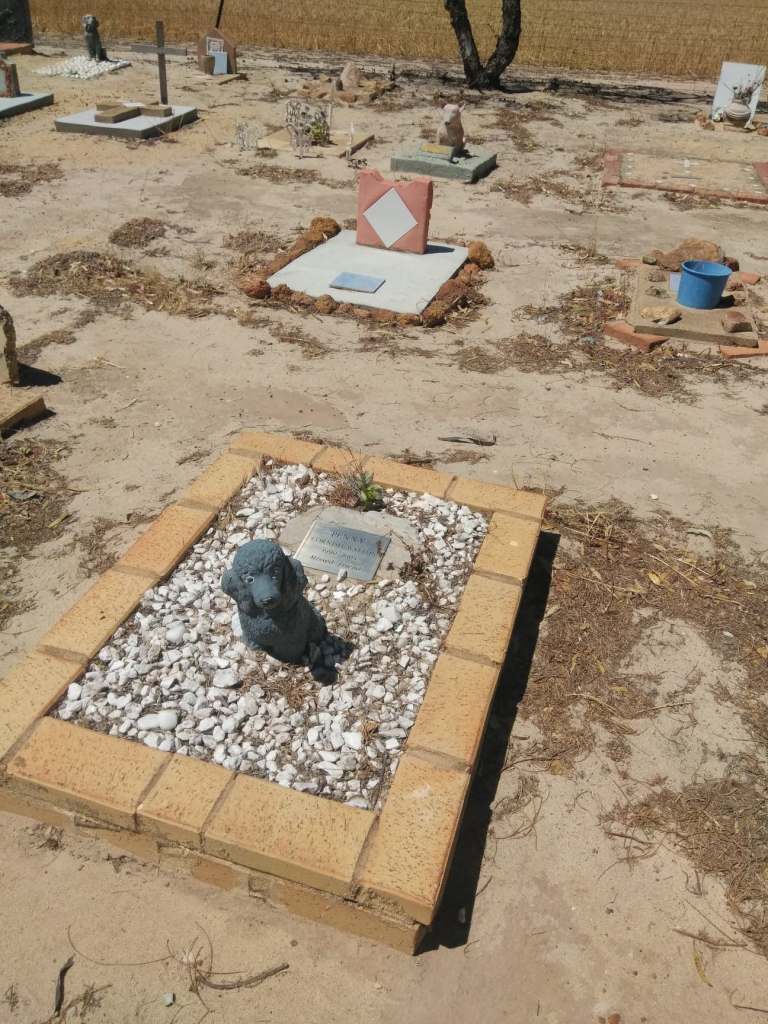
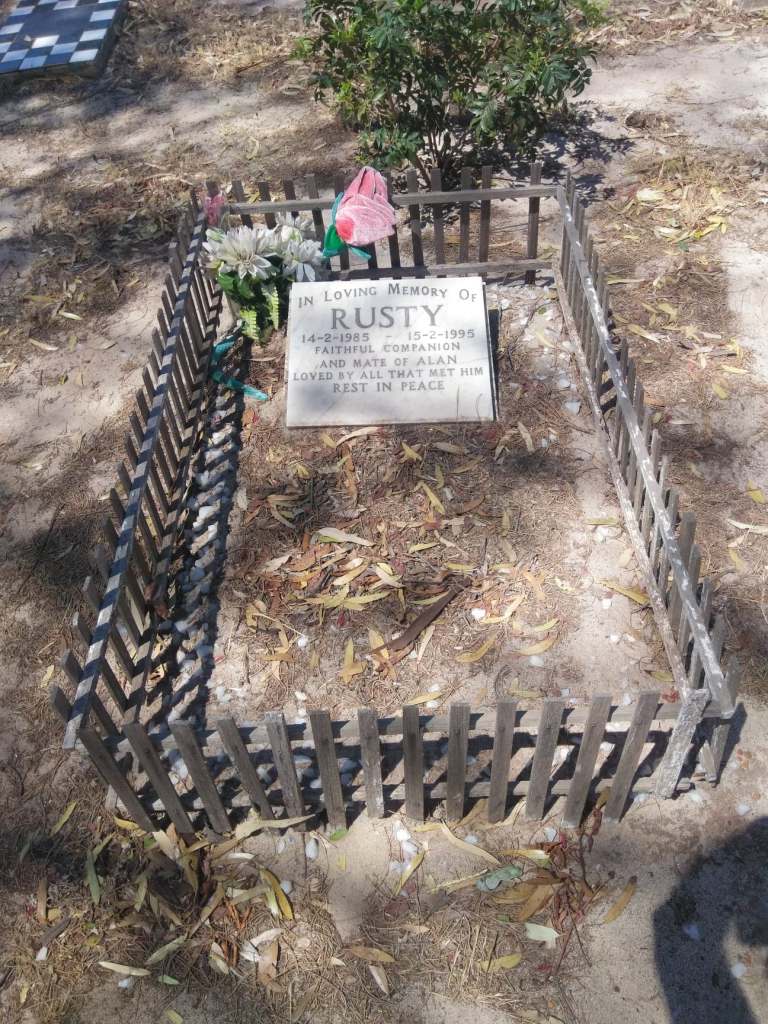
A black poodle statue with surprised eyes sat on a bed of stones, and the plaque told me she had lived for 14 years. Poor Rusty had died the day after his 10th birthday, and his grave was a simple oblong, surrounded by the railings that I had often seen around human graves for those of a higher standing in the community. 
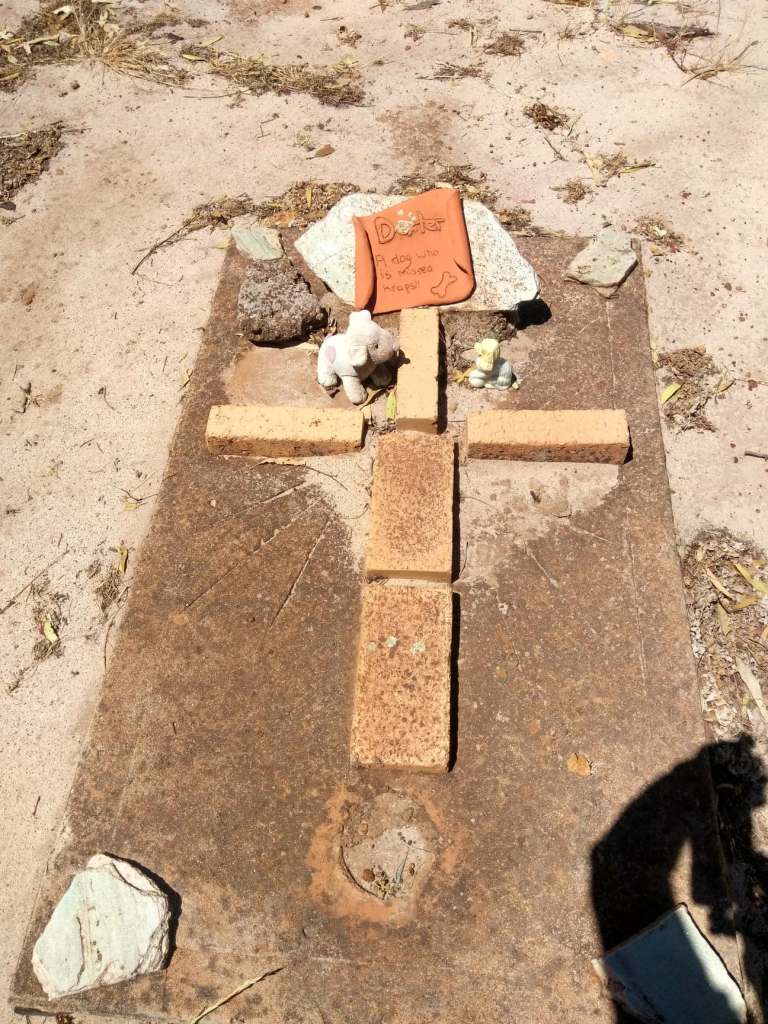
The one that touched me most was that of Dexter, who had a cross formed from bricks laid on a simple slab, with a clay scroll into which a child had carved “Dexter – A dog who is missed Heaps”.   It was sad to see a little stuffed puppy sitting on the grave as well, and I wondered if this had been Dexter’s favourite toy.
One dog’s family had improvised with a brass fire screen with a scene of Pointers out hunting.  There was no doubt that the image on the next grave was of the dog itself, a hand painted china plate with a picture of the dog and words telling of the wonderful companionship he had given for 15 years. 
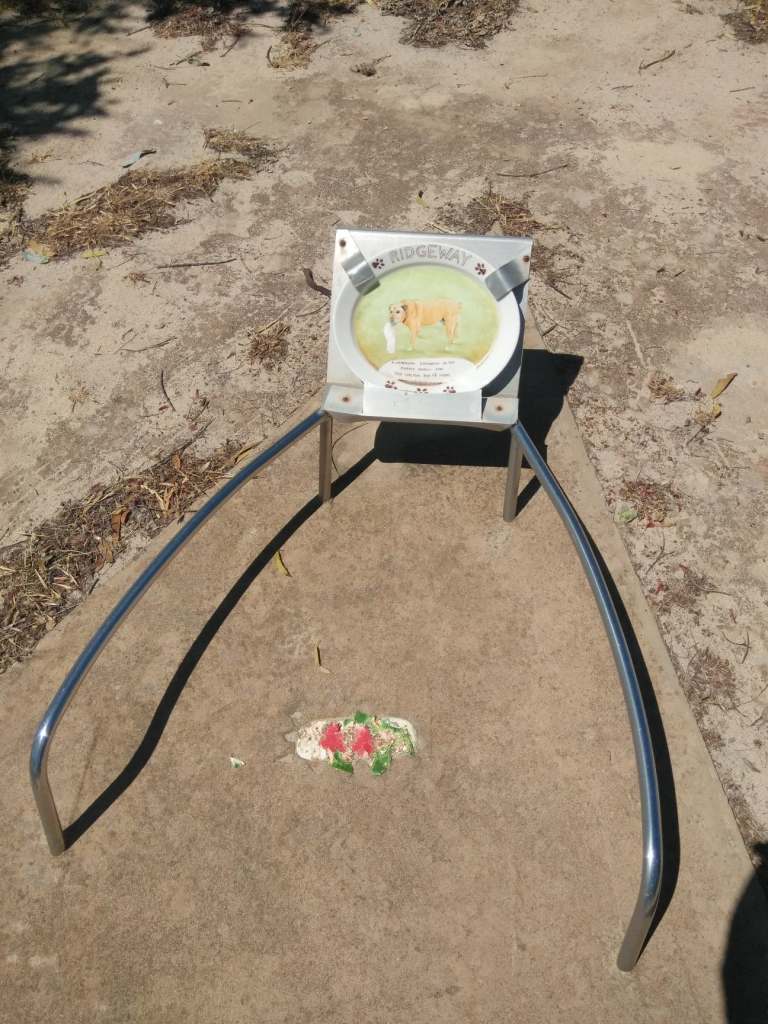
There was even a multi-story grave that housed 3 successive dogs. Some people cannot face the idea of having another dog when the one they have loved for years dies, but I think most people recognise that each dog is loved for his or her own original personality.    A point for writers – one of my teachers firmly instructed me that the animals in my stories (usually – well OK –  always,  about dogs or horses) should be referred to as it, rather than he or she. I have never been able to comply, as I know they are living, breathing personalities who deserve to be recognised as such. Maybe there would be less cruelty if we could all see them in that way, rather than as objects or commodities.

Looking around this cemetery, there can be no doubt that many people see dogs as valuable and much loved members of our families; companions, helpers, protectors and comforters. This cemetery started as one man burying his dog in the 1970s, then others from Corrigin  joined him in laying their dogs to rest. Over the years it has attracted the interest of people from far afield who want a permanent memorial to their companion. So it isn’t just the people of Corrigin who feel so strongly about their animals, though this IS the town that set the record for the most number of “Dogs in Utes”  –  a parade of 1,527 utes ( Aussie abbreviation for utility,  any vehicle with an open cargo area at the rear, which would be called a pickup truck in other countries )  each with a barking, tail wagging dog in the back.    

We all have our own ways of remembering those that we love.  Personally, I have never felt the need to have something tangible to remind me of a loved one – I have lost 3 dogs, and each have been cremated.  I have never wanted an urn with their ashes in, though I understand and respect those that do.  With my last dog, a close friend came with me to the veterinary surgery for that final visit, as she had looked after my dog many times when I worked away and loved her as much as I did.  When they asked me if I wanted to keep the ashes, I shook my head, but as I did I noticed the look of dismay on her face.  “Would you like them?”  I asked her and she said yes.  I was happy for her to have them, I could think of no better person to keep them.  

I have recently lost my Mother.  She was 94 yrs old and she had lived close by for many years, so it was sad to have to say goodbye. This Sunday her ashes will be placed in the memorial garden at our church, next to my Father’s ashes.  There are no plaques, simply a book inside the church with the names of all those who are in the garden. When I think of my father, I don’t think of the garden, I think of the furniture he built, the advice he gave me, the funny things he said.  Likewise with my mother, it is and will continue to be, the memories of all the times we had together, the laughs we shared, and the problems we talked over.  It doesn’t matter whether we have a grave to visit, a plaque, or nothing solid to see.  The important thing is that we remember our loved ones, human or animal. I wonder if our animals remember us after we’ve gone? 

Advent Calendar – Friday Fourth of December

Warning – readers may find some scenes disturbing.

Some more melancholia today as we have a traditional carol that is far from the cosy nativity scene; do you know what it is really about?

The Coventry Carol is a 16th Century Christmas carol, performed as part of a Mystery Play depicting the birth of Jesus. The carol refers to the story of the ‘Slaughter of the Innocents’ in which King Herod ordered the mass murder of any child up to the age of two, after hearing of Jesus Christ’s birth. The song is a lullaby the women sing to their fallen children.

The Slaughter of the Innocents is rarely dwelt upon, certainly not in school nativity plays, but it is a tale that that would horrify any mother. I always feel the bible stories are lacking in back story and character development. As Mary and Joseph fled ( eventually ) into Egypt did they know what awful events they had unwittingly unleashed? A modern day reporter on the scene would have undoubtedly asked her ‘How did you feel, Mary?’

Herod the King, in his raging,
Charged he hath this day;
His men of might, in his own sight,
All children young, to slay.

Then woe is me, poor Child, for Thee,
And ever mourn and say;
For Thy parting nor say nor sing,
By-bye lully, lullay.

Here are two very different versions, the traditional tune and a different tune so we can include an angelic choir boy.

The Coventry Carol – Trad. – YouTubehttps://www.youtube.com/watch?v=_jIYyPOoEc8

coventry carol kings college – Bing videohttps://www.bing.com/videos/search?q=coventry+carol+kings+college&&view

In the meantime, Elf has received his first Christmas card and is promising a lighter note when you open tomorrow’s window.

Advent Calendar – Thursday Third of December

Bethlehem Down

Christmas always has a touch of winter melancholy, especially this year and one of my favourite carols for enjoying a touch of melancholy is Bethlehem Down, made more interesting and poignant by the story behind it

Peter Warlock was the pseudonymn of Philip Heseltine (1894–1930), his choice of Warlock reflected his interest in occult practices!   Bethlehem Down was created in a mood of flippancy due to the impecunious state of Warlock and his poet friend Bruce Blunt – both notorious for their Bohemian behaviour. They hoped to earn enough money to get suitably drunk at Christmas; the carol was completed in a few days and published (words and music) in The Daily Telegraph on Christmas Eve.  Their plan had worked and they had ‘an immortal carouse on the proceeds’.

But Warlock’s career as a composer, music scholar and critic was cut short; towards the end of his life he became depressed by a loss of creative inspiration and died in his London flat of coal gas poisoning in 1930, probably suicide.

Bethlehem Down – YouTubehttps://www.youtube.com/watch?reload=9&v=yefnj5kvJTw

But elves do not bring melancholy with them – though don’t you hate them hanging around in the kitchen when you are trying to cook?

Silly Saturday – Stonehenge’s Stones

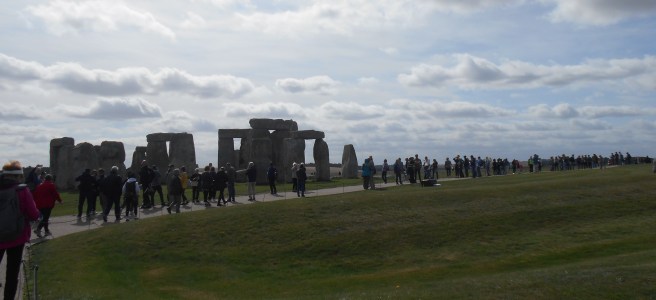
A good news item this week was that ‘a new scientific breakthrough has, for the first time, allowed geologists to pinpoint almost exactly where Stonehenge’s giant stone uprights and lintels came from. Scientists from the University of Brighton have traced the stones to a small very specific two square mile patch of woodland just south of the village of Lockeridge, Wiltshire. Builders of Stonehenge probably chose it as their source of stone because of the exceptional sizes and relative flatness of many of its sarsen boulders.

So no one has ever noticed before that in a little wood nearby, there are huge stones lying around that just happen to look like the ones at Stonehenge? Did no one ever trip over them or fall down the holes left when the Stonehenge Sarsens were extracted?

Warning, photo taken before Covid 19 social distancing

The other ‘exciting revelation was this… ‘Professor Nash was able to analyse the Stonehenge sarsens because a core extracted from one of the monument’s giant stones during repair work in the 1950s (and taken to America by one of the engineers involved in that work) was returned to English Heritage last year.’

What! Some chap is tidying up his office and suddenly thinks ‘Now where did I put that bit of Stonehenge sixty years ago…’ Was he embarrassed to return it after all this time?

https://www.independent.co.uk/news/science/archaeology/stonehenge-stones-sarsen-archaeology-a9644436.html

Sunday Salon – July 2020

I haven’t done a Sunday Salon for a while ( ages ) and still have reviews to do and lots of interesting story collections I am dipping into on my Kindle. Here are three very different novels I have recently read on my Kindle. I have posted these 5 star reviews on Goodreads and my Facebook author page. As usual it looks like Amazon is going to reject my reviews. I am also featuring a very old paperback I picked up at the charity shop which is suddenly relevant.

Little Big Boy by Max Power

This is a story about a little boy’s first love, his mother. It is not autobiographical, but is so powerful readers might assume it was, with its vivid evocation of early childhood.  It is more than that, a story of families, of Ireland in the early nineteen seventies. There are many things that are dark inside and outside the home, that will make you angry, but the tale also bursts with life, of young boys exploring and having adventures with their friends. I have included a link to one of Max Power’s blogs in which he talks about his mother.

https://www.goodreads.com/book/show/25442729-little-big-boy

https://maxpowerbooks.wordpress.com/2020/06/30/the-space-in-the-break-of-my-heart/

Warning Signs  by Carol Balawyder

More vivid than a television murder drama, this an intelligent psychological thriller with the killer trying to understand why he could be tempted to kill and how he can stop himself. It is also the story anyone will recognise of young women looking for love, the dating game. Everyone is a stranger when you first meet them, when do we start trusting a person and when you begin dating someone how do you know if you are safe? A great story that kept me on edge all the way through.

https://www.goodreads.com/book/show/49733864-warning-signs

Marriage Unarranged  by Ritu Bhathal

I have not been to India, but the pictures the author paints are how I imagine from stories told by British Asians ‘going home’ and others visiting for the first time. This is a romantic story, but also an amusing one, young people on holiday to India without their elders hiring drivers and keeping to an agenda. They want to visit a real cinema, not the new multiplex, travel around like locals. There is glamour, for this is also a business trip for Aashi’s older brother who wants to reinvent the family fashion shop, but solemn moments as they contemplate dark historic events.  As the five visit the Golden Temple there is an insight into the faith of the Sikhs. New friendships are made, Aashi’s broken heart might be mending, but how will life work out when they all return home to Birmingham?

https://www.goodreads.com/book/show/49901585-marriage-unarranged

The Decameron Vol 2 by Giovanni Boccaccio  is the second part of a collection of rather saucy short stories written during the plague of 1348. My paperback copy is not quite that old, published in 1959 and costing three shillings and sixpence. I read it a while back, but when I saw this item in the newspaper I took it off my shelf again. The stories they tell each other are a lot of fun with the ladies often managing to trick the men, but a lot of trickery in general.  I guess this little group had more fun in isolation than lots of people this century.

Game Set Match

Game, set, match are words you will not hear this week as Wimbledon has been cancelled, but there are plenty of games people have been able to play in lockdown and isolation, from real cardboard playing cards on a real table to computer games.

Humans have been playing games since forever. Adam and Eve probably got bored playing hide and seek; Eve for sure, that’s why she went looking for new interests like the tree of knowledge. Our cave dwelling ancestors collected shells and stones and drew lines in the dirt, but got annoyed with their children for time wasting.

‘Will you stop playing with those sticks and stones and go and collect some berries like I told you to.’

…and onward millennia to the last years of the twentieth century when parents would be telling teenagers to get off the computer ( the one household computer bought by fathers across the land because it would be educational for their children, though they really wanted to play with it themselves ) and do their homework, or read a book, or get out in the fresh air. At one stage I was heard to say I would never have got married let alone had children if I had known home computers were going to be invented…

And who would have imagined that their son in his thirties would still be playing computer games with his school friends; not still going round each other’s houses, they live hundreds of miles apart, but playing on line with X Boxes …

Call of Duty Warzone – 150 players in teams of 4   – already my mind is boggled. https://www.youtube.com/watch?v=0E44DClsX5Q&feature=youtu.be&fbclid

‘This game uses something called “skill based match making” which uses a combination of different player statistics to fill games with people mostly of the same skill level. The result is that as you get better you never feel like you are getting better. The advantage is that players do not feel like they don’t stand a chance against very good people. It’s very controversial within the gaming community.’

The world of computer games is a total mystery to me, but one advantage of blogging is that you can write from a position of total ignorance. I do understand that computer games have been made by very clever and creative people and they are just as valid an art form and interest as any other. Now portable personal electronic devices are the latest entertainment for older generations to worry are time wasters and just plain bad. Books, radio and television have all been frowned upon in their time.

I informally interviewed a few of the first generation to play computer games, the first parents to not mind their children playing.

In contrast to Call of Duty fans a professional chap enjoys single-player games such as Batman and Uncharted 4 ( which seems to have ‘real people’ in it ) . ‘I don’t have any online friends to play with, or the time to play online. Zelda: Breath of the Wild is probably one of the best games ever made.’

Lego Harry Potter sounds more fun, a favourite of a lady in her thirties. ‘It’s all about collecting studs and learning spells and defeating He Who Must Not Be Named!’ https://www.youtube.com/watch?v=TEQ4ky00L8Q

Lego games are all good for children and parents to play together. Another couple have bought a Nintendo Switch and the first game they are trying is Mario Kart, basically racing, to play with their young children.

Why you play is different for everybody, a mum in her thirties says ‘I like to play co-op games rather than competitive ones, otherwise it’s too annoying.’

Another professional man who enjoys computer games for unwinding says ‘How can they be called time wasters, at least they are interactive, not like slumping in front of the television.’

If I wasn’t busy blogging, writing, reading, gardening; perhaps if I tried some of these games I would enjoy them. It’s never too late to start. On Woman’s Hour this week they were talking to some ladies in their seventies who love playing computer games and their grandchildren love being able to play games with them. They like the challenge of… what are all these game about? Getting out of places, through a maze or something completely different?

 Minecraft is a game created by Microsoft where players can explore a 3D world, discover natural resources, craft tools and build houses or other structures. Now that sounds quite fun. I read in the newspaper that an archaeologist has recreated a Bronze Age landmark – with a great deal of technical help from his eleven year old daughter. Doctor Ben Edwards and Bella have created a digital version of Bryn Celli Ddu, a 3000 year old burial mound on Anglesey, with further help from other experts.

https://www.minecraft.net/en-us/

I think I would like a game where you create your own country estate with beautiful gardens which wouldn’t need weeding. If such a game exists let me know.

A more exciting thought; can authors turn their novels and short stories into computer games, will that be the next thing on Amazon KDP? I think some of my writing would be perfect, I just need a few artists and people who do coding, whatever that is…

You’ve read the books, now play the amazing games.

Do you or your family play computer games? Love them or hate them?

Silly Saturday – Sad Statues

After Nelson was toppled from his column in Trafalgar Square and dunked in the fountains, the Prime Minister announced that all statues around the kingdom would be removed and replaced by more of the ubiquitous figures of Everyman created by Antony Gormley.

Margate’s man only emerges at low tide.

Angry protestors, objecting to Gormley’s exclusive use of the male human body and also the fact he is white and has been middle aged for a good while, gathered at the foot of his Angel of the North. On arrival they called for more supporters to help pull it down as it turned out to be much bigger than it looked when they were driving along the A1.

One art enthusiast gathered to protect the great work and point out that the Angel was androgynous, a heavenly not human body and had led a blameless life, so could not offend anyone.

After a petition on 38 Degrees, parliament passed a motion that all the now empty plinths would be filled with life size replicas of the Angel of the North. Buckingham Palace released a statement saying The Queen was delighted at the prospect of seeing The Angel when she looked out of her bedroom window and retiring Queen Victoria to the back garden.

TV or not TV

When I have mentioned or reviewed television programmes on my blog at least two bloggers have commented that they never watch television. I’m sure they are not alone, but probably in the minority. If you are reading this you obviously don’t spend your life glued to the TV screen; you would not have time for blogging and life on line. But most people watch regularly or occasionally. Is television a terrible time waster or a valid part of our culture and family memories?

34584556_2115416028488176_6752829577438953472_n

Radio Times was first issued on 28 September 1923 for the price of 2d, carrying details of BBC wireless programmes. I have not been reading it for that long, but I do buy it every week so I can read proper listings and details of radio and television programmes for  my discerning selection!

Those of us in other countries may think the USA was first with television, but the BBC is the world’s oldest and largest broadcaster, its first analogue terrestrial channel, the BBC Television Service, launched in 1936. Not many people had a set or were actually watching it then and World War Two put a damper on things, with wireless being far more important for hearing news, momentous speeches and morale boosting music. The coronation of Queen Elizabeth the Second in 1953 is credited with being the spur for people to rent or buy a television set. In our family a telly did not arrive until I was four, when Mum was expecting my brother and had to rest because of pre-eclampsia; she would have had to wait till 1.45pm to turn it on for Watch With Mother.

Here is a great time waster; you can look at any past copies of Radio Times and even click to see programme details. See what my parents were watching not long before my brother was born. I am glad to say I have not misremembered Saturday evenings in our Twickenham flat.

https://genome.ch.bbc.co.uk/39a23af27ebf412690375fe97134556e

So Bill and Ben, Rin Tin Tin , The Lone Ranger and Billy Bunter came into our lives. I thought the people on screen lived in the cabinet underneath the television and was terrified of opening the doors. There were plenty of cowboys, but good English programmes as well, from Emergency Ward Ten, an early hospital drama to Panorama…

With the first episode being broadcast on November 11, 1953, Panorama is the BBC’s flagship current affairs programme and the longest-running public affairs TV programme in the world. 

Cosy evenings in with the telly, but up until the early 1980s all good things had to come to an end; after the last programme had finished a BBC announcer would wish us all a very good night, remind us to turn our television sets off and then leave the national anthem playing. The live screen was sucked into a tiny white dot which itself disappeared.
Now that you can watch any programme anytime on anything we can look back with nostalgia on the snug days of families gathered in their living rooms to watch the one television set. And it was a shared experience in the moment, that you couldn’t experience with books, apart from the golden days of father reading the latest instalment of Charles Dickens. Before the advent of video recorders everyone at school or work had probably seen the same programme the night before and be eager to discuss it. The Forsyte Saga’s 26 episodes were broadcast on Sunday evenings in1967/68 and churches had to hold evening service earlier to keep their congregation. Eighteen million people watched the final episode, a truly shared experience.
That shared experience does still exist. Plenty of households watch the latest drama serial in real time, or at least catch up in the same week before the next episode. I don’t follow dancing or cooking programmes and certainly not celebrities in jungles, but if we have visitors staying or we are at someone else’s place it is good fun to all watch together; I can annoy everyone by interrupting with ‘Who on earth is that?’ or ‘What IS she wearing’.
But even in the good old days there was a downside to television. In one of my many previous incarnations I did silver service waitressing for the money, but an older lady did it to get out of the house and away from the television her husband was glued to. While wives complained about husbands watching sport there would be husbands complaining about wives viewing endless soaps.

34670839_2115416058488173_7531615677732356096_n
Then homes began to get more than one television set, TVs appeared in young children’s bedrooms, satellite dishes and cables appeared. Theoretically you could watch rubbish on television 24 hours a day, civilisation was under threat…


The advent of home computers brought more change. Husbands retreated to other corners of the house to play with the new toy, leaving their wives in peace to choose what to watch. Later on, wives discovered the internet, social media and blogging and did not even notice if their husbands were glued to the telly. The previous two sentences are of course sweeping generalisations – feel free to correct them…

49301962_2279278039016172_484935089419976704_n

Tune in to some more of my thoughts on TV…

https://tidalscribe.wordpress.com/2020/01/18/silly-saturday-slowly/
Do you watch television?
What are your earliest memories of TV?
When did your family first get a TV set?

Sunday Salon – Fact and Fiction

I am enjoying several books on my Kindle, one novel, two short story collections, poetry and a cutting humorous slice of real life, but no new reviews since the January’s  Sunday Salon… in the meantime we have been to the theatre and seen some excellent programmes on television. Here are two stories that have stood the test of time…
Agatha Christie’s murder mystery play The Mousetrap opened in London’s West End in 1952 and has been running continuously ever since then. It is the longest-running West End show, the longest initial run of any play in history; there is a twist ending, which the audience are traditionally asked not to reveal after leaving the theatre.

The play began life as a short radio play called Three Blind Mice, written as a birthday present for Queen Mary, The Queen’s grandmother and broadcast on 30 May 1947. The theatre play is based on a short story based on the radio play, but Christie asked that the story not be published as long as the play ran in the West End of London. The short story has still not been published within the United Kingdom, but it has appeared in the United States in the 1950 collection Three Blind Mice and Other Stories.
When she wrote the play, Christie gave the rights to her grandson Mathew Prichard as a birthday present. In the United Kingdom only one production of the play in addition to the West End production can be performed annually. Under the contract terms of the play no film adaptation can be produced until the West End production has been closed for at least six months. So don’t expect to see any time soon a block buster movie brought into the 21st century and set in Bollywood or Hollywood, or perhaps on a space station. The play was set in ‘the present’ but has been left safely in the 1950’s.

DSCN2065
I first saw The Mousetrap in London in the seventies while over from Australia on the ‘working holiday’ that never ended. As for many visitors to London it was a must see and my mother had always talked about the audiences being sworn to secrecy; how amazing that no one has ever given the game away! I enjoyed it and was proud to have guessed who dunnit.

26982451_1950181711678276_1013422918_o
This time we were at The Lighthouse in Poole, an early stop on the play’s 2020 UK Tour. I remembered who dunnit from last time, but recalled nothing of the plot so it was a fun evening. There is one set, the interior of Monkswell Manor, recently converted to a guest house run by a young couple. On the radio we hear of a murder and the police looking for a suspect in a dark overcoat; as each character appears on stage they are all wearing dark overcoats. Heavy snow leaves Monkswell cut off from the rest of the world, so of course when a murder occurs we know the murderer is in the house… A plot happily repeated on islands and trains etc. by Christie. There are plenty of twists and turns to keep us guessing and the second half especially moves along at a good pace. I’m not going to tell you what happens and if you know, don’t mention it in the comments.

https://www.mousetrapontour.com/uk-tour/
We move along a few years into in the early 1960s for an excellent six part BBC Sunday evening drama ‘The Trial of Christine Keeler’. This is a story that never seems to lose its fascination, there have been documentaries, books and a film; the scandal has been examined with 21st century eyes. When I was a child it seemed to be on the news all the time, though I had no idea what The Profumo Affair might be. John Profumo was the Minister for War in the turbulent times of the Cuban Missile Crisis; not only did he have an affair with the naïve ( perhaps not sexually naïve, but in every other way ) Christine Keeler, who also slept with a Russian spy; to make matters worse, he lied to The House of Commons, his chums and presumably to his wife, who happened to be famous actress Valery Hobson. Stephen Ward the society osteopath was another leading character, a ‘libertine’ who mixed with the aristocracy and politicians, groomed Mandy Rice-Davies and Christine Keeler and was responsible for Keeler meeting these men in the first place. The press had a field day.
It is a tribute to the actors that our sympathies were with the two girls and Stephen Ward. They enjoyed living at his flat, looked after them is hardly the right term, Keeler was only seventeen when Ward met her, but to them he was a friend and they were having fun. When Profumo suggested he put Keeler in her own flat she replied ‘But what about Mand?’ She didn’t want to live by herself, she wanted to stay with her friend at Ward’s.
The six part drama was able to explore a lot more about Christine’s early life and the ex boyfriend dramas also going on at the time. Most viewers probably knew Ward ended up committing suicide, perhaps making all the more poignant the lead up to the sham trial of Ward. He was expecting his many important friends and clients to step forward as witnesses for his defence, but in the end they all deserted him. James Norton was brilliant as Stephen Ward. So too were Sophie Cookson and Ellie Bamber as Christine and Mandy, two girls who were real people, not just two dumb models to be exploited by everyone. From Stephen Ward’s elegant mews flat to the sixties clothes, makeup and hair do’s this was a polished production.

https://www.radiotimes.com/news/tv/2020-01-26/trial-of-christine-keeler-cast/
Have you seen the Mousetrap?
Do you prefer fiction or real life drama?

Landing Airside

When our family took off for Australia from London Airport ( soon to be called Heathrow ) in 1964 I never imagined I would be returning nine years later, let alone that I would spend years living very near the airport and end up working there.
With perhaps the exception of China, Heathrow must be one of the most continually changing spots of land in the world.

London got its new airport in 1946. The site included the Vicar of Harmondsworth’s back garden, bought for £15,000 by Richard Fairey in 1930 as a site for testing his planes.
The village of Heath Row was bulldozed in 1944, plans were steamrollered through by the plane-mad air minister Harold Balfour. He persuaded Churchill’s War Cabinet in the 1940s that an RAF base was needed on Hounslow Heath, when actually he wanted to push through plans for a post-war civilian airport. An old lady told me years ago that when they saw a few tents going up near their home on the Bath Road they did not think it would make much difference to their lives.

https://www.independent.co.uk/travel/the-history-of-heathrow-2228431.html

DSC_8564

In 1964 we walked across the tarmac to the steps and turned to wave to our relatives standing out on a balcony. In the seventies and early eighties you could still stroll on the roof gardens of the Queens building, children could play and plane spotters listened in to their radios.
In one of my many incarnations I was a lounge hostess for eight years either side of the turn of the century. Even since then everywhere I worked has either been demolished or changed completely. But passengers and the 80,000 ( guestimate, but it’s a lot! ) staff who work there are no doubt much the same.

6
With the children all at senior school it was time for me to leave behind my various pin money jobs and find properly paid part time work. A few hours in the middle of the day, Monday to Friday in the Terminal Three Qantas  Lounge seemed perfect for someone who had missed out on the computer revolution; all I had to do apparently was work the coffee machine and put out a few sandwiches and I spoke the same language as the passengers. Two of us just had the morning flight out to Australia to look after. It turned out my senior colleague was a right… not easy to work with, but luckily she spent most of her time talking to the Qantas girls on the desk or to her twin daughters on the phone in the kitchen. The main lounge was Business Class and a select corner was for First Class passengers. There were cheerful Australians often meeting up with friends and British holidaymakers in a good mood. Another great feature of this lounge was the wonderful view of the south runway and Concorde taking off at 11am.
This little oasis of peace and quiet was down a corridor just before The Gates and up a flight of stairs. I don’t like lifts and could see no reason why I would need to use the rackety metal box that was always being repaired. When it was time for passengers to go to their Gate they could choose stairs or lift. One day the Qantas lady asked me to escort a nervous passenger because she was afraid of lifts; so am I wanted to say! Worse was to come. I was asked to fetch the papers… the Australian newspapers just arrived on the in bound flight. It turned out this involved going down in the same lift, but with the magic key which took the lift down to hell, or at least the outside; real airside where planes park; dark concrete undercover places passengers never see. I was petrified I would be stranded there if the lift doors closed… which they did because I had to walk a few feet to reach the bundles of paper. When I returned trembling to the safety of the lounge my colleague said I should never have agreed to do it as it wasn’t our job!
Companies, jobs and uniforms were to change as frequently as the buildings, but I did not know that at the time.

liebster-award